





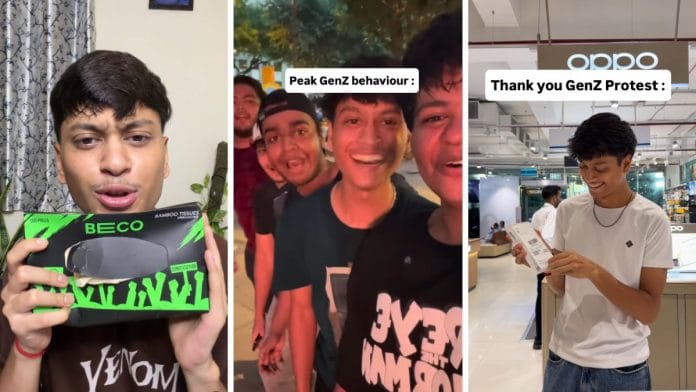


We’ve all seen the reel. A remix of the song ‘Mere Mehboob Qayamat Hogi’ plays as four or five young men line up, the first one lip syncing to the song while the others act out the added “aha!” sound behind him. Some would say it was the most influential piece of protest art that came out of the Gen Z movement.
“Peak GenZ behaviour,” said the text on the reel by 19-year-old Abhinav Bisht. The video pulled in 8.5 million views on Instagram. Bisht’s following exploded, and the clip made its way onto national television—a teenager’s 15-second bit somehow outperforming the news cycle covering the very protest he filmed at.
Once the protest was called off, many wondered what Bisht would do next. But it was only the beginning. In their desperation to reach the kids they had once dismissed, actors from the geriatric generation picked up the trend.
Anupam Kher roped in his Khosla Ka Ghosla co-stars—Boman Irani, Ranvir Shorey and Parvin Dabas—for a reunion cut, captioned “Khosla and Khurana were never in tune, not even here! Jai Ho.” The reel was conveniently timed to promote the upcoming Khosla Ka Ghosla 2.
“Not standing up for the protest and trying to use the content from the protest. Disgusting,” said fashion designer Param Sahib in a comment.
In the Viral Spiral of Abhinav Bisht’s trend, the reel audio is now touching 210K videos. Even White people have jumped on the bandwagon. Swedish creators Karl and Ekaterina Svanberg—best known in India for their Bollywood recreations—put their own spin on it.
By the time Chetan Bhagat posted his awkward iteration, dragging his IIT Delhi batchmates into frame, Gen Z had had enough. In Kher’s video, many commenters were respectful. Here, they just wanted the pain to end.
“Better than your books,” read a comment, using the author’s disastrous social media skills to roast his writing.
“Someone stop these buddhas (oldies) or they’ll ruin every new trend,” a user wrote on X.
Also read: BJP’s Gen Z Instagram outreach has flopped. Friends are cringing
The power of cringe
Bisht, on the other hand, has shed his protest origins and come into his own as a content creator. In a recent reel, he formally introduced himself to the audience that found him mid-protest. The video has over 405K likes.
The young creator understands that consistency is key on social media. And TikTok-style reels are his brand. He has filmed multiple versions of his OG reel with different casts, including some of the original creators who birthed the format and television news anchors covering the trend.
He’s also started taking brand deals. His latest video is a collaboration with Beco, the sustainable-goods brand that reportedly supplied tissue paper at the youth protest—the trend has now closed the loop from movement to merch.
“One protest really became his entire career launch,” read a comment under the reel.
Fame is a flicker on social media. Bisht managed to shape his viral protest reels into a full-blown Instagram career. While other creators at the protest could only get views on one or two videos, Bisht managed to make the viewers stay.
There’s a nice detail buried in his own back catalogue. Bisht’s very first reel was a joke about TikTok returning to India and him being ready to cash in on it this time. Funny that his brand now is reviving TikTok trends for Mr Zuckerberg’s app.
He’s also posted, more than once, about missing the protest itself—reuniting with friends he made at Jantar Mantar, thanking the movement for his brand new iPhone.
“End of an Era,” he captioned a post, waving goodbye.
His account was among many that were suspended by Meta. Thankfully for Bisht and his 9.5 million followers, it was soon restored.
If there’s a lesson in Bisht’s journey, it is to never dismiss the power of cringe.
Views are personal.
(Edited by Prasanna Bachchhav)