



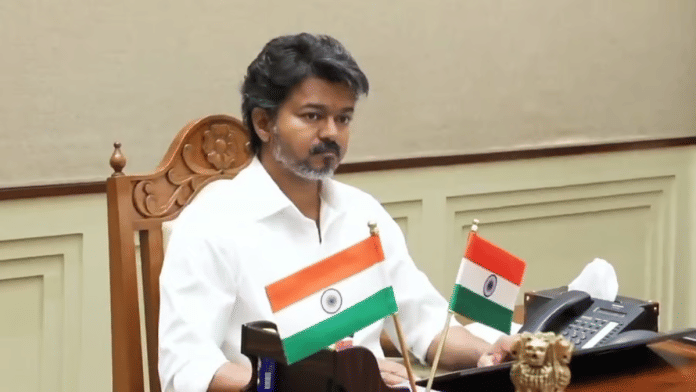
C Joseph Vijay, as Chief Minister of Tamil Nadu, has entered the sixth month of a non-Dravidian government in the state.
The six-month-old Tamilaga Vettri Kazhagam (TVK) government is caught in a series of controversies, with political volcanoes erupting around it. On crucial issues, Vijay often goes into a dim mode.
One such controversy involves allegations that TVK MLA C Arul Vignesh, who represents Kallakurichi, sent obscene WhatsApp messages to district collector JE Padmaja and visiting her residence while intoxicated. The MLA has denied the allegations, calling them politically motivated.
Vijay is gifted with a cool, quiet personality. Even when provoked, his reactions are rarely provocative.
His first crisis was establishing a majority in the Assembly. He managed it through a live telecast of the Assembly proceedings, a bold decision. However, he continues to head a minority government, and allegations of horse-trading remain a constant challenge.
Vijay faced this crisis with considerable courage. Yet, he has also committed several political missteps in his first six months in office.
He has faced strong political headwinds on several fronts. One such challenge was the Karthigai Deepam dispute at Thiruparankundram in Madurai. On 20 November, the Supreme Court permitted the ceremonial lamp to be lit at the disputed Deepathoon, a stone pillar on the hill, on 24 November, the day of the Karthigai Deepam festival. The Court allowed it as a one-time measure, while staying the relevant findings of the Madras High Court. It also clarified that the order did not establish any customary or religious right to light the lamp at that location in subsequent years. The Tamil Nadu government subsequently moved the Supreme Court seeking a review of the order.
Another challenge is Karnataka’s Congress government and its determination to construct the Mekedatu dam. The Supreme Court has also ruled against Tamil Nadu’s request for additional water from the Cauvery river.
Vijay certainly has the willpower to face such eventualities.
As someone who has observed Vijay’s rise in politics and his subsequent elevation as Chief Minister, I find a comparison with former Prime Minister P.V. Narasimha Rao appropriate. Rao was known for his ability to remain tight-lipped and quiet during periods of political turmoil. Vijay appears to have adopted a similar approach.
He is leading a minority government with two strong opponents, the DMK and the AIADMK.
Also read: DMK, AIADMK have gone quiet after defeat. TVK’s Vijay is going on the offensive after win
Six bypolls, six alliance partners and six controversies
An interesting numerical six now confronts Vijay’s political future. His party TVK faces by-elections in six Assembly constituencies in Tamil Nadu: Perundurai, Ambasamudram, Viralimalai, Karur, Tiruchirappalli East and Kolathur.
The elections are expected to be held in the first fortnight of January 2027.
Will TVK secure a majority through victories in these six constituencies? Or will a split verdict determine the stability of Vijay’s government and its ability to present the next Tamil Nadu Budget?
Politically, administratively and economically, steering the state through its financial difficulties has been a remarkable challenge for the new government.
The number six appears once again. The TVK government depends on the support of six parties: the Congress, VCK, CPM, CPI, IUML and MDMK.
The stability of Vijay’s government resembles a game of snakes and ladders. A sudden political development can change the situation overnight.
The death of V.S. Babu, the TVK MLA from Kolathur who defeated DMK leader and former Chief Minister M.K. Stalin, has created another political possibility. Stalin could now enter the Assembly if the DMK fields him in the by-election. Naturally, such a contest would be a matter of prestige for both leaders.
There are six other controversial issues that have placed the government under pressure.
One, cancellation of the Parandur airport project.
Two, free cars for all 234 MLAs.
The scheme was intended to please the first-time MLAs of the TVK. However, it backfired. The government has cited a precarious financial situation and the inherited debt burden to explain delays and constraints in implementing public welfare schemes. Against this backdrop, the decision to provide cars to legislators invited sharp criticism from the Opposition.
Three, higher allowances and Deepavali gifts for legislators.
The government has also faced criticism over increased allowances for legislators and the distribution of Deepavali gifts to ruling-party MLAs during a closed-door retreat at a resort in Mahabalipuram.
Four, the Guidance Tamil Nadu talent and investment row.
Allegations of data theft from the Industries Department, with sensitive investment information allegedly passed on to the Andhra Pradesh government, have raised concerns about the state’s ability to protect prospective investors’ information.
Five, repeated prison breaks.
Tamil Nadu witnessed a series of at least five to six high-profile escapes from prisons and police custody across Chennai, Theni, Coimbatore and Madurai. These incidents have turned prison security into a major political issue for CM Vijay’s TVK government.
Six, Vijay’s London visit.
Vijay’s visit to London to watch fellow actor Ajith Kumar compete in the Michelin Le Mans Cup at Silverstone also attracted political criticism. Although the Chief Minister was on an official visit to attract investments and study motorsport infrastructure, the DMK questioned the purpose of his trip, alleging that he had gone to watch his friend’s car race.
Six months into office, CM Vijay and his TVK government are facing a crisis. There is little tangible evidence of effective administration or governance so far. His popularity and cinema-star glamour continue to protect the government from mounting criticism, but the danger of a difficult political turn lies ahead. The six Assembly by-elections will serve as a mini referendum on his government.
Also read: Vijay has opened Tamil Nadu politics to a new breed of cinema heroes
A financial and administrative swamp
More worryingly, the TVK government appears to be caught in a deep financial and administrative swamp, with no easy way out.
All political parties have made generous welfare promises, and the burden of such largesse has contributed to the state’s financial difficulties. Vijay’s government is now facing what could be described as a form of “fiscal arrest”, much like the phrase “digital arrest” that has entered public conversation.
The charismatic cinema actor-turned-Chief Minister is struggling with budgetary pressures.
The CAG reports tabled in the Assembly after Vijay took over have exposed the financial position of the previous DMK government. Vijay’s administration has also published White Papers highlighting alleged irregularities under MK Stalin’s council of ministers. However, these disclosures have yet to make the desired impact on voters.
How has the TVK government handled the state’s economy in its first six months?
Vijay, as Chief Minister, has sought advice from two leaders representing opposite political and economic viewpoints. One is Union Finance Minister Nirmala Sitharaman. The other is former Union Finance Minister P Chidambaram.
Vijay is neither a left-wing ideologue nor a right-wing fundamentalist. He has proclaimed that his priority is “Tamil Nadu First” and the welfare of the state’s eight crore makkal (people).
When it comes to the economy and infrastructure development, however, the TVK government is yet to prove its mettle.
One aspect of Vijay’s administration that deserves appreciation is his decision to avoid confrontation with the Union government. He has maintained that Centre-state relations should remain cordial.
During Prime Minister Narendra Modi’s visit to Chennai for the inauguration of the Chennai Metro, Vijay readily agreed to travel in the Prime Minister’s convoy. Security officials suggested that the Prime Minister, Governor and Chief Minister travel in a coordinated convoy to avoid traffic congestion, given the Prime Minister’s three scheduled engagements. Vijay agreed to the arrangement and travelled in the third car, following the Governor’s vehicle.
Judging Vijay’s administration solely on the basis of its first six months may be premature, provided he delivers tangible and effective governance during the remaining four-and-a-half years of his term.
Look at Vijay from any angle, bright or dark, left or right, and his personal charisma remains on an upward trajectory. His star power continues to shine. Yet his party, the Tamilaga Vettri Kazhagam, faces mounting criticism over its handling of law and order. There are also growing concerns about Vijay’s control over his party cadre and legislators.
Eight crore Tamilians have reposed their faith in a TVK government led by Vijay Joseph. They will watch and wait until May 2031 to see whether that trust brings them genuine happiness and good governance.
R Rajagopalan is a veteran journalist and a political analyst. He tweets @RAJAGOPALAN1951. Views are personal.
(Edited by Prashant Dixit)