




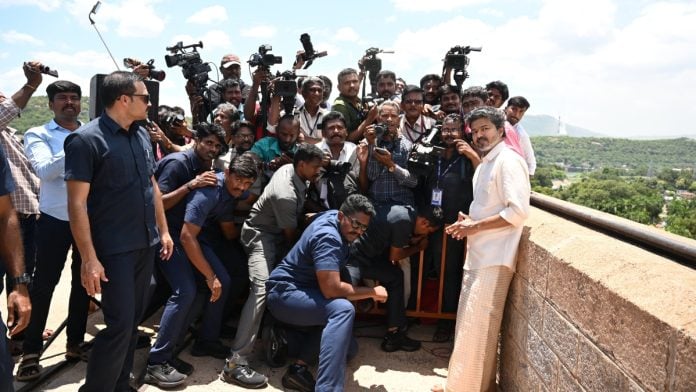

A cine craze dominance has taken hold of Tamil Nadu politics—a hold that TVK leader Vijay has ushered in. Vijay is rewriting the political future of Tamil Nadu by attempting to prove that a non-Dravidian party can successfully administer the state. The future of Tamil Nadu politics will steer around the supremacy of tinsel-world heroes.
Vijay’s strategy is two-pronged. One, to liberate the Southern states’ film industry from the DMK first family’s control, criticizing Red Giant Movies for allegedly serving industry protocols—from production and finance to distribution—and pushing cinema halls to screen their own films, featuring their chosen heroes and heroines. Two, to politically sideline the DMK as a party.
Fulfilling this mission has had an added effect, encouraging Vijay’s contemporaries—other heroes—to take the same route as “Anna” (elder brother) to lower their dependency on the DMK first family. The rise of digitalisation came in handy, specifically through OTT and social media platforms, for the cinema industry—and particularly for Vijay to challenge his rivals within the industry.
A sudden rush of cine heroes above 45 years of age—such as Ajith Kumar, Dhanush, Vijay Sethupathi, Suriya, Sivakarthikeyan, Sarathkumar, Karthi, and Vikram—are straying away from the film world to serve Tamil society. They are engaging in massive social welfare outreach, focusing on educational institutions and hospitals, and providing grants to neglected, downtrodden families in remote villages.
Yes, these very heroes, who once competed with Vijay on screen, are now duplicating the aggression he showed in sincerely serving the poor.
Even in the late 1990s, during the peak dominance of yesteryear superstars like Rajinikanth and Kamal Haasan, Vijay stood alone in helping students pursue their college studies. That attracted newcomers. Many new entrants to the tinsel world are jumping into politics through their fan clubs, taking up social welfare initiatives of their own. This next generation of Kollywood seeks to keep not only Dravidian ideology out of the narrative, but to stall the entry of national parties like the Bharatiya Janata Party (BJP) and the Indian National Congress. Will Tamil Nadu move towards a celluloid craze in the years to come?
Tall political leaders—like MK Stalin and Edappadi Palaniswami, along with their party office-bearers—risk becoming jobless if large-screen actors take over politics. A few top leaders in the DMK and AIADMK are already concerned. Should the TVK government stabilize, traditional political platforms will shrink and be taken over by cine heroes.
Also read: DMK, AIADMK have gone quiet after defeat. TVK’s Vijay is going on the offensive after win
How Vijay changed Tamil Nadu politics
Decades after MG Ramachandran (MGR) entered politics in 1972 and immediately established his own party, the All India Anna Dravida Munnetra Kazhagam (AIADMK), on 17 October 1972—framing it around pro-poor welfare and Dravidian principles—actor-turned-politician Vijay officially launched his political party, the Tamilaga Vettri Kazhagam (TVK), on 2 February 2024. Does this influx of film personalities into the political space convey that 60 years of Dravidian ideology is losing its sheen?
Will both Dravidian and Hindutva ideologies suffer a setback from this rising wave of cine culturalism?
The response to this narrative is emphatically yes.
The basic ideology of the Justice Party (officially the South Indian Liberal Federation) around the 1920s and 1930s in the Madras Presidency centered on non-Brahmin upliftment, social justice, and communal representation.
But the dilution of Dravidian politics began when EV Ramasamy (Periyar) formed the Dravida Kazhagam. It further eroded when CN Annadurai, the founder-leader of the DMK, was elected to the Rajya Sabha and dropped the secessionist demand.
In 1972, MG Ramachandran formed the AIADMK and brought God worship into Dravidian politics. Jayalalithaa, a Brahmin face, during her tenure further downplayed Dravidian theories. After M Karunanidhi’s passing, MK Stalin’s cadres began to visit temples. Now, TVK’s Vijay has demolished the remaining constraints of the old Dravidian cult.
Vijay has also inducted two Brahmin faces into his core administration.
The TVK party’s official policy documents accept a spiritual posture that embraces a belief in a higher power—marking a distinct deviation from a century of traditional, atheist Dravidianism.
Will this deviation cause future cine heroes to pivot and adopt Hindutva politics directly?
A key reference point for this is Rajinikanth, whose career-long dalliances with right-leaning “spiritual politics” frequently sparked public uncertainty regarding his alignment with Hindutva. A similar cultural shift is visible in his former son-in-law, Dhanush, who is starring in the high-profile action film Om. Dhanush’s personal style of public salutation has frequently been to render “Om Namasivaya.”
Whichever perspective you take and whatever the projections, one thing is certain: Vijay, a charismatic leader, has transformed not just his fellow heroes’ political ambitions, but the ideological framework of Tamil Nadu itself.
R Rajagopalan is a veteran journalist and a political analyst. He tweets @RAJAGOPALAN1951. Views are personal.
(Edited by Prashant Dixit)