





The recently reported outreach of the Trump administration to the Myanmar military-backed government is intriguing, considering that the US has been one of the most vocal critics of the regime.
After Myanmar’s military coup in February 2021, several countries, especially Western democracies, distanced themselves from the government. Sanctions were imposed, diplomatic engagement was curtailed and Senior General Min Aung Hlaing, who led the coup and is now Myanmar’s President, found himself isolated on the international stage. The United States was among the strongest opponents of the military takeover. It had demanded a return to democracy and supported the National Unity Government (NUG) in exile, an opposition grouping consisting of former National League for Democracy (NLD) politicians. The antagonism was such that the US enacted the BURMA Act in 2022, which authorised sanctions against Myanmar’s military establishment and non-lethal assistance to ethnic armed organisations. The continued use of Burma instead of Myanmar is in itself reflective of how reluctant the US was to accord any legitimacy to Myanmar’s leadership.
Then, on 8 October, Reuters reported that the Trump administration had quietly initiated direct talks with Myanmar’s military-backed government. Officials from the Pentagon, Department of Homeland Security and US Treasury Department had met Myanmar representatives in Tokyo in June. Then again, on 15-16 September, US Assistant Secretary of State for Intelligence and Research Michael Vance had met President Min Aung Hlaing in Naypyidaw, primarily to secure the release of American businessman Adam Castillo. The meeting, according to sources cited in the report, opened discussions on rare earths and tackling cybercrime.
However, what seems like a sudden reversal of fortunes for Myanmar is not the first in its diplomatic history. In 1988, following the suppression of the pro-democracy movement, Western governments began to isolate Myanmar’s military. But as they pursued these actions against Myanmar, China expanded its cooperation.
Also Read: India needs digital neighbourhood policy. Myanmar scam compound, crypto wallets are at border
Washington’s priorities are not India’s priorities
India’s relationship with Myanmar has been guided by strategic pragmatism rather than ideological preferences. Over the past six decades, New Delhi has worked with every government in Yangon and Naypyidaw as India’s security concerns, connectivity ambitions, geographical compulsions and people-to-people connections took centre stage.
By contrast, Western diplomatic relations have been predominantly shaped by strategic ambitions, especially in relation to China. In 2011, the Obama administration’s opening up to Myanmar was hailed as a diplomatic breakthrough, with Hillary Clinton becoming the first American Secretary of State to visit Myanmar in more than fifty years. Sanctions were eased as Myanmar undertook political reforms, and the political opening provided the US space to expand American strategic influence. The 2021 coup disrupted that calculation.
Now, five years later, another strategic consideration appears to be influencing American policy: critical minerals.
The supply of critical minerals has been in the news since the US-China tariff wars, when China imposed export restrictions on rare earths. Rare earths are a subset of critical minerals, and China dominates the global supply chain. Myanmar possesses important deposits of heavy rare earths, and the majority of this production feeds Chinese supply chains. As Washington seeks to reduce its dependence on China, Myanmar’s mineral resources have acquired considerable strategic value.
But the complication here is that many rare earth-producing areas are controlled by ethnic armed organisations (EAOs) such as the Kachin Independence Army. Though some are under the control of Naypyidaw, the fact remains that every other player in the rare earth mining, procurement and processing game is years behind China. The cultivation of relationships, commercial networks and strategic influence with both Naypyidaw and EAOs is something China has spent decades pursuing.
In defence of the recent outreach, US State Department Spokesperson Tommy Pigott stated: “You don’t solve problems by ignoring them. You solve problems by addressing them.” It’s a statement that makes Washington’s intentions clear.
American engagement could provide Myanmar with alternatives to China, but it will introduce a new dimension of great power competition into a country whose instability already has direct consequences for India’s Northeast. Washington’s priorities are not India’s priorities.
Also Read: The India-China reset will be tested in the Northeast
A new Northeast problem for India?
India has to contend with 1,643 km of porous border with Myanmar, as well as insurgency and narcotics trafficking. More mining opportunities across India’s borders could also have serious security implications.
Many of Myanmar’s ethnic armed organisations (EAOs) derive revenue from cross-border trade, informal taxation and, in some cases, narcotics trafficking. Greater international interest in Myanmar’s mineral resources could create additional revenue streams for armed groups controlling resource-rich territories, facilitating the procurement of sophisticated weapons, strengthening their military capabilities and enabling them to sustain prolonged conflicts.
Many of these EAOs have had long-standing connections with Indian insurgent groups (IIGs) operating from these territories. Unless accompanied by effective mechanisms to prevent conflict financing, the competition for Myanmar’s critical minerals could inadvertently reinforce the very instability that India has spent decades trying to contain.
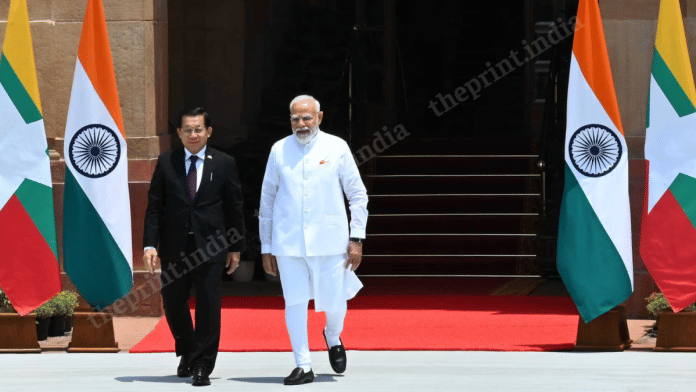
During President Min Aung Hlaing’s visit to India earlier this year, critical minerals and rare earths were discussed with Prime Minister Narendra Modi. However, mineral agreements mean little without reliable access to mining areas and transport routes to processing facilities. Unless India seriously considers reopening the historic Stilwell Road connecting Assam to Myanmar’s mineral-rich Kachin State, its ability to develop commercially viable supply chains will remain constrained.
And finally, there is the question of India’s Act East ambitions. With another major power gaining influence over both the EAOs and Naypyidaw, India could not only lose strategic space but also see its own ambitions toward the east restrained.
India cannot afford to view Myanmar through the prism of a transactional relationship or great power competition, like Washington or Beijing. The larger lesson here is that external powers may change their approach to Myanmar as their strategic interests evolve, but for India, geography and historical goodwill leave little room for such choices. How India chooses to leverage that geography and goodwill is all that matters now.
Rami Niranjan Desai is a Distinguished Fellow at the India Foundation, New Delhi. She tweets @ramindesai. Views are personal.
(Edited by Asavari Singh)