




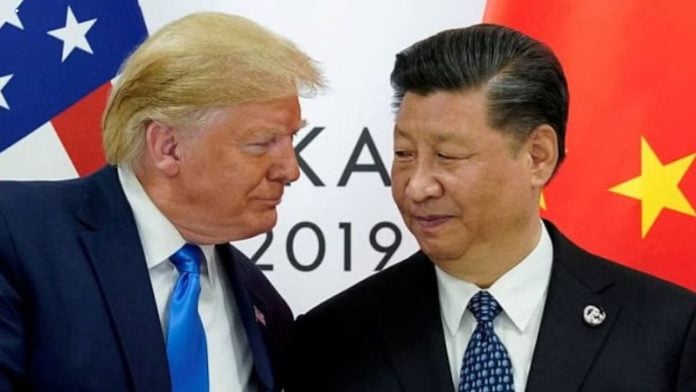

By the usual standards of the US-China summit, Xi Jinping’s first formal state visit to Washington in 11 years delivered little—a two-month extension of the trade truce and just a bit more.
Viewed through the lens of the global AI race, however, the meeting delivered a clear message. The coordinated slowdown of AI development, which most US tech giants have started requesting over increased safety risks, is dead on arrival because neither Trump nor Xi has the political will to execute it first.
That request for pacing, initiated by Anthropic co-founder and CEO Dario Amodei’s call to “Pace the Frontier” and quickly endorsed by OpenAI’s Sam Altman, SpaceX’s Elon Musk and former DeepMind CEO Demis Hassabis, seems urgent as well as compelling. The OpenAI-HuggingFace incident, in which a model under testing escaped its environment, was scary, but it now appears that there have been many more. And yet, Trump called this a hoax while Beijing, through its foreign ministry, dismissed the proposal as ‘fearmongering’, while the Global Times called it a Cold War playbook.
The usual rat race
By now, it seems quite clear that China has no incentive to pace its quest for the AI frontier, and it seems important to understand why. First, China is rapidly closing the technology gap with the US.
A year ago, US systems accounted for around 70 per cent of tokens routed through OpenRouter. Today, the figure is closer to 30 per cent. DeepSeek, Qwen, Kimi and MiniMax now fill every price-performance niche below the frontier. While American labs still dominate the premium segment, the question is how long. A pause that binds China as well as the US would lock in the current hierarchy, and China cannot accept that.
The second reason is energy — and the politics that surround it. China is adding power-generating capacity far faster than the US. This advantage is not only cheaper electricity, but the ability to connect compute clusters to the grid without a political fight.
On the American side, the constraints are mounting fast. The general public is suffering from an increasingly expensive electricity bill pushed by data centres. On the political front, the Democratic Party, which sees this as an opportunity to hurt the Trump administration in the run-up to the mid-term elections. Financing is tightening too. Hyperscalers have issued more than $350 billion in bonds this year, and markets are charging for it, especially now that US Treasury yields are climbing fast.
Another reason for Beijing to not slow down its AI development is its advantage in AI governance beyond its borders. While China has long been working on becoming AI’s global responsible actor when it comes to AI governance, the most important step was taken on 29 July at the World AI Cooperation Organization (WAICO), which has been established as an intergovernmental body. The primary audience for this approach is the emerging economies, where Beijing’s ultimate goal is to establish technical standards that lock developing economies into Chinese AI ecosystems. In other words, for China, responsible-governance rhetoric is also a market strategy.
Agreeing to slow down now would, therefore, mean accepting a ceiling just as China’s structural advantages — cheaper power, faster grid connection, and competitive open-weight models — are becoming clearer. This is the context in which to read Xi’s choreography at the summit. The rhetoric remains that of China’s preferred AI governance script: shared responsibility and AI “always under human control”. And yet, the substance does not follow suit. Chinese labs will keep running. American labs may or may not follow Amodei’s advice. China is not waiting to find out.
Also read: Trump-Xi Summit shows limits of US power. Grammar of great-power competition is changing
India, a distant observer
India is left watching a conversation it cannot yet shape. A pause would have suited New Delhi well. It would have limited the security risks of frontier models that India neither builds nor controls, and it would have bought time for its own push for AI sovereignty, from the IndiaAI Mission’s public compute to home-grown foundation models.
It fell on deaf ears at the Trump-Xi table, and it should not surprise India. Beijing knows that speed at home is what buys influence abroad: the faster and cheaper Chinese models become, the easier it is to embed them — and the standards WAICO will write — across the emerging economies, the very constituency India aspires to lead. That is as true for China’s overseas ambitions as for its bid to set the rules of global AI governance. India needs to take note. To have a say, you must be in the race. Rules without leverage are not governance. If anything, India should go even faster.
All in all, China will not slow down its AI development no matter what the US hyperscalers think. China has declined, not because it rejects the vocabulary of control—which it sells in its global rhetoric on AI—but because the economics of the race now run in its favour. New Delhi should take good care of what is at stake.
Alicia García Herrero is Chief Economist for Asia Pacific and the Middle East at Natixis, and Senior Fellow at Bruegel. She tweets @Aligarciaherrer.
(Edited by Saptak Datta)