




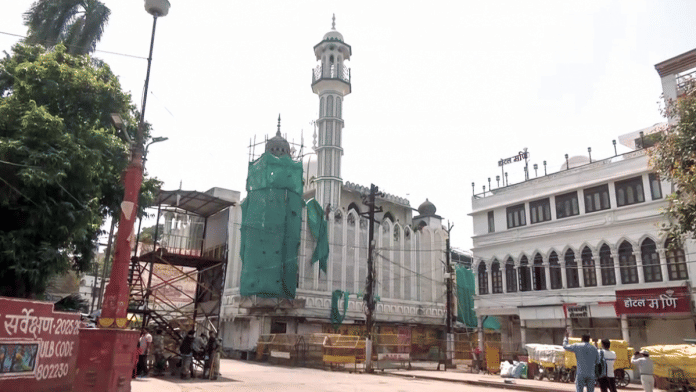

Watching videos of women and men crying over the partial demolition of Shahi Mosque in Ujjain this week, I could feel their emotions and sense of loss. Emotions don’t always follow logic. Sometimes they simply have to be acknowledged.
While sympathising with my community, I feel even sadder that there seems to be less and less space for any dialogue. The willingness to talk, negotiate, listen to the other side or even wait for complete facts seems to be shrinking day by day, especially in an era of dopamine-induced news cycles, viral social media posts and now fake AI-generated videos.
For those who are not aware, clashes erupted between protesters and police in Ujjain, Madhya Pradesh, over the partial demolition of the historic mosque. A portion of the structure falls within a road-widening project being carried out by the Ujjain Municipal Corporation ahead of the Simhastha Kumbh Mela 2028.
It’s not like there has been no effort to negotiate. Most international media have not reported it, but representatives of the mosque and the administration had reached an understanding that the affected portion would be removed by members of the community themselves.
And yet, we still ended up with stone-pelting, tear gas, clashes and people crying outside the mosque. So somewhere between negotiation and the street, something broke down.
Also Read: Muslim personal law is in conflict with POCSO. It needs reform
When trust breaks down
Religious sentiment has always been a very sensitive issue in India, but sometimes I feel there is hardly any room left for a sensible conversation around it, or even for a middle path.
Growing up as a Pasmanda Muslim, I have seen how many of our community leaders and sections of the media have fostered a sense of distrust towards authority and institutions within the community, regardless of which political party is in power. And there is no doubt that this sentiment has only become stronger under the current government. There is very little goodwill left between a large section of the Muslim community and the current government, and that is deeply problematic.
Some Pasmanda leaders have been arguing for a different approach, asking the community to understand that regardless of which party is in power, as a marginalised community we have to work with institutions. We cannot simply withdraw ourselves from every institution because we distrust the people currently running it.
At the same time, trust cannot be demanded only from one side. While the government has initiated outreach events and programmes towards Pasmanda Muslims and the wider Muslim community, there is also a part of the same political ecosystem that does not help at all. Occasional speeches, statements and messages targeting Muslims can very quickly undo whatever goodwill those outreach efforts are trying to create.
Facts vs feelings
The truth is that there is another side of this infrastructure project that also needs to be acknowledged. Madhya Pradesh Chief Minister Mohan Yadav himself took a pickaxe to a portion of his ancestral home because it was coming in the way of the same road-widening project. His sister’s house is also affected.
The High Court order also noted that 10 temples and one mosque had already been affected along the same road, while around 80 religious structures were being shifted or removed across Ujjain as part of road-widening projects, including a Hanuman temple.
These facts should matter when we create a narrative around what happened.
If we only see the video of a mosque being partially demolished, without the larger context, it becomes very easy to conclude that Muslims and their places of worship are specifically being targeted. And given the existing distrust between the community and the government, I understand why many Muslims may immediately feel that way. But that is exactly why a sense of balance is needed.
I can understand the pain of people who have prayed in that mosque for years. I can understand why watching even a portion of a religious place being demolished can be emotional. The Chief Minister himself said he felt emotional while giving up part of the house where he grew up. Hindu devotees also became emotional when the roughly 170-year-old Khade Hanuman temple was affected by road widening. Some devotees opposed its relocation, and there were people in tears while saying goodbye to a place that had been part of their religious life for generations. Emotions do not become invalid simply because there is an infrastructure project behind them.
But sympathy should not require us to ignore facts either.
If homes belonging to ordinary people, the Chief Minister’s own ancestral house, temples and a mosque are all affected by the same project, then those facts have to be part of our conversation before we conclude that this particular demolition proves that Muslims were being singled out.
And this is exactly the middle space we are losing: the ability to say, I understand your pain, but I also need to look at the complete picture.
Also Read: IIT Bombay tragedy shows how India’s shaming culture makes failure harder to bear
A more secular approach could help
In the end, I understand the religious sentiment. But I believe there is only one long-term answer to these problems: becoming more secular.
By secular, I don’t mean people should stop being religious. People are free to believe, pray and follow their religion. I mean developing a more rational relationship with religion, and having a state that remains genuinely secular and neutral towards all communities.
If an infrastructure project genuinely requires changes to a mosque, temple, church, gurudwara or any other religious structure, and the same rules are being applied to everyone, Muslims should not immediately see it as victimisation. At the same time, the state should not expect one community to compromise on its religious space while accommodating the religious demands of another.
And this is where I still have some discomfort with the Ujjain project itself. Road widening and infrastructure for the everyday needs of the public make sense to me. Cities change, populations grow and sometimes even old structures have to make space for those needs. But if religious structures are being removed or altered primarily to accommodate infrastructure for a religious pilgrimage, then I think we should be able to discuss that too.
Amana Begam Ansari is a columnist, writer, and TV news panellist. She runs a weekly YouTube show called ‘India This Week by Amana and Khalid’. She tweets @Amana_Ansari. Views are personal.
(Edited by Asavari Singh)
When Hindu heritage was desecrated, it was termed “historical inevitability.” When modern civil infrastructure touches a fraction of a minority structure with court clearance, it gets framed by liberal portals as an existential tragedy.
Indian Muslim community has gone completely into a “under siege mentality”, rightly or wrongly, given the context of rise of Hindutva.
The problem with this is that I can clearly see Indian muslim community become more conservative, become more intolerant to reforms and dialogue, which directly give rise to such incidents.