




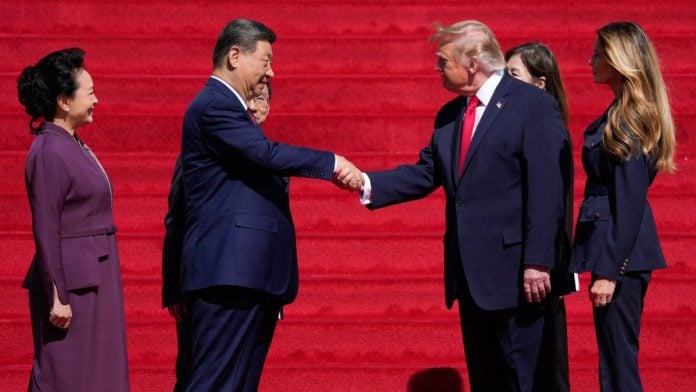

US President Donald Trump’s red carpet treatment for his Chinese counterpart Xi Jinping during his visit to Washington is more like a return gift for what he received in Beijing earlier this year. Besides the red carpet, Trump welcomed Xi to the White House with a military flyover at Joint Base Andrews along with a display of troops and jets. Additionally, Trump hosted a grand dinner in the East Room with top technology executives, including Elon Musk, Tim Cook, and Jensen Huang. It was followed by a gift—a three-foot-tall bronze statue of a bald eagle.
In May, Xi hosted Trump for bilateral talks at the Great Hall of the People in Beijing, a visit to the Temple of Heaven, and a tour of the Zhongnanhai leadership compound. This marked Trump’s second visit to China and his first during his second term.
While Xi lauded the welcome, saying everything during the visit was “done to the highest order of perfection” with “thought in every little detail”, Trump praised the reception as an “epic welcome,” voiced deep appreciation for the hospitality, and commended the personal rapport built with the Chinese President.
The jury is still out on who was a better host. Meanwhile, the rivalry in trade, technology and hosting each other continues.
Shifting global landscape
The meeting of the two major contesting powers brought out very little consensus on tariffs, trade and Taiwan. There was no joint press meet; the tariff was extended by just two months instead of two years, as hoped by Beijing. China just reiterated its unfulfilled promise to buy $17 billion worth of US agricultural products annually and 200 Boeing aircraft.
Yet, if the two contesting powers are as happy as the two pandas donated to the Atlanta Zoo, about the bilateral meetings and visits of the two presidents to each other’s countries, it signals two major shifts in the geopolitical dynamics of the present world order.
First, these meetings are touted as the beginning of the G2, a term originally coined by economist C Fred Bergsten in 2005 to encourage major economic cooperation between Washington and Beijing. The G2 agenda was mainly focused on prompting China to become a responsible economic pillar of the world order, besides America and the European Union (EU).
The second and more important signal these meetings suggest is the need for the two powers to stymie the emergence of multipolarity, which would effectively challenge the liberal and autocratic hegemonies if allowed to develop deep roots among middle powers and emerging economies.
Both signals are missing their targets and becoming increasingly diluted due to the shifting global landscape. The G2 is a non-starter as neither Washington nor Beijing is ready to bury the hatchet in the larger interest of global peace and prosperity. Both want to emerge superior, firmly anchored in ‘nationalist’ jingoism like MAGA and the official political campaign for the “Great Rejuvenation of the Chinese Nation” under the broader “Chinese Dream”. The concept of multipolarity is gaining traction among the G7, the G20, and emerging economies, all of which are increasingly growing tired of the constant economic disruptions caused by the two major economies.
There is little doubt that Beijing has emerged as the undisputed leader of the anti-America group of countries, especially since the disintegration of the former Soviet Union and the professed ‘peaceful rise’. These countries might eventually turn toward a multilateral forum led by an ASEAN-like trade forum or a democratic India with much greater economic clout and heft. In the West, the European Union (EU) and NATO allies of the US will find it difficult to deal with a world order where the US and China would be rule makers and the rest of the Western world would be left to just follow the rules.
Also read: Why China will not slow down its AI pace
A temporary phenomenon
A legitimate question that arises in this context is how long this bonhomie will last. Dual-use technologies such as semiconductors, AI, and advanced computing have become national-security issues. The US uses export controls to restrict China’s access to some technologies, while China controls critical minerals and other inputs. These measures are difficult to resolve through a conventional trade bargain. China’s stand on Taiwan remains unchanged, while the US has been committed to supporting Taiwan and under the Taiwan Relations Act, the US is legally bound to provide Taiwan with the means to defend itself in the event of any military threat to its sovereignty and remains its primary arms supplier.
US and China have stabilised their relationship to a large extent for mutual benefit but have not transformed it to last long. The two may even expand their trade, but the structural disputes and rivalry remain intact. The US-China bonhomie, therefore, appears to be a temporary phenomenon, but their bilateral relationship is likely to oscillate between cooperation in trade matters and confrontation in strategic space without being comrades forever or entering into overt conflict.
Either way, India has every reason to watch the near future and long-term US-China engagements with abundant caution. From being estranged democracies to becoming strategic partners, India-US relations have had very close and strategic convergence on the Indo-Pacific and several regional initiatives with shared concerns on the not-so-peaceful rise of China.
A stable relationship between Washington and Beijing might reduce the US’s need for deeper strategic cooperation with New Delhi in the short term. In the long term, the ideological and fundamental differences between democracy and Communism will compel India and the US to work together for a free, inclusive and peaceful Indo-Pacific and the world for lasting prosperity.
In the long term, the global power projection of the US may decline, ceding its numero uno position to China—an extremely unlikely scenario; or the artificial People’s Republic of China may disintegrate like the artificial Union of Soviet Socialist Republics (USSR)—a very likely scenario. That will be the time for India to play its role, provided it prepares itself.
(Edited by Saptak Datta)
Well short of a G 2, it will be good for all of Asia if USA and China come to a better understanding on how they will manage their competition and rivalry. Not a descent into war. Nor rivalry so intense that it begins to undo the fruits ( available to all ) of globalisation. Microchips. Rare earth minerals. Tariffs. Non tariff barriers. Creation of blocs ( both China and Russia see Quad in that light ). 2. India’s romance with USA has not become a marriage. Feel greatly relieved.