



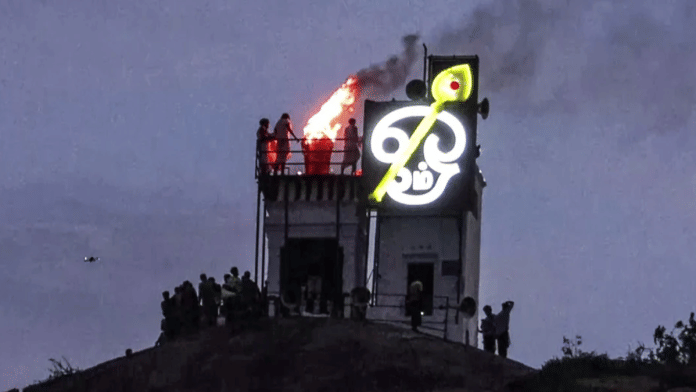
Across India, festivals have long been the golden threads that stitch diverse neighborhoods together—moments when sweets are shared across doorsteps, and the glow of celebration transcends the boundaries of faith. And it is rather sad when these occasions instead become a reason for division. On the ancient slopes of Thiruparankundram hill in Madurai, where the sacred lamp of Karthigai Deepam was meant to pierce the dusk in peaceful devotion, the flame itself has become tethered to courtroom rulings, stone boundaries, and heavy silences between neighbours.
For those who may not know, Karthigai Deepam is an ancient Tamil Hindu festival celebrated by lighting lamps. In recent decades, the sacred lamp has customarily been lit near the Uchi Pillayar Temple. However, some Hindu devotees approached the court seeking permission to light the lamp at another location, on a stone pillar known as the Deepathoon, situated higher up the hill and approximately 50 metres from Hazrat Sultan Sikandar Badusha Auliya Dargah.
In 2025, Justice GR Swaminathan ruled in favour of lighting the lamp at both locations. In January 2026, a division bench upheld the direction and held that the stone pillar stood on temple land. The management of the dargah, however, opposed the lighting of the Karthigai Deepam at the disputed pillar, calling it a survey stone.
Around that unlit pillar on the hill, the quiet devotion of a festival has given way to the loud clamour of power, politics, and the law. Will this ancient stone become a new fault line for political ambition, or a testing ground for the fragile promise of secularism? Beneath the debates over boundaries and beliefs lies an even deeper tremor: when courts have allowed the lighting of the lamp at the Deepathoon, on what grounds can the authorities refuse to implement that direction?
Also read: Bilkis Bano case and the moral cost of putting community before conscience
Only Hindus are expected to be secular
I also couldn’t stop thinking about one simple question: why does the Muslim management have an issue with the Deepam ceremony taking place some 50 metres away from the dargah?
We are not talking about Hindu devotees demanding to perform a religious ceremony within the premises of the dargah. The question of land ownership on the hill has already been settled in court rulings dating back to the British era, with the recent court ruling holding that the disputed pillar stands on temple land.
It is absurd that the dargah management should have an objection to where Hindu devotees light their sacred lamp or perform a religious ceremony on land that belongs to the temple.
And then comes the argument about secularism. How does allowing one religious community to perform its religious rituals on its own land become a threat to secularism? Or, to be precise, secularism means denying our Hindu brethren the freedom to practise their religion in the way they wish, simply because the management of a dargah objects to it?
The responsibility of upholding secularism, fraternity and communal harmony seems to be placed entirely on the Hindu community, without expecting the same from others.
What hurts most is seeing how fiercely people in the Muslim community demand space for worship and sensitivities, yet how reluctant we can be to extend that same grace to our Hindu neighbours. Fraternity cannot survive on a one-way street; we cannot always expect others to make room for us while offering no warmth in return. That is not how coexistence works. Such an attitude is not only disappointing but also short-sighted.
I wonder how different this story could have played out if hands from the dargah had stepped forward in friendship, helping to kindle that distant lamp as a living gesture of brotherhood. It could have been an opportunity for reconciliation, for dialogue and for finding a solution within civil society itself, without having to fight prolonged battles in court.
Instead, it has become another painful addition to the fault line.
It is still not too late to turn this tide—for the dargah authorities to listen to the voices within their own community calling for wisdom, stop resisting, and transform a bitter standoff into a shared celebration of light. No genuine tenet of faith demands shutting down a neighbour’s prayer. This resistance by the Muslim community in Tamil Nadu mirrors a deeper, rigid mindset of religious supremacy—the same selective spirit that celebrates reclaiming spaces like the Hagia Sophia while refusing to extend that same to others at home.
For such a mindset, secularism is merely a convenience used to demand freedom when out of power, not a principle to be upheld when called upon to share it. True faith, however, is never threatened by another’s devotion. Until we learn to cherish a neighbour’s sacred joy as fiercely as our own, the light we seek will remain out of reach.
Amana Begam Ansari is a columnist, writer, and TV news panellist. She runs a weekly YouTube show called ‘India This Week by Amana and Khalid’. She tweets @Amana_Ansari. Views are personal.
(Edited by Ratan Priya)