




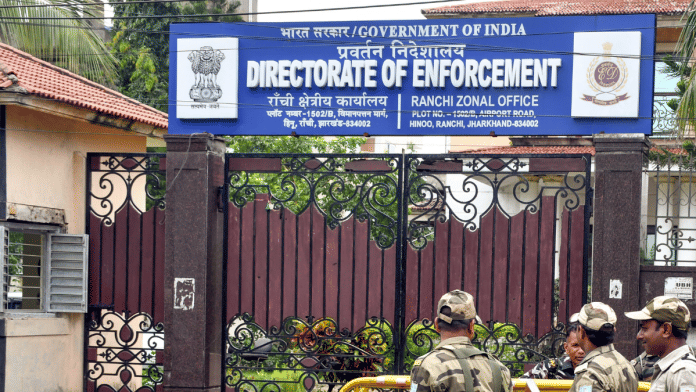

The Prevention of Money Laundering Act 2002, which came into force on 1 July 2005, has been highly controversial. The time is ripe to analyse the PMLA’s objectives, its efficacy, and the way forward.
The prime objectives of the PMLA are to tackle threats to India’s financial system and to confiscate “proceeds of crime”.
These objectives emerged from a Political Declaration adopted by a Special Session of the United Nations General Assembly (UNGA) held in New York from 8 to 10 June 1998. It called upon Member States to adopt national money-laundering legislation. India was a signatory to the UNGA declaration.
The idea was conceived to counter the world’s drug problem. It is widely known that the global illicit drug trade generates billions of dollars. Thus, ab initio, PMLA was meant to have an international perspective.
The first set of notified offences under the PMLA in 2002 included ten laws: The IPC 1860, NDPS Act 1985, Arms Act 1959, Immoral Traffic (Prevention) Act 1956, Prevention of Corruption Act 1988, and the Wild Life (Protection) Act 1972.
None of these laws deal with cross-border transactions. Thus, the international perspective was missed at the very inception of PMLA. This was a failure of India’s international obligation.
Gradually, the schedule of offences in PMLA was expanded, but still without any international perspective.
Also read: What to do when you get an ED notice—work on your body language
Failure of objective
In 2009, Part C to the Schedule was inserted in PMLA with the following wording: “an offence which is the offence of cross border implications and is specified Part A, or the offence against property under Chapter XVII of the Indian Penal Code”.
Subsequently, in 2015, there was a further insertion: “the offence of wilful attempt to evade any tax, penalty, or interest referred to in Section 51 of the Black Money (Undisclosed Foreign Income and Assets) and Imposition of Tax Act, 2015.”
These cosmetic insertions failed to include international cross-border transactions. For example, the insertion of the expression “implications” cannot be stretched legally to mean “transactions”.
Thus, cross-border transactions continued to elude the PMLA.
As if to ensure that it remained altogether out of the purview of PMLA, Foreign Exchange Management Act 1999 (FEMA) was kept out of the Schedule of PMLA. Also kept out was the Conservation of Foreign Exchange and Prevention of Smuggling Activities Act 1974 (COFEPOSA). And conspicuously missing from the net of PMLA schedule was any law that punishes cross-border hawala transactions.
Therefore, the PMLA, as enacted, bristles with arbitrariness bordering on absurdity. For example, the PMLA can punish a sex worker on a charge of money laundering but cannot touch a billion-dollar hawala operator. PMLA can prosecute a wildlife poacher on charge of money laundering but cannot touch a person who has unlawfully stashed a billion dollars abroad.
The PMLA has thus failed to achieve its objective.
Hypothetically, the PMLA cannot ensure India’s macro financial stability by confiscating proceeds of crime arising out of, say, cross-border billion-dollar money laundering. The Enforcement Directorate (ED) would lack jurisdiction to trigger the PMLA in such a situation.
What then is the efficacy of the PMLA?
Also read: Can state-owned firm be prosecuted under PMLA? Legal opinion divided on CJI’s remarks in TASMAC case
The ED’s issue
PMLA seeks only to confiscate “proceeds of crime”, arising exclusively out of offences committed under the laws as mentioned in the Schedule of PMLA.
Of course, punishment for offences committed under Section 3 of the PMLA entails a fine and imprisonment up to 10 years.
This is the crux of PMLA. If there is no “proceeds of crime”, then PMLA cannot be triggered. Also, if there is no crime or the accused is discharged or acquitted, the PMLA cannot be triggered.
In a hypothetical situation of only “crime” (as per schedule of PMLA) without “proceeds of crime”, an offence of “money laundering” under section 3 of PMLA cannot be made out and hence ED, under PMLA, will have no jurisdiction.
Unfortunately, this basic issue is often overlooked in responsible quarters including courts at all levels.
ED’s propensity to trigger the PMLA without any clue about “proceeds of crime” amounts to acting without jurisdiction. Such open-ended investigation or inquiry by the ED in an effort to locate proceeds of crime is simply an open-ended investigation or inquiry to acquire jurisdiction. This can amount to abusing the process of law.
It is clear that a special court under PMLA has to necessarily try the offence of “crime” (as per schedule) and “proceeds of crime” together. If there are no “proceeds of crime”, then ED under PMLA loses jurisdiction.
That does not, however, mean that the accused can escape scot-free. The accused can still be tried for the offence under criminal law by a criminal court, just not under PMLA.
This perspective is often missed and ED keeps on summoning the accused without a clue about any “proceeds of crime”.
The performance of the ED to administer PMLA has been uninspiring. The following official figures bear testimony to the ED’s track record.
Properties confiscated under PMLA in 21 years from 2005 amount to Rs 15,735.91 crore or about Rs 0.16 trillion as on 31 March 2026. This is about only Rs 0.0075 trillion per year. For an economy with an annual expenditure of Rs 53.47 trillion and a GDP of Rs 393 trillion, continuance of PMLA does not make economic sense.
The PMLA has also been perceived as a tool used to settle political scores by every ruling government, cutting across party affiliations. The power to arrest, attach, seize, freeze properties have been used, misused and abused rampantly.
In fact, the fear psychosis injected by ED to summon and interrogate suspects repeatedly dampens overall confidence of an investor—domestic or foreign.
Overall track record of ED in last 21 years of administering PMLA as of 31 March 2026 is as follows:
Number of ECIR (Enforcement Case Information Report) recorded: 8,851
Number of trial cases resulted in conviction under PMLA: 56
Number of accused convicted in PMLA: 124
These figures look dismal. Time is ripe to repeal the PMLA and wind up the wing of ED that administers PMLA.
Bishwajit Bhattacharyya is a senior advocate in the Supreme Court and former Additional Solicitor General of India. Views are personal.
(Edited by Theres Sudeep)