








First came the NEET leaks. Then, CBSE’s on-screen marking system malfunctioned. Finally, CUET-UG’s glitches. It wasn’t fun being a student in May.
It has taken the outrage of students and parents, the enterprise of at least three intrepid young men, and the combined efforts of social and news media to explain what exactly went wrong here, and forced the government to (re)act.
The CBSE Chairman and Secretary have been shifted—or is it ‘shunted’ as Hindustan Times wrote in its 3 June headline? And, Prime Minister Narendra Modi is “personally supervising” the NEET issue.
None of this will help the aspiring students who are stranded in no-man’s land—waiting nervously for new examination dates, or for the reevaluation of their test papers. However, the spotlight has given us a clear insight into the failures of the systems that were supposed to work.
Also read: In India’s NEET and CBSE exam crisis, the only adults in the room have been children
The three stars
The news media have played their role in several ways. Basically, that of the supporting actor, to the key players in each failure.
Take the case of CBSE’s OSM snags.
Leading English newspapers and TV news were full of the school exam scandal.
Let’s begin with newspapers.
First, they highlighted student protests with interviews of the pupils and their parents. They tracked the reopening of the reevaluation portal closely and student responses to it. The Indian Express called it CBSE’s OSM “chaos” in an in-depth article.
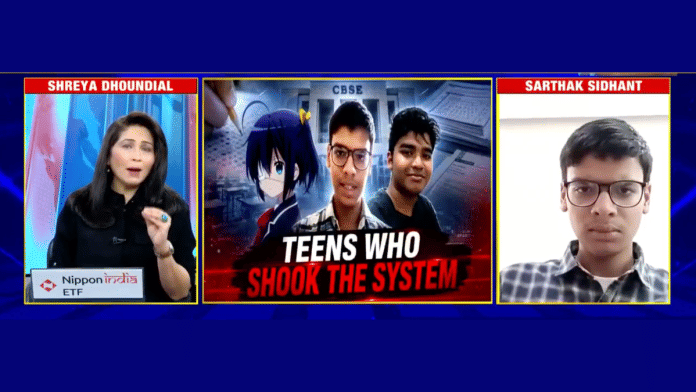
Second, they focused public attention on the investigations by three students: Vedant Shrivastava, Nisarga Adhikary and Sarthak Sidhant, who uncovered what Times Now calls the “CBSE mess”.
Overnight, those three young men have become social media and news media stars.
Shrivastava told us how his Physics paper wasn’t his Physics paper. Adhikary, an ethical hacker, found ways to breach OSM’s security and access the portal’s backend, while Sidhant discovered oversight issues in the tender process for OSM, which led to COEMPT securing it.
Newspapers gave them plenty of space. Here’s Hindustan Times: “Gen-Z blog explodes: How 17-yr-old Sarthak’s investigation of CBSE OSM tenders became centrepiece of a mega row”
Third, the news media published detailed explainers, with a sequence of events of the breakdowns. See this article in The Hindu.
Fourth, it has conducted follow-up investigations into the findings by Sidhant and Adhikary.
Here is the Hindustan Times’ detailed report on the tender process for the OSM and how COEMPT won the contract with a bid that was 60 per cent lower than its nearest competitive bidder, TCS.
The Indian Express reported the findings of an “evaluation dry run” by the Board, “less than a month before this year’s Class 12 examinations began on 12 March”, which had found “glitches” and asked for OSM’s rollout to be delayed by a year.
It also published a step-by-step description of the NEET’s paper-setting operations and the foolproof security framework, which was breached.
Also read: Cockroach party holds 1st press meet. Dharmendra Pradhan must quit for NEET, CBSE failures
Standing with the students
Television news channels followed the same pattern. They were equally energetic. Their enthusiasm was, however, often misplaced.
Can anyone explain why channels such as NDTV 24×7 have spent the last three days reporting continuously on the build-up to a new state government in Karnataka, from Bengaluru and Delhi?
Why must we trudge the “Long March to power” (India Today) with DK Shivakumar? Why must we watch images of Siddaramiah, Shivakumar and Rahul Gandhi holding hands?
But they did come back to the failures of India’s education system. They showed us, in close-ups, the evaluated test papers with red ink markings. If the papers were marked online, why the red writing?
They also kept up a constant vigil. On Monday and Tuesday, they had their eyes glued to the reevaluation portal, which had been inaccessible to students, waiting for its reopening.
CNN News 18 summed up the approach of TV news quite neatly: “Crash. Chaos. Questions”
Channels such as Times Now interviewed Shrivastava, Sidhant and Adhikary in a segment titled “Teens who shook the system”. We could listen to them and understand what they did. “Times Now with students”, declared the channel.
Television news wouldn’t be television news without its deafening debates and melodrama. We ought to enter TV news anchors for acting awards. Their histrionic abilities may not win an Oscar, but maybe a Screen Award?
On India TV, the anchor was at her best as she took on CBSE. “For the first time, we are thanking the hackers. Mothers and fathers are saying, if there hadn’t been hackers, we’d never have known how useless the CBSE system is.”
“Har level par gol mal hai… poora ka poora system hi bekaar aur ghotale se bhar hua hai (There’s corruption at every level… the entire system is useless and full of scams),” she added with a flourish.
By his standards, Republic TV’s Arnab Goswami gave a restrained performance on CBSE’s OSM issue. In a long monologue, he expressed his disappointment: Let’s start “by accepting it’s a mess,” he said.
“The implementation (of OSM) has been terrible….I don’t understand why the government allowed (CBSE) to implement this in one shot, one phase roll out,” he added.
Opinion and commentary, too, appeared in the newspapers. The Times of India had “Glitch, Retest. Repeat” as its lead editorial on 1 June. It was harsher on NTA, which conducts the NEET and CUET (UG) tests, and on CBSE. “NTA and CBSE have become symbols of ineptitude in their rushed drive to centralise and go digital,” it wrote.
CBSE also has the dubious distinction of making headlines in foreign news media: UK’s The Guardian and BBC, Singapore’s The Straits Times wrote about the school scandal in some depth.
It’s good to know May is now behind us.
The author tweets @shailajabajpai. Views are personal.
(Edited by Theres Sudeep)