




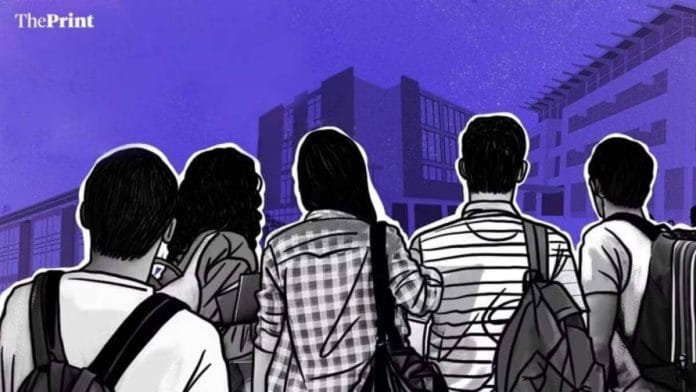

By all means, India should be celebrating this week. It’s been a frenzied national examination season that will go down in history for the ingenuity of its disasters: a NEET paper leaked and the exam was then cancelled, CBSE results were lacerated by a half-baked on-screen marking system nobody asked for or was prepared for, and there was whatever it was that happened to CUET. But the authorities have, at last, established who is to blame.
It is the Indian student.
It is with considerable relief that we report that none of the usual suspects has been found guilty in this three-ring circus. The CBSE is not to blame, nor is the National Testing Agency (NTA). And it is certainly not Union Education Minister Dharmendra Pradhan, who has presided over each of these debacles – and three NEET paper leaks in his nearly five-year tenure – with a serenity one can only yearn for. No, the culprit has to be the Indian student, and only the harshest punishment, including lathi charges, detentions and water cannons, will do.
And that punishment was duly administered. A few days ago in Delhi, Class 10 and 12 students protesting the CBSE results tried to march to Parliament. One of them told an anchor that mathematics was actually her favourite subject, so how could she have scored only 21 marks? For asking such seditious questions, she and her equally young, bewildered friends were bundled into a police van and taken away. In Bhopal on 30 May, the National Students’ Union of India (NSUI) gathered to protest the absolute bedlam unleashed by the NEET paper leak, and the police answered with lathis and water cannons, detaining almost 200 people.
Similar scenes have unfolded in Kerala, Telangana, Odisha, Jharkhand, Rajasthan, Uttar Pradesh and several other states – but you wouldn’t know it if you watched only television news. In each place, dissent has been swiftly managed, making it the most efficient exam-related exercise we have witnessed all season.
First police, then internet mob came for teenagers
Water cannons and police vans still require a fair amount of mobilisation, but tweeting a theory costs little more than your conscience and works just as well. You can always label someone an enemy of India, even an 18-year-old who just wants to know why his marks do not add up.
Vedant Shrivastav, a Class 12 student in Delhi, noticed that the physics paper CBSE returned to him during re-evaluation had been written in someone else’s hand. He pulled the scans of his English and computer science papers and compared them with the physics answer sheet. Anyone with functioning eyesight could see that the handwriting did not match. The post reached 3.2 million views. He was far from the only one. Another student, Sanjana, who had been awarded 11 out of 70 marks in chemistry, requested her scanned answer book and found that only the cover page belonged to her.
A slice of the internet then began asking the tough questions, such as: “Was George Soros funding Vedant Shrivastav?” Dedicated experts launched forensic examinations and arrived at the conclusion that Shrivastav’s newly created X account, located in “South Asia”, meant that he was a Pakistani agent. Ashok Shrivastav, a primetime anchor on Doordarshan, asked whether Pakistanis were now taking CBSE exams. Remember, Doordarshan is funded by public money, which means the Indian taxpayer effectively paid for a smear campaign against a child who had caught a state institution wanting.
Every act of scrutiny that these institutions were built and funded to provide has instead come from teenagers over the past few weeks. Nineteen-year-old ethical hacker Nisarga Adhikary, who has himself just finished school, found and flagged several vulnerabilities in OnMark, the portal used by CBSE examiners to grade scripts. Adhikary managed to gain super-admin access to the portal and discovered that the site’s master password was stored in plain text within its code. On the examiner login page of the largest school board in the country, he even left behind a viral animation.
But Adhikary had already done the adult thing and reported these vulnerabilities to CERT-In, the government’s own cybersecurity agency, in February. For more than three months, while millions of answer sheets were being scanned and marked on the same ramshackle infrastructure, he received no actionable response from the agency.
When Adhikary finally went public, CBSE attempted to save face by claiming that he had hacked only a harmless “testing platform” stuffed with dummy data. So Adhikary found even more vulnerabilities in other “insanely insecure” linked platforms that had been left exposed to the whole internet. It was only after this latest round of public shaming that CBSE issued a public statement and name-dropped the IITs as the solution.
The show of incompetence and negligence didn’t end there. A 17-year-old named Sarthak Sidhant asked a few pointed questions about CBSE’s tendering process. Sidhant is another school student, not a seasoned reporter or regulatory expert, who asked how Coempt EduTeck came to be running CBSE’s OSM programme. In its previous avatar as Globarena, Coempt EduTeck ran the technology behind the 2019 Telangana intermediate results, where a bungled evaluation led to nearly 40 per cent, or over 3.8 lakh candidates failing. In the weeks that followed, 21 students reportedly died by suicide. The state government had then instituted an inquiry and taken the company to court.
Yet, the tainted firm was hired by CBSE. A clause that would have disqualified a bidder for poor past performance mysteriously vanished, while the financial and technical eligibility bars were lowered. Based on the student’s groundwork, news organisations are now pursuing the story and asking why the rules were rewritten during the tendering process, putting the futures of lakhs of students on the line. Because, apparently, the dead ones did not count.
Mature teenagers up against incompetent adults
Three students – not all old enough to vote – have forced accountability onto a system that remains deliberately opaque. Each of them, along with the thousands now protesting, has brought more rigour and honesty to the task than the institutions in the dock.
But why should these teenagers have to do this – especially at such a vulnerable time in their lives? Who is the adult here, and who is the child?
On one side stands the education ministry, a body with both a mandate and a budget, which has lost and leaked papers, bent the rules, and botched the results of critical exams on which the country hinges. On the other side is a handful of schoolchildren armed with nothing more than an internet connection. Only one of these has displayed any real maturity, and it was not the one constitutionally obliged to know better.
Still, a badge of maturity is cold comfort to a teenager. Fate – and the Indian state – has forced a certain chutzpah upon them. They have learned an important lesson early and will not all wait around to be failed twice. The sharpest and most privileged among them will do what this country’s brightest have been doing for a few generations: leave.
But leaving is a luxury that most of these children cannot afford. Behind those who can make their voices heard sit millions who cannot: young Indians with neither the means nor the wherewithal to attempt an exam twice or seek a re-evaluation. They have no audience. And they will have to accept whatever the machine gives them – the result that will determine the size of their lives.
Karanjeet Kaur is a journalist, former editor of Arré, and a partner at TWO Design. She tweets @Kaju_Katri. Views are personal.
(Edited by Prashant Dixit)