



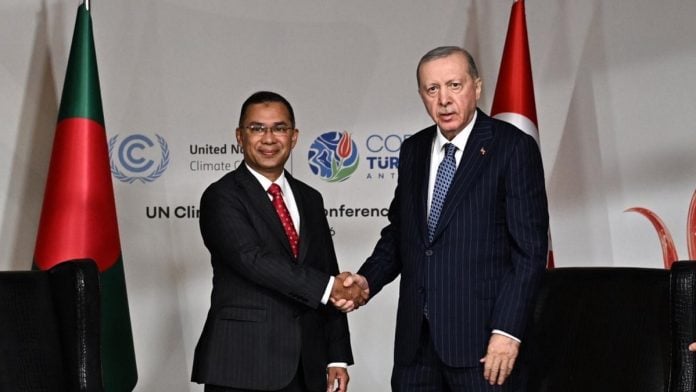
One of the key events on the sidelines of COP31 in the Turkish city of Antalya was a meeting between Bangladesh Prime Minister Tarique Rahman and Türkiye President Recep Tayyip Erdoğan.
Rahman arrived on 10 November for a three-day visit that combined the UN climate summit with bilateral talks. It was one of Bangladesh’s major diplomatic events under Rahman, who has so far visited Malaysia, China, Japan and the United States (for the 81st UN General Assembly in New York) since taking office in February 2026. What’s more interesting is that, despite several press reports and diplomatic signalling, Prime Minister Rahman’s visit to India remains in limbo.
In the past, India was visited by almost all newly elected leaders in Bangladesh. However, Rahman has skipped Delhi entirely. Former Prime Minister Sheikh Hasina’s presence there remains the major political hurdle contributing to tensions between the two neighbours.
Away from Delhi, business and shared Islamic ties seem to have driven Dhaka’s early diplomatic engagements under Rahman. There have so far been bilateral visits to Malaysia, China, Japan, and now, Türkiye.
But why does Türkiye matter to Bangladesh, and vice versa? And how might closer ties between the two shape regional dynamics, especially by annoying New Delhi?
Also Read: R&AW is being blamed in Bangladesh for air force pilot’s death. It’s a red herring
Türkiye’s regional ambitions
Türkiye’s courting of Bangladesh is no surprise. Over the past decade, Ankara has visibly been an aggressive campaigner for influence in the Indian subcontinent, focusing particularly on countries that stand at odds with India politically. Islamic connections are another key force driving Ankara into the region.
Viewed through both prisms, one country stands out as a key ally of Türkiye—Pakistan. In this regard, a recent noteworthy event was the Mecca Pact between Türkiye, Pakistan and Saudi Arabia. Whether the pact has been a success or failure remains unclear, given the limited military language used by Pakistan after Saudi Arabia came under attack from Iran.
The Islamic connection and tensions with India make Bangladesh an interesting candidate too, and political debates have already emerged over Dhaka’s interest in the Mecca Pact.
Ankara’s bid for influence in part aspires to challenge India’s regional supremacy. But its rising defence industry also sees the geographically smaller countries of the Indian subcontinent as key markets.
During Operation Sindoor, Türkiye reportedly sent more than 350 drones along with operators. Turkish drones, including the Bayraktar TB2 and YIHA, were highly visible during the conflict between India and Pakistan.
Not to forget, Türkiye’s stance on Kashmir, especially under Erdoğan, has been that of a bully and is an annoyance for India.
It is no surprise that Türkiye, a NATO member, has ambitions to add more markets to its growing defence industry. Countries in India’s neighbourhood, with their newly formed sense of securitisation, are an appealing proposition.
In 2025, Türkiye’s defence and aviation exports surpassed the US$10 billion threshold—a key milestone for a traditional industry that has revamped itself over the past two decades, especially in manufacturing unmanned aerial vehicles (UAVs).
Also Read: India and EU have new reasons to engage. Real test comes after FTA is signed
Partnership with Bangladesh
Türkiye is one of Bangladesh’s major trading partners, with bilateral trade totalling US$1.36 billion in 2025. The two countries have set an ambitious trade target of US$2 billion. Interestingly, Dhaka holds the upper hand in trade, with exports totalling US$926 million, while imports from Türkiye were worth almost half as much, creating a net trade deficit for it.
Beyond trade, workforce ties and investment further diversify Dhaka’s engagement with Ankara. Türkiye’s Arçelik acquired a majority stake in Singer Bangladesh in 2019 for about US$75 million, highlighting Turkish corporate interest in Bangladesh’s manufacturing sector.
Given that Tarique Rahman avoided India in his early months in office, his visits to Malaysia, China, Japan and now Türkiye form a string of economy-centric pearls across wider Asia. In June 2026, less than four months after Rahman took office, Dhaka invited Türkiye’s foreign minister, Hakan Fidan, bringing these beads together.
In 2022, Bangladesh was reported to have placed an order for the Turkish combat drone, the Bayraktar TB2.
During his meeting with Erdoğan, Prime Minister Tarique Rahman reportedly discussed strengthening defence cooperation, with a cardinal focus on joint investments in this sector. The Bangladesh government and military also seem to be working closely to materialise these prospects.
Bangladesh Army Chief Waker-Uz-Zaman, a key face of authority during the July-August 2024 movement, visited Ankara in July 2026 for five days and held talks with Türkiye’s defence minister and chief of staff. While defence ties are projected to grow, this could also be Ankara’s answer to the growing trade deficit with Dhaka.
To conclude, the political push in India’s neighbouring countries for diversity and cooperation beyond Delhi, coupled with Türkiye’s idea of pan-Turkism—an ideology that grew in the 19th century as a way to unite Turkic people in Russia and solidify Turkish ethnic identity and culture—offers Ankara a strategic space in the Indian subcontinent.
It needs to be noted that while the original philosophy of pan-Turkism focused largely on culture and ethnicity, it has found renewed geopolitical expression under President Recep Tayyip Erdoğan, who has been in top leadership positions for over two decades as prime minister and then president.
Erdoğan has leveraged shared cultural identity to expand Türkiye’s influence across Central Asia and extend Ankara’s strategic footprint in the Indian subcontinent through deeper defence and diplomatic ties, initially with Pakistan and now with Bangladesh and others.
Rishi Gupta is a commentator on global strategic affairs. The opinions expressed in this article are those of the author alone and do not reflect the views of the author’s current or past affiliations in any form.
(Edited by Asavari Singh)