


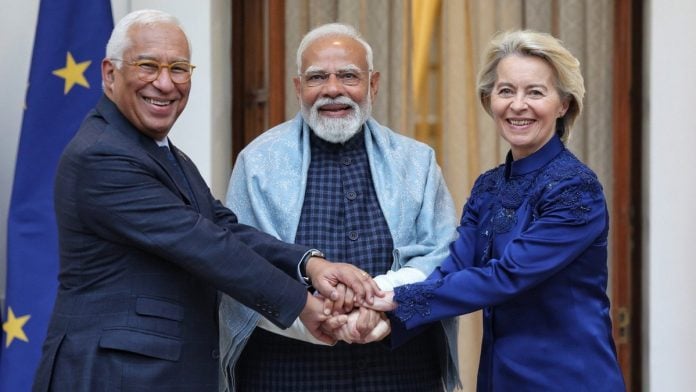
Prime Minister Narendra Modi is expected to land in Brussels in December, where India and the European Union are preparing for the formal signing of their long-negotiated Free Trade Agreement (FTA). If signed as planned, the agreement would connect two of the world’s largest economic markets, encompassing more than two billion people, and establish the foundation for one of the most consequential trade partnerships in the world.
The proposed visit, following the G20 Summit in the United States, comes after an unusually active year of diplomatic engagement, including the India-EU Summit in January, the signing of the security and defence partnership agreement, the ministerial Trade and Technology Council meeting in July, and the Strategic Partnership Review Meeting in November.
Amid the shifting sands of contemporary geopolitics, this relationship has seen it all. Two decades of ambitious declarations, prolonged negotiations and intermittent ups and downs later, it is finally acquiring the political momentum and institutional depth that its underlying complementarities have long warranted.
Yet the FTA, for all its significance, is not the culmination of this convergence. While the extraordinarily long negotiations have at times created the impression that signing the agreement is an end unto itself, the deal will mark the beginning of a more demanding and long-drawn process. Agreements do open markets, but do not automatically create resilient supply chains, technological capabilities, commercial trust or mutual understanding.
The run-up to the PM’s visit is an appropriate moment to examine four interconnected dimensions of India-EU relations. These are the timing of convergence, the instruments (economic, technological and security) through which it is taking shape, the contradictions and challenges that could constrain it, and the deeper mutual understanding required to translate formal agreements into a durable partnership.
Also Read: Not just a military theatre: Strategic significance of the Black Sea, beyond Russia & Ukraine
The geopolitical logic of convergence now
India and Europe have long recognised their complementarities. India offers a large market, skilled human capital, expanding industrial capacity and an important Indo-Pacific partnership. Europe offers deep financial markets, investment, advanced manufacturing, research networks, technological expertise and regulatory influence. Yet their strategic partnership, established in 2004, has frequently struggled to convert this promise into sustained outcomes.
What has changed is the strategic environment.
Russia’s invasion of Ukraine forced Europe to confront its dependence on American military capabilities, intelligence and deterrence. China’s economic assertiveness made supply-chain lock-ins and technological dependencies matters of national security and brought them into wider strategic debate. Trump’s second presidency added a third pressure: even close partners could no longer count on predictability from Washington.
These pressures are not identical for India and Europe. While convergence on diversifying from China is obvious, Europe faces the added problem of dependence on a slipping American backstop. India, never an American treaty ally, must manage the asymmetries of a powerful and all-encompassing strategic partnership deeply scarred by Trump. Despite these differences, both nevertheless confront the costs of excessive exposure to the US.
Together, these developments underscore the emerging geopolitical logic of de-risking from the US. It is not an attempt to replace America, but a deliberate effort to develop complementary and predictable partnerships, capabilities and strategic redundancies so that dependence on an indispensable power does not become a permanent vulnerability.
The changing strategic environment and Trumpian disruption are the most visible part of this story. But there are also dense technicalities to contend with.
The instruments: market access to strategic capacity
The FTA is the most visible instrument of this convergence. Negotiations began in 2007, stalled in 2013, resumed in 2022 and concluded in January 2026. The European Commission proposed its conclusion to the Council in September. Formal signature, European Parliament consent and completing India’s domestic procedures are still required before it comes into force.
Contrary to a common misconception, the agreement as structured does not require separate ratification by all 27 national parliaments.
The scale is considerable indeed. EU-India goods trade reached €118 billion in 2025, while services trade amounted to €67 billion. Approximately 6,000 European companies already operate in India. European investment stock in India stood at €132.8 billion in 2024, compared with €13.7 billion of Indian investment in the EU.
But the more consequential question is what happens after market access improves.
The FTA could encourage Indian firms to look beyond Europe’s familiar industrial giants toward specialised manufacturers, regional innovation clusters and smaller enterprises. European businesses, in turn, will need to understand India’s diverse industrial ecosystem, bureaucratic limitations and commercial expectations. Governments, for their part, can negotiate market access, but businesses will have to put money to get the FTA going.
Nor does the current FTA encompass other dimensions of economic integration. The Investment Protection Agreement and the agreement on Geographical Indications remain under separate negotiations. The November 2026 Strategic Partnership Review Meeting explicitly reaffirmed the intention to conclude both, but that’s not happened yet.
Climate regulation presents another challenge. The EU’s Carbon Border Adjustment Mechanism, sustainability requirements and technical standards may impose substantial adjustment costs on smaller Indian exporters. European economic security and India’s industrial ambitions do not always align neatly.
Mobility offers another example. A Comprehensive Framework on Cooperation on Mobility was signed in January, alongside the announcement of an EU pilot Legal Gateway Office in India. Neither forms part of the FTA, nor do these arrangements automatically confer employment or residence rights on Indians across member states.
Technology cooperation, by comparison, is acquiring significance. The Trade and Technology Council, whose third ministerial meeting took place in Brussels in July, is advancing cooperation on semiconductors, AI, quantum technologies, high-performance computing, advanced telecommunications and resilient supply chains. That said, much of this cooperation remains at the stage of joint work programmes and pilot initiatives. Commercial and industrial results will depend on sustained implementation.
The conclusion of negotiations on India’s association with Horizon Europe — the EU’s flagship research and innovation funding programme — announced in November, opens another avenue. Subject to completion of the necessary procedures, Indian institutions could participate more fully in collaborative research in areas such as digital technologies, industry, space, climate and energy.
This confluence is rather significant because research cooperation not only leads to co-production of knowledge capital but also helps commercialise and convert it into technological capability. Space cooperation, particularly in satellite communications, Earth observation and navigation resilience, offers a related avenue. Space-related research can be pursued through Horizon Europe, while operational space-security cooperation also falls within the separate India-EU Security and Defence Partnership.
Let’s look at security and defence. The Security and Defence Partnership signed in January 2026, followed by the first Security and Defence Dialogue in March, provides a framework for cooperation on maritime security, cyber threats, counterterrorism, space security and eventually defence-industrial matters.
Maritime security is the most developed vertical between the EU and India and offers particularly tangible opportunities. European naval operations like ATALANTA and Aspides in the western Indian Ocean and adjoining waters intersect with India’s interests in protecting shipping routes, chokepoints and critical infrastructure. Information-sharing, maritime-domain awareness, counter-piracy cooperation and partnerships with littoral states could translate diplomatic convergence into operational cooperation.
Across these sectors, the objective should be strategic capacity rather than a proliferation of disaggregated outputs. Cooperation must lead to coherent outcomes serving both sides’ interests. The EU appointed its first military attaché to New Delhi in 2023. India took three years to reciprocate. The decision to appoint a defence attaché to the EU was announced by September 2026, but the appointment has yet to materialise. Once the attaché is in place, it would be a welcome step toward faster day-to-day coordination.
Contradictions and challenges
There is a temptation to frame the Russia question as the principal obstacle to achieving the true potential of India-EU relations. This obstacle is often exaggerated by both sides and deserves closer scrutiny. India’s longstanding defence relationship with Moscow remains an undeniable strategic reality. But diversification toward Western and other suppliers is equally real and ongoing.
Treating the India-Russia relationship as an insurmountable obstacle risks overlooking both the trajectory of India’s defence modernisation and the considerable cooperation already underway with Europe. Some differences require de-hyphenation, others compartmentalisation, and still others sustained and candid communication. The objective is not to eliminate disagreement, but to prevent it from becoming an obstacle to cooperation elsewhere.
Consider the opportunities. Europe is undertaking one of its largest military-industrial transformations in its modern history. Apart from hundreds of billions of euros being spent on defence capabilities by European countries separately, the EU’s Security Action for Europe (SAFE) instrument alone provides up to €150 billion in loans to member states for common defence procurement.
For India, which seeks to expand defence exports and manufacturing partnerships, this transformation presents a considerable opportunity. Yet SAFE’s procurement rules impose specific eligibility and component-origin conditions, among other complications. The India-EU Security and Defence Partnership creates avenues for engagement, but does not automatically provide access to European common defence procurement instruments.
Negotiations on a Security of Information Agreement, launched in January, could facilitate deeper exchanges of sensitive military information. However, once again, such an agreement would not itself guarantee access to SAFE financing or procurement opportunities.
India can continue strengthening bilateral defence relationships with France, Germany, Italy and other European partners. Indeed, these relationships remain indispensable and will drive the overall India-Europe momentum. But bilateral defence synergies cannot fully substitute for positioning Indian defence industries within the EU’s emerging common procurement and defence-industrial frameworks. Sensing this unprecedented moment, countries such as South Korea are actively seeking opportunities in Europe’s expanding defence market via instruments such as SAFE.
Revisit the ‘Othering’
Perhaps the most underestimated challenge lies beyond formal policy.
India and Europe have often understood each other through longstanding and sweeping generalisations. Europe is frequently imagined in India as a relatively homogeneous political and economic actor, obscuring myriad differences among member states, regional economies and strategic cultures. European perceptions of India can similarly remain confined to familiar assumptions about democracy, bureaucracy, market complexity or geopolitical haze.
An FTA will of course create reasons for businesses, investors, researchers and institutions to interact more frequently. But these interactions require understanding how the other side actually thinks, functions and articulates its views.
How do European institutions make decisions? How do Indian businesses navigate regulatory differences between national and state-level authorities? What opportunities exist beyond Europe’s major industrial economies? How well do smaller European enterprises understand Indian markets, and how familiar are Indian firms with Europe’s specialised manufacturing ecosystems? How comfortable will the Indian side be with European media discussing India’s democratic credentials? What will be the impact of rising anti-immigration sentiment in Europe on Indians seeking better mobility? How far is India willing to accommodate the European penchant for regulation, and will Europe break out of its shackles of over-regulation?
These questions may seem less dramatic than geopolitical disagreements, but they actually shape whether the concluded agreement generates durable relationships.
Universities, think tanks, industry associations, media interactions, regional governments, research institutions and professional networks therefore have a more important role than what usually meets the eye.
Also Read: The war at the bottom of the sea is here. UK uncrewed vessel Excalibur shows its future
From strategic complementarity to strategic consequence
Ultimately, neither India nor Europe operates in a zero-sum world. Both are driven by interests, historical experiences, threat perceptions and strategic calculations. Recognising this is not a diplomatic favour to either side, but the foundation of a realistic partnership for the longer haul.
In an increasingly unpredictable international order, India and Europe have discovered renewed reasons to engage. Strategic complementarity has always existed. Whether both sides can finally turn it into lasting strategic consequence lies on the other side of the FTA signing ceremony.
Swasti Rao is a Consulting Editor (International and Strategic Affairs) at ThePrint. She tweets @swasrao. Views are personal.
(Edited by Asavari Singh)