




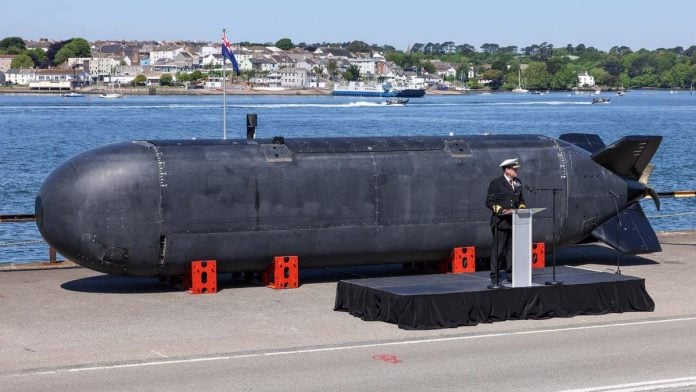

As British Prime Minister Andy Burnham met US President Donald Trump face-to-face for the first time in New York this week, London announced another piece of an increasingly technological transatlantic defence relationship: a new UK-US collaboration on AI and autonomy. Almost simultaneously came news of a rather more tangible experiment in autonomy. A British uncrewed underwater vessel had successfully launched an American heavyweight torpedo.
The timing was apt. The test sits squarely within AUKUS, the Australia-UK-US security partnership whose Pillar II has focused more and more on advanced capabilities—AI, autonomy, quantum technologies and, crucially, uncrewed underwater systems. Its first “signature project”, announced in May, is devoted to interchangeable payloads and enabling technologies for Australian, British and American UUVs.
Uncrewed drones and their ability to deliver potent payloads have been the flavour of military affairs lately. Two experiments conducted at opposite edges of the battlespace, nine months apart, are redefining warfare.
On 29 November 2025, off Sinop on Turkey’s Black Sea coast, Baykar’s Kızılelma uncrewed combat drone detected a jet-powered target with an onboard MURAD AESA radar and destroyed it with a Gökdoğan beyond-visual-range air-to-air missile. The aircraft was also operating an indigenous secure datalink and identification-friend-or-foe system. It was an important demonstration of how far an uncrewed combat aircraft could move into a mission so far monopolised by crewed fighters.
Then, on 13 September this year, the experiment went underwater.
At the British Underwater Test and Evaluation Centre in Scotland, the Royal Navy’s experimental XV Excalibur—an extra-large uncrewed underwater vehicle (XLUUV)—launched an American Mk 48 heavyweight torpedo. Conducted under Project Broadsword and Trial Iron, it was the first such US-UK launch from an uncrewed underwater vessel. The Mk 48 was carried externally beneath Excalibur rather than fired from a conventional internal torpedo tube on a submarine.
Kızılelma and Excalibur are not technological equivalents. The physics of warfare in the air and beneath the ocean remain radically different. But conceptually, they belong to the same transformation.
For decades, drones were predominantly the eyes and ears of militaries: they watched, mapped, detected and acquired targets. Armed UAVs subsequently moved into strike missions. In the Russia-Ukraine War, new frontiers of drone tech have become common. Now uncrewed systems are migrating towards some of the most demanding combat functions traditionally reserved for expensive crewed platforms, such as fighter jets or submarines.
The pilot or submariner has not disappeared, but the weapon no longer necessarily requires the human to be sitting inside the platform carrying it.
Also Read: Logistics is the new frontier of weaponised interdependence. China has the upper hand
Deep seas vs blue skies
Calling Excalibur simply an underwater drone obscures why this technological frontier is particularly difficult.
An aerial uncrewed vehicle operates in an environment comparatively rich in electromagnetic connectivity. It can use satellite navigation and radio-frequency datalinks and, depending on the platform and circumstances, maintain relatively rapid communication with its operators.
Seawater, however, changes the equation. Let’s see what complications arise.
Radio-frequency electromagnetic waves propagate poorly through seawater. Acoustic communication, therefore, remains central underwater, but it comes with limited bandwidth, comparatively high latency and issues with multipath propagation, Doppler effects and environmental interference. Not just that, but temperature, salinity, depth, ambient noise and seabed geography all affect the acoustic environment.
GPS creates another problem. Unlike in the air, satellite navigation signals do not provide normal continuous positioning to a submerged vehicle. Excalibur itself has tested a quantum optical atomic clock designed to improve navigational accuracy where GPS is unavailable.
Testbed uncrewed submarine XV Excalibur went to sea with @InfleqtionUK's quantum optical atomic clock on board – the first time such a device has been operated at sea in an underwater vessel.
➡️https://t.co/GFhq9qOQKd pic.twitter.com/mCRXOOb4II
— Royal Navy (@RoyalNavy) October 28, 2025
Cutting a long and technical story short, an autonomous underwater vehicle must therefore solve several problems simultaneously—determine its own location without continually surfacing; interpret what its sensors are detecting; navigate around obstacles; conserve enough energy for long missions; communicate without compromising stealth; and continue functioning during periods in which contact with human operators may be intermittent or disrupted.
This is why underwater autonomy is not simply aerial drone technology put inside a waterproof cylinder.
Excalibur itself emerged from Britain’s Project Cetus. Developed by MSubs with the UK Submarine Delivery Agency in under three years, the roughly 12-metre, 19-tonne vessel is the largest uncrewed underwater vehicle trialled by the Royal Navy so far. It is an experimental platform rather than an operational replacement for Britain’s nuclear submarines, designed to test autonomy, payloads and future underwater missions.
The Excalibur experiment has not only gone beyond propulsion and carried a heavyweight torpedo, it can be operated remotely as well. A remote operations centre in Australia previously controlled the uncrewed underwater vehicle in British waters. This demonstrates another emerging feature of networked warfare: the operator, platform and weapon no longer necessarily need to stay in the same geography.
Unmanned, Uncrewed, Autonomous
Before I go further, it is important to note that unmanned, uncrewed, and autonomous are not the same thing and the vocabulary surrounding these systems has been deceptively loose.
“Unmanned” remains the older and widely used military term for a vehicle operating without personnel aboard. “Uncrewed” is now preferred because it describes more precisely what has physically changed: there is no crew inside the platform. It does not tell us who—or what—is controlling it.
Neither term should therefore be treated as synonymous with autonomous.
An uncrewed system may remain remotely operated by a human. An autonomous system can perform functions such as navigation, route planning, obstacle avoidance, sensor processing or elements of mission execution without continuous human instruction—in short, on its own.
And neither automatically means autonomous lethal decision-making.
This distinction becomes much more consequential once the uncrewed vehicle carries weapons.
The Excalibur experiment did not, according to publicly available evidence, demonstrate a machine independently hunting a submarine, identifying it as hostile, deciding to attack it and firing a torpedo without human authorisation.
What it showed was something narrower, but nevertheless consequential—the mechanical, electrical and software integration necessary for an American heavyweight weapon to be carried and released by a British autonomous underwater platform. The US Navy itself describes the experiment as an early step towards adding lethality to autonomous undersea systems.
The underwater-autonomy paradox
Australian defence expert Malcolm Davis identified the larger dilemma after the Excalibur test.
He described the experiment as potentially the first step towards swarms of armed UUVs operating alongside crewed submarines, adding mass to the undersea battlespace. But he immediately identified the problem too: radio waves do not travel well underwater. How, then, do militaries keep humans “on the loop” while armed UUVs operate autonomously, and ensure humans continue making decisions about lethal force?
This is hugely important – it marks a first step towards swarms of armed UUVs working with crewed submarines to add mass to the undersea battlespace.
But the challenge is command and control in that domain. Radio waves don't travel well underwater. So how do we keep humans 'on… https://t.co/65UP44I1S0
— Dr. Malcolm Davis 🇺🇦🇺🇦🇺🇦 (@Dr_M_Davis) September 23, 2026
That question captures the paradox at the heart of underwater autonomy.
The environment in which machines may require greater autonomy is simultaneously one of the hardest environments in which humans can continuously supervise them.
What matters here is the distinction between whether the human is in, on or out of the loop. Let me explain why.
A human in the loop retains a direct decision point before lethal action. A human on the loop supervises an autonomous system that can perform substantial functions itself while retaining some capacity to intervene, constrain or retask it. Moving the human out of the loop raises a considerably different ponderable: whether a machine should be allowed to select and engage targets without meaningful human intervention at the point of lethal action.
Davis’s point is deeper and political — he does not envisage liberal democracies willingly crossing that last threshold.
Yet underwater physics makes the middle ground unusually complicated. The less reliably humans can communicate with an armed platform, the more autonomy that platform may require simply to remain militarily useful.
To illustrate the difference, Kızılelma can operate in the air within an electromagnetic environment where radar, identification systems, datalinks and human command can interact relatively rapidly.
Excalibur disappears beneath that electromagnetic horizon.
The two developments therefore point in the same direction while facing very different command problems.
Modularity and mass
There is another reason the Excalibur experiment deserves attention.
Project Broadsword was approved by the US Department of the Navy Rapid Capabilities Office in February 2026. The Mk 48 could be launched less than seven months later.
The achievement was not simply fitting a torpedo underneath a large robotic submarine. American and British engineers had to make an American kinetic payload work with a British autonomous vehicle through compatible mechanical, electrical and software interfaces.
That points towards another transformation in military technology: modularity.
For much of the modern defence-industrial era, a submarine, its sensors, combat-management system and weapons were developed as components of an exquisite integrated platform. Altering one component could require years of redesign, testing and certification—a painfully convoluted process.
AUKUS Pillar II is experimenting with something different: common interfaces, modular payloads and software-defined architectures that allow technology developed by one ally to operate aboard another’s platform.
Its first signature Pillar II project explicitly seeks payloads and enabling technologies that can eventually operate across Australian, British and American UUVs. The contemplated missions include ISR, anti-submarine and anti-surface warfare, mine warfare, electronic warfare, logistics, strike and protection of critical seabed infrastructure.
This takes us beyond interoperability, which allows allied partners to fight together, to interchangeability. This potentially allows one ally’s weapon, another’s platform and another’s sensors or software to become components of the same combat manoeuvre or architecture.
That brings the two experiments back together.
A fighter traditionally packaged the pilot, radar, communications, propulsion and weapons inside one aircraft. A submarine similarly brought sailors, sonar, command systems, propulsion and torpedoes inside one hull.
Networked warfare allows these functions to be distributed—a sensor detects, another platform may classify, the network transmits what it can, algorithms process information, a human elsewhere supervises or authorises and, finally, an uncrewed platform carries the weapon.
The technological revolution, therefore, is not simply about “drones getting ubiquitous”. It is the gradual separation of sensor, shooter and human across a network.
And the implications could be even more profound underwater because uncrewed systems offer something navies desperately need: mass.
A highly capable nuclear-powered attack submarine is enormously expensive, scarce and crew-intensive. An XLUUV cannot simply reproduce everything an SSN does, nor is that necessarily the point. Large numbers of autonomous systems could instead complement scarce crewed submarines—extending surveillance, carrying sensors, deploying payloads, acting as decoys or eventually carrying weapons.
Australia’s Ghost Shark programme is explicitly moving towards this model of crewed-uncrewed teaming. Australia has also created a Maritime Autonomous Systems Unit to integrate Ghost Shark, Speartooth and other autonomous systems into naval operations.
The Australian Chief of Defence Force recently alluded to the logic neatly: a Virginia-class submarine can move quickly to somewhere that matters; large numbers of Ghost Sharks might eventually be everywhere else that matters.
That is a very different math of naval power, and one that could see the evolution of UUV swarms and saturation tactics currently unknown.
Undersea at war
The war is already at the bottom of the sea because there is increasingly something worth fighting over down there.
The seabed carries the physical and critical infrastructure of an economy. Submarine telecommunications cables transmit the overwhelming majority of intercontinental digital communications. Energy pipelines, electricity interconnectors and sophisticated military sensors also traverse or occupy the seabed.
A recent IISS study by Darshana Baruah and Virpratap Vikram Singh maps these emerging “new geographies” of submarine cables across the Indo-Pacific. The strategic irony is indeed striking: cloud computing, AI and supposedly weightless digital economies remain dependent upon remarkably tangible pieces of infrastructure lying on the ocean floor.
That vulnerability is already attracting military attention across the globe.
Russia has developed specialised capabilities for seabed reconnaissance and operations against underwater infrastructure. China has invested extensively in deep-sea technology and large uncrewed underwater vehicles. The United States is developing Boeing’s Orca XLUUV; Australia has Ghost Shark; Britain has Excalibur.
But technological triumphalism would be premature.
America’s Orca programme illustrates how difficult this technology still is. Development began years ago and subsequently encountered significant delays involving design, manufacturing and pressure-vessel construction. The first prototype was delivered only in September 2025, with the remaining vehicles expected later.
Also Read: Shoot and scoot—what Pakistan’s SH-15 guns mean for India’s artillery
What about India?
The Indian Navy already has an XLUUV programme under the Make-I framework. Official project documentation envisages four prototypes followed by up to 40 production vehicles and identifies missions including underwater-domain awareness, surveillance and ordnance delivery. Approval for indigenous design and development was given in October 2022.
The Navy’s own assessment is unusually candid about the challenge. It identifies propulsion, power, autonomous control, sensors, miniaturisation and weapons integration among the critical technological hurdles and acknowledges that Indian industry is attempting development of an XLUUV of this kind for the first time. Command, control and communications are themselves identified as a critical technology requiring indigenous development.
DRDO’s underwater-technology roadmap shows that India understands where the frontier is heading.
The Indian Ocean carries the cable routes of a rapidly digitising economy. Chinese naval activity makes underwater-domain awareness increasingly consequential. The Arabian Sea and the Bay of Bengal, within the wider Indian Ocean, create an enormous surveillance problem that cannot indefinitely be solved simply by adding more expensive crewed ships and submarines.
India therefore is developing several pieces of the puzzle. The more uncomfortable question is how quickly it can integrate them.
Kızılelma gave us one glimpse of that future in the skies and Excalibur has now taken the question beneath surging seas.
The war at the bottom of the sea is already here. What is changing remarkably quickly is who—or what—will fight it.
Swasti Rao is a Consulting Editor (International and Strategic Affairs) at ThePrint. She tweets @swasrao. Views are personal.
(Edited by Asavari Singh)