




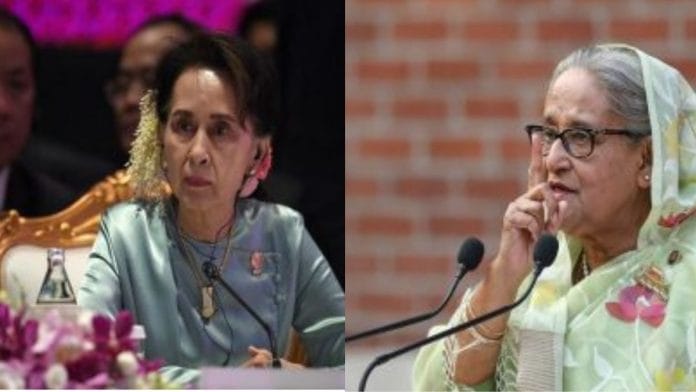

The past week has been interesting for India’s neighbourhood. Within a span of just a few days, two of South Asia’s most consequential political figures Aung San Suu Kyi in Myanmar and Sheikh Hasina in Bangladesh re-emerged into public view after prolonged periods of political absence. In an unprecedented move on 3 August 2026, Myanmar’s new government released photographs of Suu Kyi. A Nobel laureate, the face of Myanmar’s democratic transition whose government was dramatically dissolved in a military coup on 1 February, 2021 and perhaps one of the most recognisable political figures in Asia.
Two days later, Sheikh Hasina addressed international media in a virtual press conference in New Delhi. The longest serving Prime Minister of Bangladesh presided over nearly sixteen years of rapid economic growth transforming Bangladesh into one of South Asia’s fastest growing economies with infrastructure development and an increasingly assertive foreign policy. Her dramatic ouster which was widely criticised to be a “regime change” in 2024 marked the most significant political upheaval in Bangladesh since the restoration of parliamentary democracy.
Neither woman was heard from since their turn of fortunes. Yet, as soon as they appeared, they once again dominated political discourse in their respective countries and beyond. What appeared at first glance to be coincidental, in fact revealed far deeper structural realities. Their reappearance was not merely about two leaders; it was a reminder of how politics actually functions in South Asia’s neighbourhood. Despite coups, revolutions, elections and regime changes, politics in many states of the region continues to revolve around personalities rather than institutions.
The simultaneous re-emergence of Suu Kyi and Hasina exposes an uncomfortable truth that Myanmar and Bangladesh may have changed governments but neither has fully moved beyond the leaders who defined their modern political history. Loved and hated in equal measure, what is clear is that both women still command public attention.
Myanmar’s calculated reappearance
For the government of Myanmar, the decision to release photographs of Aung San Suu Kyi was a highly calculated move. Since the coup, there has been virtually no news of Suu Kyi. She seemed to have disappeared after her detention and information about her health was speculated in hushed tones. Her political party National League for Democracy (NLD) did not contest the elections held this year and now stands de-registered. Many believed that the Suu Kyi era had ended. Yet this week it was the military itself that authorised the release of her image.
That single decision is the revealing of Naypyidaw’s evolving political priorities and ambitions. After the coup many critics of the then junta chief and now President Min Aug Hlaing argued that he would be able to move beyond military rule and conduct credible elections that would gain any level of international political legitimacy. However, five years on the carefully timed release of Suu Kyi’s photographs looking well and healthy suggests that the government has a roadmap. It is increasingly seeking to project an image of confidence, stability and normalcy as it attempts to strengthen its domestic legitimacy and rebuild regional acceptance. Lest we forget that the release of the photographs came right before his state visit to Thailand where he received a red-carpet welcome. President Min Aung Hlaing has already visited India and China.
If the first phase for the President’s post coup strategy was conducting elections and consolidating control over state institutions, the second and more challenging step is to seek external legitimacy. Carefully managed humanitarian access to the country’s most famous political prisoner helps cultivate an image of confidence without making substantive political concessions. Though one could argue that its irony at play as the move ultimately underscores her political legacy. If Suu Kyi had become irrelevant, there would have been little reason to publicise her image.
Hasina’s shadow over Bangladesh
A similar paradox exists in Bangladesh. Hasina’s press conference immediately became the dominant political story across the world except in Bangladesh where it was blacked out. Even though she has lived in exile since 2024 and faces a death sentence meted out by Bangladesh’s International Crimes Tribunal which convicted her in absentia for crimes against humanity, her supporters viewed her press conference as a confirmation that political battles are far from over. She has dismissed the verdict as legally void and announced plans to return to Bangladesh in December 2026. Opponents of Hasina found themselves once again debating her potential next move rather than discussing a post-Hasina political order. But what seems clear is that whether she is celebrated or criticised, Hasina remains inseparable from contemporary Bangladeshi politics and unlike the NLD, Hasina’s Awami League has not been dissolved.
Implications for India
For India the significance of this extraordinary week’s events goes well beyond the personal fortunes of the two political neighbours. Myanmar and Bangladesh as not distant geopolitical theatres but India’s immediate neighbours sharing long porous borders, people to people linkages and critical security interests. Therefore, any political instability in either country has direct consequences for India from refugee flows and cross border insurgency to narcotics trafficking, connectivity projects and the strategic balance in the Bay of Bengal. The re-emergence of Aung San Suu Kyi and Sheikh Hasina is a story of incomplete political transitions. While governments have changed, the very personalities that drove the transitions continue to grip and polarise political discourse. For India, recognising that reality while preparing for the future rather than the personalities of the past, will be key to navigating an increasingly complex neighbourhood.
India’s approach has traditionally been one of strategic pragmatism having maintained relations with Myanmar through military rule, democratic transition and the present administration. It has similarly worked with successive governments in Bangladesh. That continuity will remain essential if India wants to secure its borders.
However, the question that has arisen from these coincidental events are not whether both these leaders will come back to power but whether Myanmar and Bangladesh can build structures that support political orders without depending on symbolic political absence or presence of a single individual. Because until they do, every photograph of Aung San Suu Kyi and every address by Sheikh Hasina will continue to dominate political imagination and possibly lead to further turmoil in India’s immediate neighbourhood.