




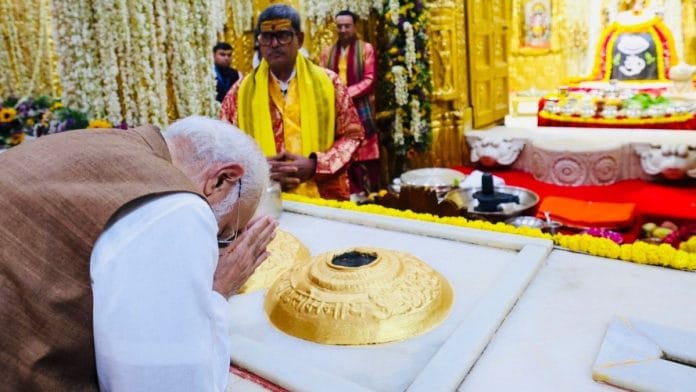

Prime Minister Narendra Modi visited Gujarat on Monday to pay obeisance at the Somnath Temple. He participated in the Somnath Amrut Mahotsav, a festival commemorating 75 years since the inauguration of the restored Somnath Temple by India’s first President, Dr Rajendra Prasad, in 1951. This was a landmark moment in the cultural renaissance of independent India, and the Mahotsav celebrates its enduring importance.
Much has been planned around the Somnath Amrut Mahotsav, with the Prime Minister taking part in a series of sacred religious and cultural ceremonies, including the Vishesh Maha Puja, Kumbhabhishek, and Dhvajarohan rituals, signifying sanctification, devotion, and the ceremonial hoisting of the temple flag.
The PM also released a special stamp and coin honouring the timeless legacy, spiritual significance, and national heritage embodied by the Somnath Temple.
Also Read: What Vishnu’s Kurma avatar teaches modern India about labour
Why is Somnath important?
The Somnath Temple is regarded as one of the most ancient and revered temples in India, with references to it in sacred Hindu texts, Puranic literature, and historic accounts dating back many centuries. The original shrine is associated with Soma, the Moon God, and is believed to have been constructed in gold. Named after Soma, it is one of the oldest continuously venerated temples in Hindu civilisation.
Somnath holds immense religious significance as the first among the 12 Jyotirlingas of Lord Shiva. Each lingam is believed to have appeared on its own, carrying the divine cosmic light of Shiva in the form of a lingam, and representing Him as a pillar of light. Millions of Hindus visit Somnath as an act of spiritual aspiration and deep devotion. The temple is dedicated to Lord Shiva, and the lingam embodies his eternal presence as the destroyer of evil and the protector of cosmic order.
Somnath as a symbol of resilience
Somnath temple history is a narrative of faith, destruction, reconstruction, resilience, and sanctity. Mahmud of Ghazni raided Somnath in the 11th century, and it was later demolished by Aurangzeb—attacks that were indicative of both religious and economic spite, as well as the vulnerability of peaceful people.
Rani Ahilyabai Holkar later had the shrine rebuilt with a consecrated idol in 1783, while in 1800 Maharaja Ranjit Singh is said, by some accounts, to have brought back the original gates of Somnath and placed them at the Golden Temple in Amritsar. Finally, the post-Independence reconstruction project involved stalwarts such as Sardar Vallabhbhai Patel, KM Munshi, and Dr Rajendra Prasad.
Rebuilt time after time, Somnath is representative of the resilience of a deeply spiritual civilisation that has faith and confidence in its own greatness and in the achievements of its ancestors. Through generations of India’s civilisational memory, the Somnath Temple has been a pillar of the culture and history of our country. Throughout the ages, the temple endured repeated invasions and destruction for its gold, for its value, and as a centre of learning. And yet, devotees continued to rebuild the temple through the ages until it became a symbol of continuity and cultural self-belief.
After Independence, Sardar Vallabhbhai Patel took the lead in the reconstruction process, and Somnath became an emblem of the resurgence and cultural revival of the newly independent Indian people who began reclaiming their heritage. As we mark the 75th year of the Somnath reconstruction, it remains an enduring icon of India’s spiritual ethos, historical memory, and civilisational identity.
Somnath as an enduring centre of learning
Prabhasam ch parikramya prithvi-krama-sambhavam — our ancient scriptures were quoted by Modiji to mean that a single pradakshina (circumambulation) of the divine inner sanctum or Prabhasa Kshetra carries as much spiritual merit as circumambulating the entire earth itself.
Traditionally known as Prabhas Patan, the Somnath Temple has always been a centre of profound learning, spirituality, intellectual discourse, and a predecessor of ‘think-tanks’ as we know them. It was also a meeting point of Pashupata philosophy and cultural preservation. The shrine has, through the centuries, sustained intellectual traditions that endured despite repeated historical disruptions.
Ancient scholars such as Lakulisha and Soma Sarman transformed the place into a great centre of philosophy. Historical figures like Bhava Brihaspati and the Pashupata acharyas played vital roles in ensuring that the temple remained a hub for worship and intellectual study. Rulers such as Vishaladeva Vaghela and Tripurantakar worked to protect the spiritual and intellectual traditions of the site. Ahilyabai Holkar and the Gaekwads of Baroda protected the devotees’ right to worship. Veer Hamirji Gohil and Veer Vegdaji Bhil also courageously defended the temple and have become a part of Somnath’s living memory.
How rich is my God?
The Somnath Temple is one of the richest temples in India. I have written earlier about how money collected at temples can be used for the economic and educational upliftment of Hindus.
The Somnath Trust recorded an annual income of Rs 31.06 crore in 2014-15, with expenditure during the same period in the range of Rs 18 crore. It also had an annual budget of Rs 132 crore, covering the shrine and its broader ecosystem of operations, maintenance, development, and social initiatives.
Tourist trails
In the decade that has passed, Somnath has become one of India’s most prominent spiritual tourism destinations. Government and tourism data indicate that Gujarat’s pilgrimage circuit has seen sustained double-digit growth. Improved highways, rail connectivity, airports, digital promotion, and large-scale infrastructure development have led to this stupendous growth.
Annual footfall today at Somnath is estimated at nearly 92-97 lakh devotees. Last year, on Maha Shivratri alone, 3.5 lakh devotees descended on Somnath. This will obviously reflect on the balance sheet of the Somnath Trust. You do the math.
The transformation has been accelerated by projects such as the Jetpur-Somnath four-lane highway, the Sabarmati-Veraval Vande Bharat Express, the reopening of Keshod airport, and more flights to Rajkot International Airport.
Cultural tourism has also expanded significantly. The temple has a sound-and-light show, which has recently been upgraded to include 3D laser technology and narration. This alone, in the last three years, has attracted more than 10 lakh visitors. Festivals such as the Vande Somnath Kala Mahotsav have also revived ancient devotional and artistic traditions associated with the sacred site.
Also Read: Story of Somnath defined not by destruction but by unbreakable courage—Modi on Somnath temple
A confluence of history, politics, and faith
The disagreement between Jawaharlal Nehru and President Rajendra Prasad over the 1951 inauguration encapsulates an intellectual argument between the proud but wounded children of Mother India and westernised elites who have lost pride in the absence of knowledge about their own history and empathy towards the victims of civilisational wrongs. Thus, they end up becoming self-loathing and self-deprecating Indians.
The Constitution denotes secularism as “Sarv Dharma Sambhav”, which directs everyone toward a duty to be responsible and accommodate all by recognising the brutal history of Bharat. Historical and civilisational wounds can be healed by dressing them with the putty of acknowledgement. Participation by all in religious ceremonies is a step in the right direction and needs to be perceived through the lens of neutrality.
History, politics, and faith constantly intermingle, and thus parallels between Somnath Temple and Ram Mandir are drawn. They depict the tale of two places of reverence for Hindus, memories of a wounded but proud civilisation, and the modern state, with a government whose tagline is “Vikas bhi, Virasat bhi”.
Meenakshi Lekhi is a BJP leader, lawyer and social activist. Her X handle is @M_Lekhi. Views are personal.
(Edited by Asavari Singh)
“….westernised elites who have lost pride in the absence of knowledge about their own history and empathy towards the victims of civilisational wrongs. Thus, they end up becoming self-loathing and self-deprecating Indians.”
This is an inaccurate reading of history. Nehru and others that Lekhi ma’am puts in such a bracket were nationalists of the highest order who put the nations first. From what I have read of Nehru’s writing and his subsequent work which laid the foundation of modern India, through institutions and building, these were people who recognized India’s potential. Describing them as self-loathing and self-deprecating is not just wrong but does a deep disservice to their contribution. They were people who wanted Indians to rise above narrow religious dogmas and embrace that they belonged to the nation. You may not agree with them but you cannot denigrate them based on ideology.