









People, especially the upper middle class, in Kolkata often ask me why Mamata Banerjee receives so much, largely uncritical, support from Indian liberals. Don’t we realise, they ask, that Mamata’s Trinamool Congress has not provided great governance in Bengal? Do we not know that Trinamool cadres, especially in the districts, include hoodlums? That her support for minorities veers dangerously close to pandering or appeasement?
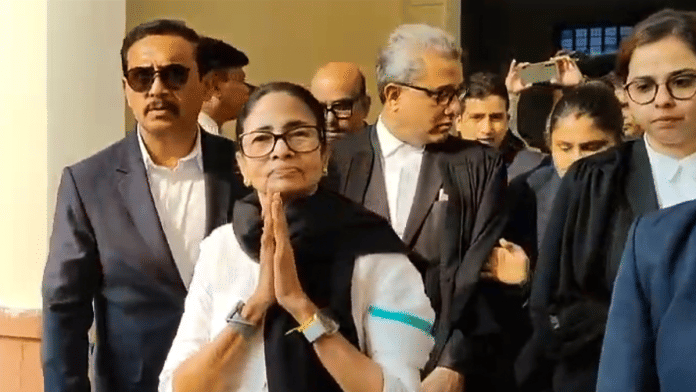
I thought of these questions on Wednesday when Mamata became the first Chief Minister to address the Supreme Court and argue her own case with fervent passion. I don’t know what will become of the case or what their lordships will make of Mamata’s arguments. But of one thing there is no doubt: her court appearance not only reaffirmed Mamata’s reputation as a fighter but it also helped explain why she has so much support among liberals.
I used to know Mamata when I lived in Kolkata in the 1980s and 1990s, and I admired her courage. We forget now that the CPM, which ruled West Bengal in those days, ran a reign of terror. Publications that were critical of the state government — such as the ABP group where I once worked — were subject to intimidation and faced violence. In the case of ABP, this took the form of a CPM–supported strike during which the police looked the other way as ABP employees were assaulted. In general, the police force was openly partisan and functioned as an arm of the ruling party.
The terror covered up the CPM’s role in driving industry out of Bengal and destroying the economy in the decades that it ruled the state. This began as a war on capitalism but ultimately became a farce because so many party functionaries accepted bribes from businessmen. Journalists used to joke that CPM did not stand for Communist Party of India (Marxist) but for Communist Party of India (Marwari) because of the traders, property dealers, and business people it used to take money from. (I am sorry if this sounds parochial but in that era, rich people in Bengal tended to be Marwaris.)
The Congress, the principal Opposition in the state, was lazy and flabby. It did not help that its leadership at the Centre bought into the phoney legend of Jyoti Basu and treated the Bengal Chief Minister as a great statesman.
Mamata was about the only Congress leader who had the guts to take on Jyoti Basu and the CPM. She paid for her defiance. She was beaten up on the streets by CPM workers and lathi-wielding policemen on several occasions, and spent months recovering from her injuries. I remember her talking to newspapers, while she was in pain, her body covered in bandages.
She swore then to finish off the CPM. And she kept her word.
A ‘street fighter’
Even then, well-educated Bengali liberals were slow to warm up to her. Some of the objections were classist. She wore rubber chappals. She lived simply in humble accommodation. She made mistakes when she spoke English. She was, they used to say, not a leader in the league of Jyoti Basu who went to university in London and became a barrister. The term ‘street fighter’ can be a compliment but when the bhadralok used it for Mamata, it was a sneer. They much preferred the style of Jyoti Basu who could elegantly sip a fine Scotch while his bloodthirsty cadres went on violent rampages.
While upper middle class opinions of Mamata have had to be revised in the light of her spectacular political success, many of the bhadralok continue to be surprised by the extent to which, outside of Bengal, Mamata is regarded as a heroine by liberals.
In fact, the reasons are not that difficult to find. Most of India’s liberals have quietly admitted defeat in the battles they once waged. Secularism used to be the battlefield that liberals would die on. That battle has been lost and the field abandoned. The liberal position now is that yes, India is a Hindu country but that doesn’t mean we should mistreat Muslims. It is a far more limited position than the one they would have defended a decade ago.
It’s the same with their attitude toward Narendra Modi. They once treated his ascent as an aberration and believed that he would only last a single term. Now they treat him as a force of nature which cannot be stopped or restrained. Even those rare moments when it seems that things may be changing do not last. In the aftermath of the last general elections, liberals claimed that the BJP’s decline had begun; now that opinion has been revised.
The sense of defeat has translated into a gradual acceptance of the reality that this government can do what it likes. It is hard to find a single liberal who has total faith in the Election Commission or has any respect at all for the Chief Election Commissioner. And yet most liberals now believe that there is no way of restraining the Election Commission.
It’s the same with many other institutions: no liberal believes that the presiding officers of either house of Parliament can act independently without the government’s permission. Perhaps the liberals are wrong; but what matters is that they believe that the subversion of the system cannot be stopped.
Worse still, they have stopped expecting very much of the national opposition. Even when it means well, it is largely ineffectual. All government-versus-Opposition battles now resemble a mouse roaring helplessly at a raging elephant.
Also read: 10 examples of the BJP’s ‘Bengal Virodhi’ mindset—mispronunciations to unpaid dues
It’s Mamata’s Bengal
The reason Mamata Banerjee has their respect is because she is the one politician who challenges this defeatist consensus. No matter how powerful the Centre may seem, nothing deters her. Others may have given up fighting the Election Commission, but she will go to the Supreme Court and challenge its functioning.
Secularism may be a tired, washed out concept in much of India, but in Mamata’s Bengal, it still reigns in all its majesty. For her, it’s a battle that has not been lost and one that she will continue to fight.
It’s now much over a decade since I last met Mamata, and I am aware of the (many legitimate) criticisms of her government and her own mercurial style of governance.
But even from a distance, it seems to me that she has not changed in the most fundamental sense; she still fights the impossible battles. She is still not intimidated by the magnitude of the challenges. No matter how much her critics may sneer, she will always go the extra mile.
Moreover, unlike many of those who oppose the government, Mamata actually understands politics. The BJP has thrown everything it has at her but she continues to triumph election after election often confounding the political commentators and exit pollsters who continually forecast her defeat.
And as difficult as this current battle may seem, it’s not as difficult as the battle she faced when she took on the CPM and the might of Jyoti Basu at a time when they were all-powerful and her own party refused to back her.
So yes, Mamata Banerjee is far from perfect. But, in an era of defeatism and negativity, she is that rare person who will fight for the values she believes in.
Vir Sanghvi is a print and television journalist and talk show host. He tweets @virsanghvi. Views are personal.
(Edited by Aamaan Alam Khan)
Don’t call it secularism. It’s pseudo-secularism.
And no ine in rhe right mind will consider Mamta Banerjee, who asked girls to not go out after dark, as a liberal.
Interesting.
So the only criteria for “respect” for any leader is to be able to defeat modi. The rampant corruption, the steep decline in Bengal’s potential, the dead secularism for which mamata’s appeasement is also responsible, the political violence TMC goondas unleash, all of this is fine. Just defeat BJP.
In your hate for the BJP, the “liberal” class seems to blind to what is being done to Bengal.
Mamata is the most intolerant leader in the current group of CMs.
But hey she defeated modi, right? So chill out.
Absolutely abhorring and disgusting. Glad this “liberal” class is relegated to where it belongs. Oblivion.
Indian liberals ‘respect’ Mamata because they hate Modi. What is the diffrence between CPM’s Bengal vs Mamata’s Bengal ? She with her grit and fighting spirit just co-opeted the CPM people and changed their ‘label’. Inside there’s no change, hence Bengal is still rotting
Wondeful article.Kudos…