






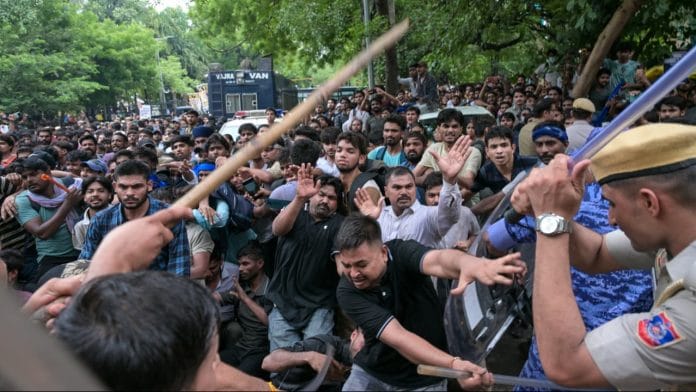


It’s easier to say what the current students’ protests are not than what they are. Judging by the events of the last week, they are not a straightforward rerun of the so-called India Against Corruption movement. They are not as well organised. There are no RSS-manufactured crowds. Nobody at Jantar Mantar would welcome Sadhvi Ritambhara in the way Anna Hazare and his puppet-masters did in 2011. There is no individual trying to use the movement as a personal promotional advertisement in the way Arvind Kejriwal did with the IAC.
Nor are the parallels with student movements in Nepal and Bangladesh valid. The aim there was regime change. The protesters were violent and determined to destroy government property and draw global attention to the blazing fires they had lit. That is clearly not the intention of the Jantar Mantar protesters. They don’t want to bring down the Indian government or burn down Parliament.
And of course they are not anti-nationals, no matter what the so-called godi media tells you. They are not part of some vast ISI conspiracy. They have not been funded by the CIA or China.
So what is an appropriate parallel to what we are seeing? It’s hard to say because the protests are not about strategy or grabbing political power. Nor do they follow a linear progression. The Cockroach Janta Party (CJP) started as a social media phenomenon inspired by anger over the Chief Justice of India’s remark calling a section of the country’s youth “cockroaches”. A mass protest movement against the education system and the NEET paper leak followed. But once Sonam Wangchuk merged his own cause with the protesters and began a hunger strike, it became something else. And now, in the face of the government’s lathis and pellet guns, it has shape-shifted again.
A palpable anger
The protests, as they now exist, are less a movement and more an emotion. They are an expression of public anger and frustration. Though their demands keep being recalibrated — Wangchuk has reportedly softened his stance from demanding Education Minister Dharmendra Pradhan’s resignation to it just being considered — the anger that the protests embody is not going away.
In that sense, this stage of the protest reminds me more of the public anger over the 2012 Delhi bus gang rape case than anything the IAC ever did. Then too, young people felt that politicians had not done enough and had failed to make India safe for women. The anger spilled onto the streets.
This time, too, young people feel that the politicians have failed the country. Students have to cope with an education system that stinks. Year after year, exam after exam, question papers are leaked and then sold on the black market. As this rarely happens in most other countries, it must be possible to prevent it from happening here too. The fact that it continues to happen suggests the government doesn’t care about India’s young people and therefore has not bothered to do enough to stop it.
That is the nub of the issue. Of course, it comes with deeper grievances. Young people find it harder to get jobs. They are not optimistic about the future. Ten or fifteen years ago, people were genuinely hopeful about India’s future. The youth believed they would be able to earn more money than their parents did and enjoy a better standard of living.
Now, they don’t believe it would ever happen. They believe that the promise of India has been betrayed. They believe they will be lucky to get any jobs at all. That’s why so many of them try to leave India—not to get great jobs abroad but to find any kind of employment at all.
Every 20 minutes, one Indian on average is apprehended at the US border trying to enter the country illegally. Most of them are from Gujarat — which is projected as a model state. That tells you something about the pessimism young people have regarding India’s future.
I am not sure that the government recognises any of this. Its focus has been on encouraging defections to cobble together numbers needed to pass unnecessary legislation while using the coat of patriotism — through its focus on criminalising disrespect to a nationalist song — to cloak the changes. Encouraged by recent election victories and the sterling job that the Chief Election Commissioner has been doing in reorganising the electoral rolls, the government has come to believe it’s invulnerable.
Also Read: TV news showed the CJP protest live. Then it rewrote the story on primetime
An unforgettable truth
When the protests began, the government thought that they were a tiresome irrelevance. When they gathered steam, it fell back on its standard policy: never give in to protests. No minister would resign. A section of the media would be instructed to play down the protests and brand them as the handiwork of evil foreign forces.
It needn’t have done that. There were other options. Yes, it could not have met the underlying grievance of the protesters: it can’t create jobs because it has lost control of the economy. But it could have responded to the more immediate demands. The education minister could have resigned to do organisational work. Wangchuk could have been given a face saver to end his fast. When protesters began demanding a visit from Rahul Gandhi, alarm bells should have gone off; the government could have intervened before mainstream politicians got involved.
It did none of those things because ego and perceived firmness took precedence over strategy. The attitude was, ‘We have seen off many such movements. We will easily handle these kids.’
And perhaps it will. By firing pellet guns at unarmed protesters, the government can disperse any crowd. Young people with no real experience of participating in protests can be intimidated by brutal and ruthless police and paramilitary forces.
But what the government can’t fight is an emotion. The people who demonstrate at Jantar Mantar and elsewhere in India only form the tip of the iceberg. The anger and disillusionment they have expressed is shared by those who watch these protests on social media. Each time they watch a video of a policeman slapping a woman or shoving a lathi near their private parts, the anger grows.
These are students with genuine grievances. Allowing the police to dishonour the women protesters or break their bones might be an appropriate response for an authoritarian, dictatorial state. But it is the worst thing this government can do — even tactically, given that it is not overly concerned with morality — in the heart of the national capital, in front of hundreds of cameras recording every move.
Even if the government manages to quell these protests — which it might — it will never wipe away the perception that, when confronted with its failures not just to find jobs for young people but also to conduct exams properly, its response was not to listen but to attack, assault, and abase.
There was a time when young people believed that Narendra Modi would change India for the better. Rest assured that this generation will not believe that. Nor will it ever forget how the government responded to genuine grievances.
Vir Sanghvi is a print and television journalist and talk show host. He tweets @virsanghvi. Views are personal.
(Edited by Insha Jalil Waziri)
Going beyond the dynamics of this protest, really wish the government knew how to conduct tamper proof examinations. And then to create jobs for Indians after they have completed their education. After twelve years in office, such vast political dominion, that is a fair question for all Indians, not just these wonderful protestors, for whose well being I can only pray, never having ordered food online on Swiggy or Zomato.
“They are not as well organised.”
They seem to appear out of nowhere and fall disorganized when mobile is shut down. They are organized
” There are no RSS-manufactured crowds.” No they are AAP manufactured.
” Nobody at Jantar Mantar would welcome Sadhvi Ritambhara in the way Anna Hazare and his puppet-masters did in 2011.” There was a Kashmir MLC asking for article 370 welcomed and allowed to speak there, that is equivalent.
” There is no individual trying to use the movement as a personal promotional advertisement in the way Arvind Kejriwal did with the IAC. ” Multiple individuals such as Dipke, Rathee et al are doing exactly that.
This article was edited a few minutes ago. An earlier sentence described Anna Hazare as a publicity seeking old man and said that such a character was absent here. What is Sonam Wangchuk? He cannot be described in such terms but then neither can Hazare.
I think Vir Singhvi is using his name and past experience to command money to write unresearched incoherent rants and expects them to treated as cogent.
Oh my… there is a surge of blogs on this publication, especially from a chorus of Darbari media agents. Generally rabble-rousing, predictably victimhood-laden, deliberately provocative, maliciously melodramatic, ideologically biased, opinionistically exaggerating, and often vituperative is their tone.
Paper leakage is a serious problem, and it deserves action. But the Darbaris, their proxies, their intermediaries, their financiers, and their domestic and international masters seem to be confused. They conflate and extrapolate this issue with every topic and are trying to destabilize Bharat’s people-elected government.
Choose your actions wisely now, for you have to bear the consequences later—because Karma and Dharma spare none.
Satyameva Jayate