







Laughing with delight, the guerrillas fled: The first bomb of the war to win Tamil Eelam had just exploded inside the toilets of the Urikkadu Chidambaram high school in the idyllic port town of Valvettithurai. Fourteen year old Velupillai Prabhakaran was the youngest of a small group of radical nationalists preparing, in mid-1969, to go to war. The bomb — made by stuffing firecracker powder inside a glass bottle, and set off by a detonator fabricated from a cork and an incense stick—turned out to be much easier to make than a revolution. Their mentor and tutor, Venugopal Master, suggested kambadi, fighting with a cane, might be more age-appropriate. The local criminal Sambantham, who had a pistol up for sale, shooed them away: “This is not a play gun.”
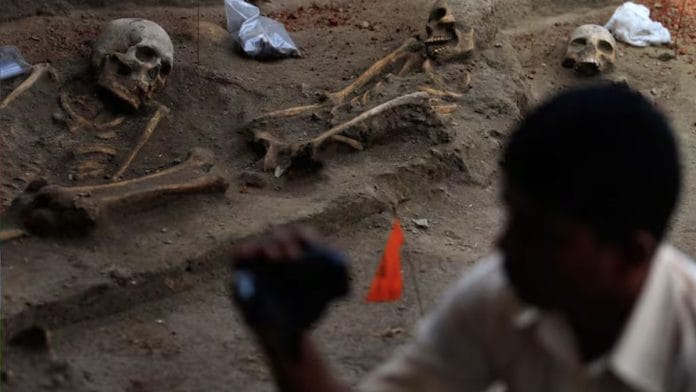
This week, seventeen years after Prabhakaran’s death in the battle of Vanni, investigators concluded the excavation of a mass grave that held the bodies of 582 children, women and men, alleged to have been executed by Sri Lanka’s army at Chemmani in 1995-96.
Everywhere in Sri Lanka, there are similar, grotesque memorials marking the passage of its many civil wars: The shallow graves into which the bodies of 300 Sinhala high-school students were thrown after being murdered by army; the pit in Mannar which hold the corpses of Tamils murdered by the Liberation Tigers of Tamil Eelam (LTTE); the beach-side field in Kurukkalmandalam, from where the remains of more than 100 Hajj pilgrims massacred in 1990 by the LTTE commander Vinayagamoorthy Muralitharan are now beginning to emerge.
The story of how Sri Lanka ended up in this state of primal savagery might seem strangely familiar to Indians, because it is. Each pile of bones is evidence of what happens when politics disintegrates under the weight of ethnic or religious chauvinism, and dialogue is replaced by the sound of gunfire.
No quarter given
Even though the victims have emerged from the mud in Chemmani, we do not know their stories: Why the five-year-old girl we now know as S25 ended up in a shallow grave together with her little blue backpack and a toy; whether she knew S-48 and S-56, the two other children buried nearby; what her connection was to the headless body tossed in with its hands tied behind its back; whose home the toddlers’ dresses, socks, footwear and tiny bangles found nearby came from. A preliminary investigation by the Human Rights Commission of Sri Lanka noted that it had recorded complaints of enforced disappearances in the area as early as 2003, but these were never investigated.
According to the testimony of Lance-Corporal Somaratne Rajapakse—a soldier convicted of the rape and murder of schoolgirl Krishanthi Kumaraswamy in a 1996—more than 300 people were buried in the ground.
The mass killings go back to the first days of the Eelam war, when the LTTE massacred Sinhala fishing communities at Mullaitivu in 1984. This had escalated into a steady series of reciprocal savageries by 1990. Tamil civilians had been slaughtered en masse, and their bodies burned, by the Sri Lanka army at Kalmunai in 1990; these killings were vengeance for the execution of 600 surrendered police officers. The killings became ever more brutal: LTTE cadres, many of them women, hacked 50 Sinhala villagers to death in 1999, leaving body parts strewn across the village of Gonagala.
For decades, however, Sri Lanka had been skipping towards the grave. In 1931, Sri Lanka—then Ceylon—became the first South Asian country to adopt universal franchise. The country had no parties or national movement; as the historian Fred Halliday noted, the “indigenous bourgeoisie simply basked in the sunshine of Edwardian imperialism.”
Elite Tamils who had embraced English, Christianity and the British Raj, established a significant presence in government and politics. Electoral democracy meant power for the majority, a threat to this privilege. The Tamil leader GG Ponnambalam pushed, in 1939, for an electoral system that would deny any community a majority; the idea went nowhere.
For their part, Sinhala politicians had long stoked fears of ethnocide. The colonial period had been traumatic for the community, beginning with a Portuguese effort to destroy Buddhism and ending with the destruction of the Kandyan kingdom by the Raj. The scholar SJ Tambiah would wryly describe the Sinhala as “a majority with a minority mindset.”
One of the first actions of the plutocrat Prime Minister Don Stephen Senanayake after Sri Lanka became independent in 1948 was to strip citizenship from Tamil migrant workers recruited by the Raj to work in the country’s coffee estates and plantations. India agreed, in 1964, to take 525,000 of these so-called ‘stateless Tamils,’ a process wrenched them out of their communities.
Tamil subordination grew steadily. Ethnic-Tamil civil servants were compelled to learn Sinhala to be promoted; Sinhala was embedded into the court system; Tamil students had to score higher marks than their Sinhala counterparts to get into university. There were anti-Tamil riots in 1956, 1958, 1977 and 1981, effected through criminal squads with close ties to politicians and the military. The consequences had long been predicted: “Two torn little bleeding states” would emerge from the one-language policy, the socialist leader Colin Da Silva warned, not a united nation.
The road to war
Long before the teenage insurgents at Urikkadu Chidambaram school began their bomb-making, Tamil and Sinhala leaders were waltzing towards an abyss that would consume them both. The Tamil leader SJV Chelvanayakam backed Prime Minister Dudley Senanayake’s election in 1965, based on an agreement to make Tamil the language of record in the Northern and Eastern provinces.
The new government, though, soon faced furious protests from right-wing Buddhist clergy and the politician Sirimavo Bandaranaike—later to become the world’s first woman prime minister. The following year, a group of officers led by army chief Major-General Richard Udugama was prosecuted—though acquitted—on charges of plotting to overthrow the prime minister.
Even as Prabhakaran and his teenage friends tried to buy weapons, Tamil politicians like V Navaratnam began calling for independence. Venugopal Master, Prabhakaran’s tutor, told his students that Tamil and Sinhala shared an island, but not a nation; the community would only flourish in a state of its own. Two years later, the liberation of Bangladesh fuelled hopes that India might one day do the same for Sri Lanka’s Tamils, and thus offer them restoration of their kingdom.
The 1971 JVP rebellion, led by Janatha Vimukthi Peramuna also gave the Tamil insurgents hope. Although the poorly organised JVP was crushed—the bodies of hundreds of its cadre were simply tossed into the Kalami river, wrists still tied behind the back—the fighting demonstrated that an armed struggle could overthrow the Sri Lankan state. The destruction of the state, the LTTE leadership reasoned, would have been even easier had Sri Lanka not been supported by Indian frigates, Soviet and Chinese artillery, British helicopters and Pakistani ground troops.
Following a bomb-making accident, Prabhakaran gave himself the name Karikalan, or ‘charred leg’—the name borne by the great Chola emperor Tirumavalavan, who, according to legend, marched north with his sword and drum, finding no worthy enemy until his path was blocked by the Himalaya.
Also read: Nothing can stop Tukaram Mundhe. He’s after safe food—not restaurants, celebrities or publicity
The downfall
Like so many leaders, Prabhakaran was condemned by his own hubris. Declining an offer to be given control of Jaffna, he told the Indian High Commissioner, JN Dixit, “I am already chief of the north. I want the east also.”
From the assassination of Jaffna mayor Alfred Duraiappah in 1975 to the 1983 ambush of an army patrol that killed thirteen soldiers and ignited full-scale war, Prabhakaran had built an increasingly lethal fighting organisation. The LTTE, though, held only two districts, Kilinochchi and Mullaitivu. The organisation survived the first three Eelam wars by abandoning inhabited areas, and melting into the forests. From there, it asserted its power by organising suicide bombings and spectacular raids on high-value targets, like airports.
Eelam War IV, the scholar Peter Roberts has argued in an unpublished thesis, succeeded not because the Sri Lankan army had adopted radically new tactics or means. The key factor was Prabhakaran’s ill-advised decision to meet the army in conventional battle, imagining the LTTE would prevail. Even though the Sri Lankan army had been degraded by decades of conflict—more than 43,000 soldiers deserted—it succeeded by sheer mass.
No one won the war: The Tamils did not gain federal autonomy, let alone independence. The Sinhala majority emerged from the war ruled by a corrupt and despotic oligarchy that led the country to economic collapse. To blame the military alone for the barbarism of the Eelam Wars is too easy. Leaders of both of Sri Lanka’s major political parties were responsible for turning to force rather than political accommodation. For their part, Tamil chauvinists were too eager to unleash nightmarish levels of violence, which made dialogue impossible.
To move forward will take much more than the prosecution of killers. It will need Sri Lanka to reimagine its nationhood as one in which all its peoples can participate.
Praveen Swami is Contributing Editor at ThePrint. His X handle is @praveenswami. Views are personal.