






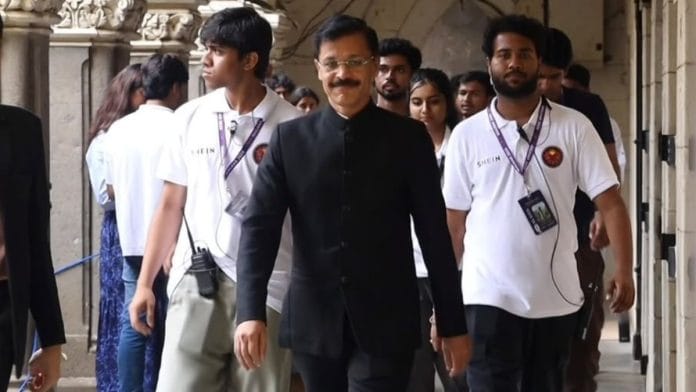

New Delhi: Maharashtra’s Food and Drug Administration Commissioner Tukaram Mundhe’s name has become synonymous with Mumbai food culture, much like the humble vada pav itself, in the three months since his posting to the department.
The FDA under Mundhe, a 2005-batch IAS officer, has cracked down on several iconic eateries in Mumbai, including the century-old Noor Mohammadi, Aditya Birla New Age Hospitality’s Waarsa and Flint, run by chef Rahul Akerkar, the over-century-old Parsi dairy farm, the over-70-year-old K Rustom & Co, and The Willingdon Sports Club.
Street food that was served in brighter shades of red, orange and yellow is now being seen in more natural colours. Cotton candy is being sold in its natural white colour instead of the bright pink produced by artificial dyes. Non-dairy “analogue” paneer and the sale of loose edible oil have been banned. Even the canteens inside the Bombay High Court underwent inspection.
And in the last week, he has gotten even Bollywood involved.
The FDA sent show cause notices to actors Shah Rukh Khan, Ajay Devgn and Tiger Shroff. Their signature ‘V’ hand gesture in modern Vimal Elaichi advertisements hasn’t brought them any victory so far, as the FDA alleges that their advertisements amount to surrogate advertising for Vimal Pan Masala, a product prohibited in the state.
Even celebrities are flagging violations, looking up to him as a saviour. Actor Shweta Tiwari recently made a reel about receiving a cockroach with her Red Bull order from Swiggy Instamart.
“Mundhe ji, where are you?” she asked in the video. It is a question many people in Maharashtra are asking—some hope that the bureaucrat will fix all their food hygiene woes, while others hope he won’t turn up at their restaurant and shut it down.
And that is why Tukaram Mundhe is ThePrint’s Newsmaker of the Week.
Roses and brickbats
The lore around Mundhe isn’t new. Back in 2020, the official residence of the municipal commissioner saw hordes of people gathered outside. They were holding placards to show their love for Mundhe, who was being transferred from Nagpur. As he left the bungalow, the crowd reportedly showered his car with flower petals.
But this journey towards being showered with petals has involved 25 transfers in his 21-year career.
Mundhe grew up in Beed district’s Tadsonna village and joined the IAS in August 2005 as a supernumerary assistant collector at Solapur, one of his longest postings so far. In his own words, he is “a man who walked barefoot on farm soil before walking corridors of power”.
Even though most of Mundhe’s postings have been relatively short, owing to over two dozen transfers, he has managed to upset politicians almost everywhere he has gone.
For Mundhe, the transfers are a part of his job.
“Being a public servant, an IAS officer, the same rules apply to me. I cannot crib about one thing…It is a part and parcel of the job. When I’m a government officer, transfers are there and it’s the authority of the government,” he told ThePrint’s Editor-in-Chief Shekhar Gupta in an interview.
He agrees that it becomes difficult, especially for his family.
“But if you are performing a role and you have taken a stand that you have to work a certain way, if it has a cost, you have to take it that way,” he says.
Also read: Tukaram Mundhe shows food is a big issue in India. Just not in the way BJP thought it was
‘Glass half full’
With over 12 lakh Food and Business Operators, all Mundhe sees are violations of food safety norms and adulteration of everyday food products.
Regarding his notices to Khan, Devgn and Shroff, Mundhe’s thought process is clear.
“I am basically after safe food. We have to have safe food, safe drugs, because that’s my role as a regulator,” he told Gupta.
He explains that the notices have been issued under the Food Safety and Standards (Advertising and Claims) Regulations, 2018, which prohibit misleading or surrogate advertisements. The advertisements talk about “elaichi” instead of calling it pan masala or gutkha—which is the basis for the allegations of misleading advertisements.
There are other violations that Mundhe has found, from milk to analogue paneer, that are glaring. He often talks about food items in the “high-risk” category under the law, which include those foods that are high in fat, sugar and salt (HFSS).
“We found an open drain under the kitchen. It can’t get worse than this. And it is a known (restaurant),” he said in the interview.
But Mundhe’s approach to his job and life keeps him going.
“Indian Administrative Service is the only service in the world where you have multifaceted roles. One day, I work in AIDS control, another day in animal husbandry, the third day I work in health, the fourth day I work in sales tax, and on the fifth day I work in a corporate. So you get exposure to do anything under the sun. If I’m ready to learn, I think I’ll be enriched. No other person gets as much exposure as the IAS,” he told Gupta.
He says that while the basic structure of governance remains the same, an IAS officer needs to study the sector.
“And if you study that, you enrich yourself and contribute in a better way…Whatever postings I have had, I take it as the glass half full, that I have been able to learn so many things and contribute to so many areas,” he says.
Swords and mosquitoes
The FDA’s actions have also increasingly come under the Bombay High Court’s radar.
Just this month, the High Court reprimanded the FDA for its high-handed approach, orally remarking that it might be using a sword to kill a mosquito.
But Mundhe disagrees with the court’s observations.
“We don’t (use a sword to kill a mosquito). We have a law in place. We go by that. There is no reason to kill a mosquito because we have to kill the menace of unsafe food. That is our job, and we will go as per the act and rules and regulations. Nothing beyond that. Nothing less than that,” he told Gupta.
More recently, the Bombay High Court allowed Pune-based Gurunanak Dairy and Sweets to reopen after a re-inspection gave it a compliance score of 98 per cent. The court also directed the FDA to pay the business Rs 5 lakh in compensation for the loss it had caused.
But this order also failed to faze Mundhe.
“We will use our legal options…We stand by what we say,” he said a day after the judgment, in his signature style.
For Mundhe, performing the role is more significant than the role itself.
“I don’t define my job. I try to perform the role associated with this post,” he told Gupta.
(Edited by Prashant Dixit)