





From the markets behind the Friday mosque in Bamako—packed with shops selling prayer beads, the Quran and horns, skulls and quills of wild animals used in folk religion alongside medicinal herbs, as well as betting slips for horse races in France—the street loops back to the National Assembly and the offices of 107.4 FM, the state-run Radio Islamique de Bamako. A coup led by Lieutenant-Colonel Amadou Touré in 1991 had dismantled both authoritarian rule and the dysfunctional socialism that had kept Mali, a landlocked country in West Africa, among the world’s poorest nations.
For a while, the marketplace seemed evidence that many faiths and practices could coexist.
Last week, jihadists from Jama’at Nusrat al-Islam wal-Muslimin (JNIM)—the Al-Qaeda-led coalition operating across the Sahel—swept aside Mali’s small army and its Russian mercenary forces in the northern city of Kidal. Bamako itself has been under siege for months.
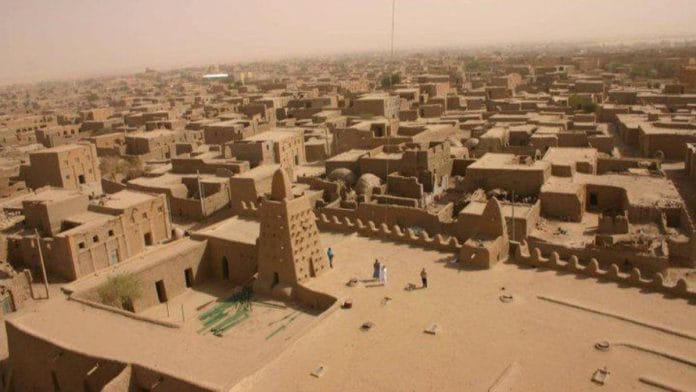
Even as jihadists tightened their grip on the capital, the International Criminal Court announced $8.4 million in damages for 65,000 victims subjected to violence by JNIM’s predecessor groups in 2012. The city where the worst atrocities took place, Timbuktu, has been under siege since 2023 and tens of thousands of refugees have fled. Flights to the city were suspended last week.
Eyes off the ball
The world’s attention is fixed on the Persian Gulf, but the crisis in Mali demands urgent attention: for the first time since the fall of Kabul in 2021, a jihadist organisation is close to seizing control of a nation-state. France sent its military to Mali in 2012 and liberated Timbuktu from jihadist control after ten months of fighting. JNIM retreated into the desert and waited. After another coup in 2021, French troops left Mali. The Russian mercenaries who replaced them proved both brutal and ineffective.
Evidence of an emerging problem has been evident for decades.
Warning signs had been visible for decades. Around 1992, the scholar Benjamin Soares recorded an early public expression of Islamist pressure: “In the name of God, the Compassionate, the Merciful,” a handwritten sign read, “We ask the management to stop the advertising and the screening of pornographic films. If not, we are going to ransack the cinema, God willing.”
Every Friday, Radio Islamique’s preachers would rage against the emergence of casinos, premises which rented rooms by the hour to couples and the decision to allow bars and restaurants to remain open during Ramzan.
Then, inspired by Tablighi Jamaat preachers from Pakistan, a member of the Tuareg rock band Tinariwen abandoned his suits, his Rolex and his instruments for a Kalashnikov. That man, Iyad Ag Ghali, has now led the Islamist movement of the Sahel to the edge of victory.
Also read: UAE exit from OPEC isn’t about oil. Iran War making Gulf states seek new shelters
The messianic impulse
Like all empires, this one began with a vision. Late one night, reading a biography of the Prophet Muhammad, the cleric Al-Hajj Umar ibn Said al-Futi al-Turi experienced a revelation: he would become, he wrote, “The Muhammad of the Sudan,” uniting the Fula people into a great nation and restoring the purity of Islam. The Fula of the Sahel, he believed, were like the pre-Islamic Arabs—wavering in their faith, given to animist practices, divided by clan feuds. Jihad would redeem them as it had redeemed the Arabs.
The caliphate Umar built between 1849 and his death in 1864 covered some 2,50,000 square kilometres, stretching from Dinguiray in the west to Timbuktu in the north and southward to Ségou on the banks of the Niger.
Islam had arrived in the region around 800CE, carried by traders arriving in search of ivory, ostrich feathers, slaves and the gold-mines, which produced two-thirds of the medieval world’s needs. The faith embedded itself in the fabric of society, providing access to networks of traders and creditors whose influence ran from Europe to Africa. The Mali empire adopted Islam as the state religion in 1324.
For much of its history, the Sahel had been unified under great empires. Islam reached the region around the eighth century, carried by traders seeking ivory, ostrich feathers, slaves and gold—which supplied roughly two-thirds of the medieval world’s needs. The faith took root over the following centuries, providing access to trade and credit networks stretching from Africa to Europe.
The Mali empire’s Islamic identity reached its apogee under Mansa Musa, whose celebrated pilgrimage to Mecca in 1324 announced the kingdom to the wider world. The new rulers of Mali claimed descent from the Quranic Bilal ibn Rahbah, sometimes referred to as Bilal al-Habshi, a former slave who occupied a position of great trust under Muhammad.
The great medieval traveller Ibn Battuta, who visited Mali in 1351, praised its wealth—as well as the harsh disciplining of children who lagged in memorising the Quran. He was scandalised, though, by the absence of gender segregation and by court rituals he considered un-Islamic: Female servants appearing unclothed before the court, subjects prostrating themselves in dust and ashes before the sultan, and royal poets performing in feathered bird masks. The Mali empire, weakened by wars with Berber powers and with the sultan of Morocco, eventually collapsed and was succeeded by the Songhai empire.
From the seventeenth century onwards, jihad emerged as a recurring motif of movements for political change. Awbek Ashfaga, also known as Nasir al-Din, led a theocratic movement in the Senegambia region, seeking to purify Islam and resist the slave trade. Later, the cleric Usman dan Fodio mobilised peasants, slaves and pastoralists against the sultans of the Hausa kingdoms. The victories of his jihad produced the Sokoto Caliphate, which fell to the British in 1903. Finally came Umar’s empire—which in turn was overwhelmed by French imperial expansion.
The end of the century was to see the heads of Tuareg rebels displayed on the streets of Timbuktu by the French military.
Also read: How India should prepare for a future war with Pakistan and China
The breaking of a nation
Even though Islam had given the Sahel a single faith, other fractures remained unhealed. Ibn Battuta distinguished three categories of people in the region: black Africans, fair-skinned Berbers, and “whites” like himself from North Africa and the Middle East. These were alien distinctions to the people he described—and Berbers were in fact vassals of the Mali kingdom—but were to bake themselves into the social fabric. The Scottish explorer Mungo Park, travelling through the region in the 1790s, observed that Moors regarded the Hausa as an abject race. Black Africans, themselves overwhelmingly Sunni Muslims, often reviled Berbers as slave traders, indolent and uncivilised.
French colonialism sharpened these divisions. Mali’s first president, Modibo Keita, recalled being made to sit on the floor at a meeting while seats remained available to Europeans. After independence, racial resentments hardened: blackness became associated with enslavement, non-blackness with predatory banditry. The reality was more complicated—some Berbers had traded in slaves, but most were poorer than other Malians.
The Tuareg north suffered persistent neglect. In 2002, three-quarters of Timbuktu’s population lived below the poverty line—seven percentage points higher than the national average. Eighty per cent were unemployed.
Smuggling flourished in this vacuum, and thousands of Tuareg served as mercenaries in Muammar Gaddafi’s Libya. Tuareg insurgents fought three secessionist wars—in 1963–64, 1990–96 and 2006–09—before allying with Al-Qaeda in 2012. After Gaddafi’s fall, returning mercenaries found in JNIM a well-funded and well-armed home. Ag Ghali drew the nationalist cause into jihadism: the latest iteration of a movement that had swept across Mali many times before.
The ten months Timbuktu spent under jihadist occupation offered a glimpse of what might come. Residents were forced to witness the amputation of thieves’ hands in the city’s squares; women were whipped, raped and forced into marriages; ancient manuscript libraries were burned; mausoleums and shrines destroyed.
Colonel Assimi Goïta then seized power through two back-to-back coups in 2020 and 2021, vowing to achieve the “refoundation” of a sovereign Mali. His regime’s populist nationalism provided no answers to the country’s problems. As the security situation deteriorated, the economy also crumbled.
The lesson of JNIM’s survival is clear: Force is needed to set the conditions for political change, but combating jihadism also requires political effort and state. From Iraq to Afghanistan, Syria, and now Mali, the world’s major powers have shown they lack the will for either.
Praveen Swami is Contributing Editor at ThePrint. His X handle is @praveenswami. Views are personal.
(Edited by Saptak Datta)