





Last week, Russian officials were simultaneously present in Afghanistan, Pakistan and India, suggesting the beginning of another great game along the South Asian frontier, except that Russia no longer has the greatness of its erstwhile empire. Nor does it have a British empire to compete against. But even after decades, the appeal of Afghanistan still remains for Russia.
Russia’s foreign intelligence chief, Sergey Naryshkin, was in Kabul on 14 October to meet the Taliban’s intelligence chief, Abdul Haq Wasiq. The same day, New Delhi hosted the seventh round of the ‘India-Russia Special Mechanism on Pakistan and Afghanistan’. Meanwhile, in Pakistan, Russian interior minister Vladimir Kolokoltsev met the country’s civilian and military leadership, including Prime Minister Shehbaz Sharif and Army Chief Field Marshal Asim Munir. It was the first visit by a Russian interior minister to Pakistan, during which Moscow and Islamabad signed an MoU to strengthen cooperation in combating organised crime.
That three Russian security representatives were in three regional capitals in the same week was unlikely to be a coincidence. Though a full picture of Moscow’s intentions will emerge in the coming months or years, the trajectory is manifest. In this region, Moscow appears to be expanding its role by seeking to mediate between Kabul and Islamabad, all the while coordinating with its time-tested partner New Delhi on the same issue.
From Soviet invasion to formal recognition
The last Soviet soldier left Afghanistan in February 1989. But the invasion’s infamous legacy remains visible in many ways, including the landmines strewn across the country that still kill Afghans. Robert D Kaplan in his Soldiers of God cites a few studies to argue that the Soviet Union killed 1.3 million people in Afghanistan, a toll exceeding the death toll of the Iran-Iraq war and equivalent to the toll of 75 Israeli invasions of Lebanon on the scale of the 1982 invasion.
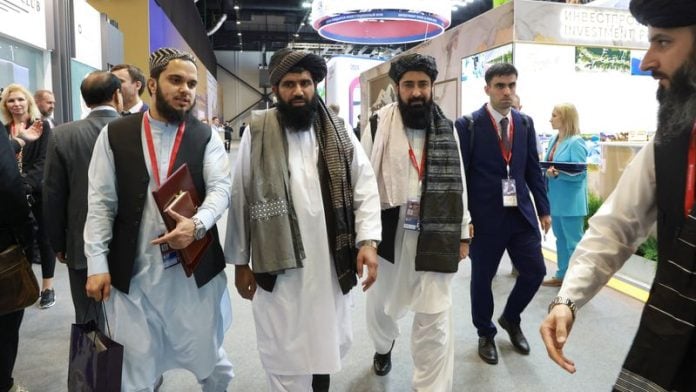
Today, Russia is back in Afghanistan, not to invade or install a pro-communist government, but to do business with those at the helm. It removed the Taliban from its terrorist list in April 2025, recognised their government that July, and in May 2026, signed a military-technical cooperation agreement with them. Though the terms are not public, reports suggest it covers the repair and maintenance of Russian and Soviet-made equipment. It is a long way from the 1990s, when Moscow backed the Northern Alliance against the first Taliban regime.
The irony is hard to miss. Russia is trying to mediate between the Taliban – heirs of the very mujahideen that drove them out of the country – and Pakistan, which financed, trained, and nurtured them.
For Russia, the Afghanistan-Pakistan landscape resembles a chessboard. Chess is a two-player game. But those who practise alone know the trick of playing both sides. That is Moscow’s current strategy. Any pawn moved from Afghanistan’s side has to be met with another in Pakistan, and Russia must anticipate both carefully. It just so happens that chess is a beloved pastime in Russia.
The point is that both countries have always been interlinked in Russia’s strategic calculations, as they have been in those of many other regional and extra-regional players. For instance, when it was clear that the Soviets were losing to the mujahideen by 1987, their best hope was to “destabilise the guerrillas’ rear base” in Pakistan. Kaplan writes that the US State Department reported over a hundred terrorist incidents in Pakistan cities that year, with Pakistan suffering one third of all the fatalities and one half of the wounded in terrorist attacks worldwide in 1987. A Russia that once exploited the link between the two countries to bleed its enemy now hopes to sustain that link.
Today, Russia seeks a stable Afghanistan where the Islamic State Khorasan Province (ISKP) won’t find breathing space and where instability and chaos do not spill into Central Asian states that Moscow still treats as its sphere of influence. This intent is clear from the head of Russia’s Federal Security Service warning that ISKP, based in Afghanistan, is recruiting members from Central Asian states. A report by Afghanistan International goes even further, claiming that Russia is funding and equipping a special Taliban unit to counter ISKP.
Besides, on October 15-16, Moscow, which holds the chairmanship of the Collective Security Treaty Organization (CSTO) this year, hosted a joint meeting between the CSTO, the Shanghai Cooperation Organisation (SCO) and the Commonwealth of Independent States (CIS). The theme was security in Central Asia and Afghanistan. Read alongside the three simultaneous visits, Russia’s layered Afghanistan strategy comes through. A larger delegation led by the Russian Deputy Prime Minister is due soon in Afghanistan.
Also read: Moscow Format has become a talk-shop. Afghanistan is receding from global agenda
Russia, an unlikely mediator
Afghanistan will not stabilise as long as it remains locked in ‘open war’ with Pakistan. So, Moscow is engaging Islamabad too. But its embrace of the Taliban may complicate matters, as may its reported mediation. If Russia sees the Taliban as a counterterrorism partner in the fight against the ISKP threat, then Pakistan holds the Taliban responsible for terrorism on its soil and for harbouring the Pakistani Taliban. Moscow still acknowledges terrorism emanating from Afghanistan, but it distinguishes that from the Taliban administration.
When fighting erupted along the Afghanistan-Pakistan border earlier this month, the Russian embassy in Kabul tweeted, “We are seriously concerned about the ongoing military confrontation between Pakistan and Afghanistan, which affects civilians, including children”. Many read this as tilting towards the Taliban, which accuses Pakistan of killing civilians in airstrikes in Afghanistan, a charge Pakistan obstinately denies.
Others have tried to play this role. China, Qatar, Turkey and Saudi Arabia have all attempted to mediate between Islamabad and Kabul. At best they have secured temporary ceasefires that were quickly punctured, or agreements without written or verifiable mechanisms. On October 5, the Russia-led Moscow Format Consultations on Afghanistan could not produce a joint communique because of Taliban-Pakistan tensions over terrorism.
Russia, moreover, has historical baggage that it brings to the table as a potential intercessor. Pakistani security analyst Muhammad Amir Rana wrote in a column for Dawn, “Is it not interesting that the conventional wars fought by India and Pakistan collectively may not have lasted for more than a few weeks, and that Pakistan fought its longest war against the Soviet Union in Afghanistan?…The Pakistani leadership still takes pride in that success.”
The present is an obstacle too. If Russia indeed is arming the Taliban, Pakistan may fear the weapons will be turned on it. Russia can still bring both sides to the table. It holds real leverage over the Taliban, which will want to preserve Russian recognition and the cooperation that comes with it, and Pakistan has reason to use Russia’s proximity to the Taliban to give dialogue a chance.
From fighting the mujahideen to courting their successors, Russia is rewriting its place in the region’s history. In some respects, it is whitewashing its past. Whatever the consequence of the current not-so-great game Russia is playing, they will reinforce how short the world’s collective memory of Afghanistan can be.
Bantirani Patro is a staff writer at ThePrint. She tweets @bantirani_patro. Views are personal.
(Edited by Prashant Dixit)