








What do you say about a group of women and men who seize the opportunity that comes their way and make a name for themselves?
At ThePrint, we say well done. Well done, Batch 5 students of ThePrint School of Journalism’s online course. The 30-odd students who took up the internship offer surprised everyone, including themselves, with their productivity.
Don’t be misled into thinking these were young college types. Yes, there were freshly-minted graduates, but we also had mid-career professionals as well as retired individuals.
Together, they have reported and written over 100 stories for ThePrint since mid-March. They have edited videos, recorded podcasts, researched for Editor-in-Chief Shekhar Gupta’s signature ‘Cut the Clutter’, and transcribed recordings. They’ve worked on social media promos and marketing strategies. They have also just stood and watched and (hopefully) learned.
Above all, they have learned to take “No” graciously when their story ideas are rejected.
Varun Sharma, who lives and works in Gurugram, knows what it feels like: “You pitch a story, it gets interrogated. You go out, conduct interviews, gather data and build an analysis. (Then) your editor picks every word apart in your first draft. Unlearning… has been the steepest learning curve of my life,” he wrote in an e-mail.
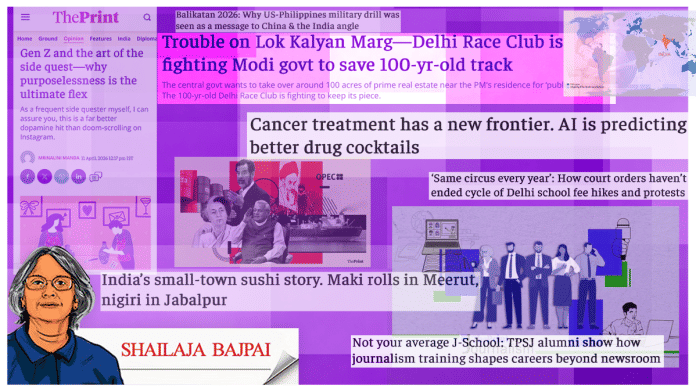
The interns wrote about everything: From “6 geopolitical conflicts that shaped India’s energy strategy” and “Why the US-Philippines military drill was seen as a message to China” to “India’s small-town sushi story” and “Gen Z and the art of the side quest”, the range of topics has been as different as each intern is from the other.
The editors who have been painstaking guides and mentors, identified one quality common to this batch of interns: “Enthusiasm”.
Students have been equally, er, enthusiastic about their internship. Mrinalini Manda, who returned to India after completing her education in Australia, called it a “life-learning experience.”
“Exhilarating and stressful,” said Tarini Unnikrishnan, who has previously worked in publishing and marketing.
It’s been “exciting” for Jaydeep Gadhavi, who wants a career in journalism. “I learned how a newsroom works,” he said.
“This has given me a lot of fulfilment,” said Saumya Sharma. A former criminal lawyer, she came to ThePrint “with no expectations except to learn as much as I could.”
“It’s been wonderful,” summed up Sahaj Sankaran, a film scriptwriter from Mumbai. “It’s a different type of writing, free and constrained. You always have too much to say but you learn structure and coherence.” Read his fascinating Ground Report about the trouble facing the Delhi Race Club, locked in a battle with the central government.
Being in the newsroom
The Batch 5 interns confirmed what we believe at ThePrint and at TPSJ: ‘The newsroom is the best classroom.’
You don’t need a BA Honours degree to learn the skills of good journalism. You can acquire these from experienced editors and reporters who also act as teachers and mentors.
As the Dean of ThePrint School of Journalism, I am, rather shamelessly, promoting the idea of a short certificate course in journalism, followed by an intensive two-to-three-month internship for anyone who wishes to acquire the necessary skills, knowledge and confidence (very important) to pursue journalism professionally.
Don’t take my word for it. Here is Rahul Saikia, who came from Shillong for the internship: “Certain key aspects of journalism can only be learned in the newsroom. One-on-one sessions with my mentor…(or) sitting with a copy editor to carefully review a draft, line by line…”
The editors who guide them agree: “Training in the newsroom is essential,” said Ananya Bhardwaj, Senior Associate Editor, who had three interns working with her on the crime and security beat. “We discuss ideas, give them leads and contacts, and sit with them as we go through their reports. Just being with other senior reporters has great value,” she added.
Our collective experience at ThePrint School of Journalism tells us we can get it right. After the four-month online course, students opt for internships either at ThePrint’s Delhi office or from wherever they’re based, under the guidance of an editor.
Since May 2024, six TPSJ batches have interned at ThePrint and left with impressive portfolios. Some of them now work at ThePrint: Udit Bubna (Batch 2), Kasturi Walimbe (Batch 3) and Niyati Kotiyal (Batch 4). Others have gone on to do impressive work in different fields as this article tells you.
Along the way, we have tweaked the internship programme. “We’ve been on a learning curve too. With every batch, we have evolved and learned how to improve the internship,” said Janki Dave, Editor, Operations, who oversees the day-to-day running of the internship.
“I think with Batch 5 we are seeing visible results of the processes we have put in place,” she added.
The interns gain an understanding of a multimedia newsroom by working in different departments. This includes the editorial desk, the social media and publishing desk, the video team, the marketing department and the research team. They spend a fortnight or a month at each one. Finally, they pick a specialisation for a month and work with one editor on articles.
As the Dean of TPSJ, I keep track of each one’s progress and coordinate with the editors who mentor them.
The editors have been strict task masters—and it’s remarkable how willingly the interns have taken to being back at ‘school’ again.
Their “energy” has impressed Swasti Rao, Consulting Editor, Strategic Affairs. She’s worked with four to five interns and found them “very hard working”.
“They don’t cut corners. I am very proud of them. They come with big ideas. What I did is give them an understanding of the newsy angle and explain that they’re writing for a mass audience – this is not a university term paper,” Rao said.
Of course, editors had to ask for several rewrites. Bhadra Sinha, Editor, Legal Reporting, said she coped with a lot of pressure.
“You have to make them understand what they have to do, the focus of the story and that they’re not writing a legal brief,” she said. “You have to convert everything into stories for readers.”
Also read: Readers have the last word at ThePrint. Keep sending us your mails
From around the country
The Batch 5 interns come from across India: Shillong, Bengaluru, Pune, Mumbai, Hyderabad, Ludhiana, Siwan, Ahmedabad, and Chandigarh and Delhi.
Why did they leave the comforts of their homes and jobs to live in small paying-guest accommodations in Laxmi Nagar or Lajpat Nagar for several months during the hottest season in Delhi—only to be treated like students all over again? Do this, do that, no you can’t do this, redo this, redo that…
For Bhavya Priya from Siwan in Bihar, “It has opened up new opportunities for me to explore the world beyond my comfort zone, understand how newsrooms operate, and gain valuable professional exposure.”
Jaydeep Gadhavi travelled from Ahmedabad because he wanted to experience a newsroom “to pursue a career in this field further on”.
Chandigarh’s Nishtha Modgil wanted “to work closely with accomplished mentors while exploring better opportunities.”
Lakshminarayan Devraj who comes from Bengaluru, said the internship allowed him “to apply what I learned in TPSJ. I hope to acquire knowledge on how each department works in new-age journalism.”
Or take the case of Akshat Mohan from Hyderabad. He’s in Delhi “to pick everyone’s brains in the newsroom every day.” He said the newsroom is very special and already “I love it – the dynamics here”.
And then there’s Sahaj Sankaran, who wanted two things: to figure out how a newsroom works and how to write differently.
Ajay Mathur, from Gurugram, wants to see if he can take to writing after he retires in a few months; Velamarthi Venkatachalam travelled from Bengaluru to learn about writing on politics; Anmol Kapil wants to be a reporter and came to learn the basic skills and then there’s Vinay and Brian and Amrin and Alfreza and Nitika who went to take photographs of Jama Masjid at 4 am….
There are too many interns to write about. But this much is clear about all of them: they are persistent, full of ideas, and determined to learn to report the news and write stories.
Write news reports, quick hits, in-depth articles, opinion pieces for the ‘PoV’ section, lifestyle, health, crime, culture, Hollywood, Bollywood, write on topics such as ‘India on an FTA signing spree, but limited utilisation & widening trade deficits temper gains’ or on how ‘Cancer treatment has a new frontier. AI is predicting better drug cocktails’ and ‘Scripted politics: How netas are borrowing blockbuster dialogues to land punches’.
Strategic affairs, national security, and defense are the most popular subjects among interns. They’re also the most complex to write about.
“Often, the interns came with big ideas that were confusing. I had to shoot them down and get them to focus on one doable idea,” said Snehesh Alex Philip, Deputy Editor, who heads the defence, strategic and foreign affairs vertical.
Interning remotely
Many interns such as Arun, Kushagrata and Subatra work remotely. They are sent out on assignments in their respective locations or they pitch ideas, discuss the reporting plan with their mentors and then deliver the story.
Arun Singh, who is in the US, has contributed articles on the frontiers of science and cancer treatment.
“As science, particularly biotechnology, is my area of interest, I was required to pitch ideas related to science with a focus on biotechnology. I am learning how to write science stories with minimal jargon, making them accessible to a general audience,” he wrote in an email.
Subatra AL is an English literature student in Chennai and worked with ThePrint’s Chennai correspondent Shweta Tripathi during the Assembly elections.
“I entered the programme with no prior knowledge of journalism — only a deep curiosity and eagerness to learn. In my internship… Shwetha encouraged me to speak to political sources, take photographs and videos on the field, and most importantly, understand how a story should be shaped and told,” Subatra said in a WhatsApp message.
Shweta Tripathi, Special Correspondent, was mentoring a young intern for the first time. “Guiding her was easier because she understands the news, at least at the basic level… She’s a quick learner and has a nose for news,” Shweta said in an exchange over WhatsApp.
Also read: The first batch of ThePrint’s J-school has graduated—what students want in the next
The takeaway for the interns
For each intern, there have been key takeaways. Most of them mentioned that the internship had boosted their self-confidence. They learned how to chase people, speak to complete strangers and find sources of information, often on their own.
“I was very nervous during my first visit to a police station,” recalled Anmol, who worked on crime stories, “but now I am surprised by how calm I’ve become while chasing crime stories. I am satisfied with my work.”
Neelam Pandey, Deputy Editor on the political team, mentored several students. She said she would let them “make their own way” and “navigate entry” to different offices or events without her intervention.
“We have to help them learn to do it themselves,” she said.
Interns were also delighted to see their work in print with their bylines. Nishtha Modgil said it was the “best feeling”. Akshat Mohan said his mother, a former journalist, and his grandfather were “very happy”. Bhavya was “super excited” and wondered what people would think of her work.
Their families are equally happy. “My family has been very encouraging,” said Ajay Mathur. “I have been looking for something to engross me, and this does.”
“I hope to remain a lifelong student of TPSJ, always learning, unlearning and growing,” wrote Subatra.
Saumya Sharma, whose output is prodigious, seems to have found her second calling.
“I have very strong opinions, but I wanted to find a fact-based, meaningful way to convey them. I also learned how to refine my writing for a general audience,” she said. “It’s been a great learning experience.”
Mrinalini Manda had come to Delhi with an “open mind”. “I have learned how to be in a professional space. I was deterred by harsh feedback, but I learned that I can go back after a ‘no’. And I have found my voice,” she said.
“After being in a real-world newsroom, this is definitely where I want to be,” said Tarini Unnikrishnan. “Now, I look at everything and think, ‘Can I write about this?’”
Behind the byline
Before leaving, a reality check. The interns have done well, and it is there for everyone to see.
However, none of it would have been possible without the editors who worked tirelessly with the interns. It is important to recognise the effort they put in to make the internship meaningful — assigning work, guiding the interns and then reworking what they produce.
Janki Dave says that since many interns are domain specialists, editors have to find an intersection between their expertise and the stories they write.
It’s not easy. “Many of them want to write opinion, but we have to guide them towards reporting facts,” said Neelam Pandey. “I have learned great patience from working with them.”
Ananya Bhardwaj put her interns on the crime beat. “It’s the best way to learn news reporting and the practice of journalism,” she said. “It gives them exposure and forces them to get facts and talk to people. We have to keep after them, encourage them and then sit down and walk them through their stories.”
It doesn’t end there.
First stories must be vetted by the mentors. Then they are verified, fact checked. Gitanjali Das, Associate Editor who oversees the news editing team and the speed desk, said there are several challenges. One is engaging the interns in productive work. Another is helping them learn how to structure a story, write headlines. A third is to keep them busy and interested. Each of these takes time — something the editors and the editing desk seldom has in a fast-paced newsroom environment.
And then the stories must be edited and reworked for publication in ThePrint.
“Their reports go through two sets of eyes for complete verification,” she explained.
Ultimately, it has been worth it. The interns are now budding journalists, and ThePrint has many stories to show for its efforts.
Shailaja Bajpai is ThePrint’s Readers’ Editor. Please write in with your views and complaints to readers.editor@theprint.in
(Edited by Prashant Dixit)