




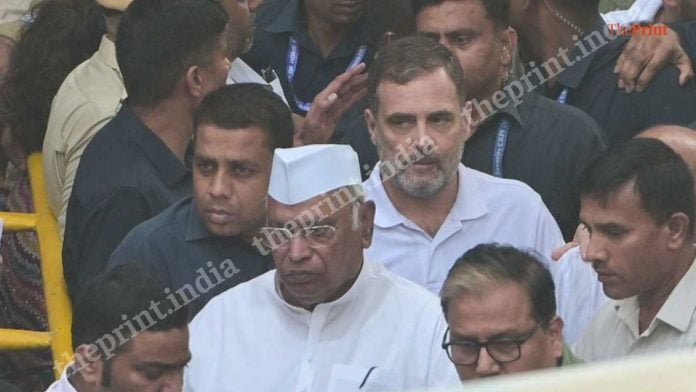

In Delhi, the Indian National Congress’ events that caught the nation’s attention, especially among the masses, were overshadowed by a radically different reality at its Uttar Pradesh headquarters. Far from echoing the discourse of its passionate and charismatic leader, the events in Lucknow descended into hooliganism, resembling a street fight among party karyakartas. At a formal ceremony marking a leadership transition ahead of the upcoming UP elections, the scene was one of a party in the doldrums: workers, divided by factionalism, clashed, and senior leaders had to form human shields to restore order.
This is the central contradiction of contemporary opposition politics in India. It reflects the divide between New Delhi’s lofty constitutional discourse and the factionalism embedded in state units at the grassroots level. It is easy to be mesmerised by the national narrative being built around Rahul Gandhi, the charismatic leader of the Congress, on Reels and television screens. Yet, for all the evident charisma at the top, the leadership still has little control over its party cadre in the states. It is this local cadre that does the hard work of election management on the ground.
There is celebrity charisma, and there is the cadre. Between the two lies a widening disconnect, which is the central weakness of opposition politics in India today.
Friction in UP: The anxiety of being swallowed whole
The trigger for the Lucknow brawl exposes deep internal insecurities. There was a sudden, top-down shift in leadership in UP. One change involved replacing Ajay Rai with state MLA Aradhana Misra, “Mona,” as chief, while the other involved naming Saharanpur MP Imran Masood working president. Both moves were aimed at reviving the party’s traditional coalition comprising Brahmins, Muslims and Dalits. Misra, a three-time MLA, has deep familial roots in the party, giving it an entry point back into its lost upper-caste fold. Similarly, Masood commands significant clout among minority Muslim voters in western UP.
However, the party’s attempt at social engineering immediately opened deep wounds. The clash between supporters of the outgoing chief and those aligned with the incoming leadership reflects the panic within the party. The INC faces a dilemma: on one side stands the formidable, resource-rich election machinery of the ruling Bharatiya Janata Party (BJP); on the other is its dominant alliance partner, the Samajwadi Party (SP), led by Akhilesh Yadav.
The Congress cadre knows all too well that the SP has historically been a predatory ally, eager to absorb whatever remains of the Congress’s traditional vote base. Every seat the Congress concedes during alliance negotiations, or every district where it yields ground to the SP, renders local Congress workers obsolete. The violent friction at the Mall Avenue headquarters should be read as a desperate act by a regional unit terrified of being swallowed whole by its own coalition partner.
This anxiety is not unique to Uttar Pradesh; it is also evident in Maharashtra, where local Congress leaders frequently lock horns with their alliance partners in the Maha Vikas Aghadi (MVA). There, the newly appointed president, Harshwardhan Vasantrao Sapkal, is facing flak from many of the party’s elected legislators and feudal leaders who hold sway in their fiefdoms. His efforts to revive the party and rebuild the cadre-based organisation for which the Congress was once known have met with staunch opposition. Traditional caste leaders have choked funds and shown apathy towards his initiatives, fearing that their authority will be undermined by a regional president steeped in Gandhian and Congress principles.
Both states reveal a lack of programmatic clarity and an inability by the central leadership to address problems within state units. This leaves regional leaders fighting among themselves for crumbs. They also fear that their senior alliance partners will permanently inherit their grassroots machinery.
Reality check: Registry vs polling booth
The tragedy of this disconnect is also operational. Even as viral videos showed INDIA bloc leaders marching through Delhi, their legal strategy encountered bureaucratic friction. The petition had to be filed through lawyers, and the delay caused by the march meant time was running out as the Supreme Court registry prepared to close. The registry flagged 14 technical defects in their plea. Though clerical in nature, this setback is a perfect metaphor for the opposition’s broader weaknesses.
Filing petitions in the Supreme Court and holding high-profile press conferences targeting Chief Election Commissioner Gyanesh Kumar can make for good prime-time television. Such actions may be necessary, but the strategy will be a flop if the party lacks basic organisational discipline. The same grit is needed to translate street anger into effective booth-level management, a prerequisite for winning elections in India.
We must remember that elections in India are won in the unglamorous minutiae of polling stations. Winning elections under the current first-past-the-post system requires an army of disciplined booth committees to spend weeks working through draft electoral rolls. They must cross-reference names, file Form 6 applications to include eligible voters, and track deletions in real time. This requires proper, coordinated and rigorous training. If a regional unit cannot manage a peaceful leadership transition at its own headquarters, it is difficult to see how it can coordinate the hyper-local discipline required to counter a hostile state machinery. That machinery sits like sheshnags at thousands of individual voting booths.
As the battle for Uttar Pradesh heats up ahead of the elections, the lesson from the Lucknow brawl is clear. The opposition cannot rely solely on an elite air war of narratives and jargon, or on the charisma of its leadership. There is no doubt that the Congress’ top leadership is leaving no stone unturned in trying to change the party’s fate. But optics can spark public debate, while constitutional arguments can rally the urban intelligentsia, but both are temporary measures.
The task before the national leadership is to bridge the rifts within and between state units by instilling institutional discipline. The grandest alliances will remain a house of cards if these organisational basics are neglected. The opposition must introspect, reflect, and fix its internal culture. Finally, it must ponder, as the saying goes, that an army that throws shoes at itself in the barracks can never hope to win the battle for the republic.
Nikhil Sanjay-Rekha Adsule is a lawyer, an alumnus of TISS, Creighton Peden Scholar, USA, and a Senior Scholar at IIT-Delhi. He tweets @Surajya_Raje_. Views are personal.
(Edited by Prashant Dixit)