



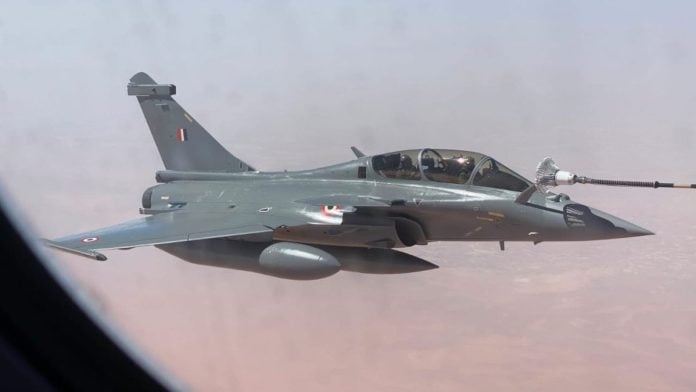
A major kerfuffle erupted in India after a British aviation directory reported a drop in the country’s active Rafale fleet from 36 to 32 aircraft.
FlightGlobal’s 2027 World Air Forces directory lists 32 active Rafale fighter jets in the Indian Air Force (IAF). This number is down from 35 in its previous edition, and four less than 36 originally procured from France. This sparked strong reactions, including pushback from former and current military professionals.
FlightGlobal’s latest World Air Forces directory, based on Cirium data, presents the figure without verifiable proof. Pakistan’s information ecosystem has treated the number as fresh confirmation of claims that PAF shot down four Rafale fighters during Operation Sindoor in May 2025.
A former IAF Vice Chief who was in post during that operation has called the count “patently false”. Air Marshal N Tiwari (retd) has also pointed to earlier specific tail-number claims that were later contradicted by aircraft appearing in exercises. He goes on to recall the equally ludicrous assertion floated by Pakistani handles that Squadron Leader Shivangi Singh had been taken prisoner.
Indian commentators are drawing attention to the bridge-support tender the IAF floated in June 2026, covering all 36 Rafales.
The familiar cycle has begun again: an external article appears in a foreign publication, sourcing dodgy data; Pakistani accounts amplify it, Indian voices express umbrage, and the conversation returns to the same unanswered question of exact losses.
We respond with indignation and anger, using words like false, fiction, baseless, devoid of evidence and so on.
This cycle is counterproductive.
Ignore or inform—the IAF has to choose
The IAF faces a straightforward choice that it has to make.
Either it can decide that the precise number of Rafales lost (if any) is not a matter on which it intends to engage the public or media, and therefore ignores the noise entirely. Or it can decide that the question carries enough narrative or political significance that the facts should be stated cleanly and completely.
What it cannot usefully do is hover between the two: offering general statements that “losses are part of combat,” rejecting particular claims as false, and then reacting with visible irritation each time a new report recycles the same debate.
Partial, reactive responses keep the issue alive without resolving it and give fresh oxygen to the very debate the IAF wish to avoid.
Military organisations have long understood that equipment losses are not, by themselves, a measure of success or failure. The Israeli Air Force’s (IsAF) experience in the opening phase of the 1973 Yom Kippur War remains one of the clearest modern illustrations.
The IsAF’s losses in the first 12 hours were staggering: 30 A-4s, six Phantoms, and four Super Mystères. Yet the outcome was a splendid victory.
Attrition can be a painful metric; however, it alone does not determine the fate of an entire military operation. Outcome is measured by whether the targets were successfully engaged, whether the battlefield was reshaped, and whether the political objectives of the war were secured.
Counting wreckage can never be the central metric.
Also read: A Muslim NATO in the making? How Türkiye and Pakistan are building defence ties
Op Sindoor’s real scorecard
A similar distinction applies to Operation Sindoor. India conducted strikes against terrorist infrastructure and military sites in response to the Pahalgam attack. The entire operation lasted less than 100 hours, culminating in a ceasefire request from Pak DGMO, which India accepted.
IAF achieved the political objectives set forth by the national leadership, and the request for ceasefire was accepted when conditions for termination of the conflict were met. Equipment damage was not part of either of the calculus.
If the service believes that there is no operational value in disclosing potential losses, then the service must choose the consistent policy of silence or indifference. In that case, every new FlightGlobal entry, every Pakistani claim of three, four or six Rafales, and every recycled tail-number assertion should be left unanswered. The inventory is known to those who need to know it.
Let them win on social media; we won on the battlefield.
If, on the other hand, the service judges that continued ambiguity is itself damaging because it invites speculation, or leaves an opening for adversaries to shape international perceptions of Indian capability—then denial is not the ideal remedy. An angry tweet or forceful counter is not enough. Misinformation can only be countered by factual information.
The extent to which such information can be revealed will always be constrained by operational considerations. A clear statement of the facts, subject to operational security caveats, would be enough to deflate the narrative balloon.
Also read: R&AW is being blamed in Bangladesh for air force pilot’s death. It’s a red herring
Make a choice
The present approach of taking umbrage while withholding a definitive account does neither. It signals that the numbers matter enough to contest yet not enough to publish, which is precisely the posture most useful to those who wish to keep the question open. The institutional response should be decided in advance, not improvised each time a new paper appears.
Rafale count has become a recurring proxy for a larger argument about the operation’s costs and results. The proxy is useful only to those who prefer not to discuss the results. Much of the record is public: damage inflicted on the targets in Pakistan, the ceasefire that followed, the subsequent tender covering the full original fleet, and the continued participation of previously “lost” aircraft in exercises.
To counter a fake narrative, or to ignore the noise, is an institutional choice. Continuing to react, without choosing either silence or disclosure, simply ensures that the next narrative, the next claim, and the next round of umbrage will arrive on schedule.
Group Captain Ajay Ahlawat is a retired IAF fighter pilot. He tweets @Ahlawat2012. Views are personal.
(Edited by Saptak Datta)