



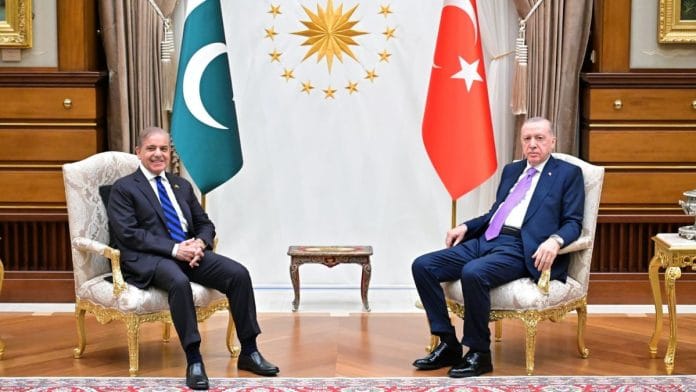
Within a few months in 2026, Pakistan and Türkiye put their names to two defence agreements. The Mecca Joint Defence Agreement with Saudi Arabia was signed in August, followed most recently by a separate Badr defence memorandum of understanding (MoU) with Qatar and Indonesia in October. The agreements signal both the consolidation of Ankara-Islamabad ties and the beginning of the two countries’ burgeoning role as security providers across regions. This role can be easy to misread.
Türkiye and Pakistan are not signing up to fight other states’ wars. What they are arguably doing, though, is emboldening their partners, particularly Islamic nations, by equipping them with a better arsenal to defend themselves. Rather than creating a single formal alliance, the two countries are building an interconnected network of defence arrangements to increase their footprint across regions, from the Gulf to Southeast Asia, with Africa potentially next.
The security architecture that Türkiye and Pakistan are building brick-by-brick leans closer to deterrence by denial instead of deterrence by punishment. Except the means of denial are mainly signalling instruments: both countries seek to dissuade their partners’ adversaries from attacking them through rhetoric and, at best, deploying ‘defensive’ logistics.
Attack on one isn’t an attack on all
The Mecca Pact carries a collective defence clause akin to NATO’s Article 5. The agreement’s text, made public recently, includes in its Article 2 that “An externally originating armed attack against any of the Parties shall be considered an attack against all the Parties”. The attacked party will receive immediate assistance from others with “all means of mutual assistance that they can provide to one another”.
The pact, however, has already faced early credibility tests, having gone uninvoked during crises in which a member state came under attack. For instance, intensifying Houthi attacks on Saudi Arabia and the Afghanistan-Pakistan conflict have not prompted direct military involvement. Instead, the response has focused on mediation and diplomatic support, as evidenced by the Mecca parties meeting Iranian officials in late October to try to de-escalate regional tensions.
In any case, the Mecca Pact countries share divergent threat perceptions. For Riyadh, concerns over Iran, Houthi attacks from Yemen, and overall Gulf security have led it to look for new security guarantors beyond its traditional partner, the United States. For Islamabad, India remains its principal adversary, with Taliban-ruled Afghanistan emerging as another troubled frontier. Meanwhile, Ankara’s chief security concerns stem from Syria, Iraq, the Eastern Mediterranean, the Western Balkans, the Caucasus, and, to some extent, Israel.
Leaders of the Mecca Pact countries have stressed the alliance’s purely defensive nature and said they have not identified any country as a common threat. This means that member states with disjointed priorities may find it difficult to coordinate their military responses or operationally deter their potential adversaries. The latter may take this as a sign that the Mecca Pact members are unwilling to incur risks in conflicts they don’t consider their own. This, in turn, could shape their adversaries’ strategic calculations.
In all likelihood, the pact will prioritise joint military capacity-building during peacetime, while envisaging mediatory and political support, intelligence sharing, and the delivery of weapons and logistics during wartime. This makes its objectives broadly similar to those of the Strategic Mutual Defense Agreement (SMDA) between Pakistan and Saudi Arabia. Article 3 of the Mecca Pact reinforces this interpretation. It states, pursuant to Article 2, that “the Parties shall cooperate closely in the fields of defence, defence industry, and security; develop relations among their Armed Forces; and carry out agreed activities aimed at strengthening cooperation in defence.”
Defence-industrial cooperation, however, will not automatically translate into military interoperability among the armed forces, a goal central to the Mecca agreement. Indeed, Saudi Arabia’s financial resources, Türkiye’s indigenous defense-industrial ecosystem and systems-integration capabilities, and Pakistan’s operational experience and established manufacturing capacity complement each other and represent a remarkable case of pooling assets. But all three countries operate different systems and follow different doctrines. As noted earlier, they also have disparate threat perceptions. These factors may impede the development of interoperable protocols and an integrated command-and-control structure.
The Badr MoU signed on 21 October in Doha makes the nature of its framework clear from the get-go. It does not contain a mutual defence pledge. It aims to focus on improving the signatories’ military-industrial capabilities through joint production, integration, technology transfers, and creation of resilient defence supply chains.
Also read: Will India’s trade deals reach small exporters? Madhya Pradesh’s FTA helpdesk can tell
A Muslim NATO?
The fact that these agreements have been signed by Islamic countries, and are intended to serve their interests, says something about their character, beyond the Islamic names from Mecca to Badr (Arabic for full or bright moon). The Mecca Pact and the SMDA have already been observed as steps toward a ‘Muslim’ or ‘Islamic’ NATO. Article 40 of Pakistan’s constitution guides the country to strengthen “fraternal relations among Muslim countries based on Islamic unity”.
To be fair, both Türkiye and Pakistan have expressed their willingness to provide security to the Muslim world. Their partnership harks back to the Cold War era. They joined Iran in setting up a Regional Cooperation for Development (RCD) in 1964, which became dysfunctional, later being reorganised into the Economic Cooperation Organization (ECO) in 1985, whose members are incidentally Muslim-majority countries.
It won’t be unusual if more Muslim states were to place their bets on Pakistan and Türkiye-led military belts of cooperation. Egypt, despite working closely with the Mecca Pact countries as part of an informal four-country grouping called R4, has not signed the agreement due to its strategic hesitancy toward potential military obligations. There was speculation about Bangladesh joining the Mecca Pact, with indications that it could turn into a broader agreement for the Muslim world. There is a pattern to how this is being built.
Where Türkiye and Pakistan each have good ties with a particular country, they may use that for trilateral cooperation, or widen it to include partners both get along with. Essentially, separate bilateral projects led by Türkiye and Pakistan are being folded into a coordinated framework. The gains for Ankara and Islamabad are regional influence and a bigger defence-industrial footprint through weapons exports, which may create strategic dependencies on them in the longer haul, granting them leverage during crises.
The yardsticks for evaluating the success of the military cooperative systems being built by Ankara and Islamabad look something like this: solidarity and declaratory support alongside likely geopolitical alignment in the short term, and over the medium-to-long term, the benchmark will be the depth of defence-industrial ties they cultivate, which could lay the groundwork for increasing similar security frameworks.
Views are personal.
(Edited by Ratan Priya)