



The Quad pairs four countries—India, the US, Japan, and Australia—to shape an Indo-Pacific defined by strategic alignment. However, the geographic scope of the Indo-Pacific is still to be established.
Strategic experts like Harsh Pant say that drawing precise geographic border lines becomes less important since the Indo-Pacific is primarily a geostrategic concept.
The Westphalian order established by World War II initially responded cautiously to China’s aggressive foreign policy. But Beijing’s continued violation of sovereign land, waters and airspace of neighbouring States required an increasingly muscular response.
The Quad, with its commitment to a rule-based order with three members outside the P5, represented the first realistic and evolving response to China’s aggression by sea and land, especially in the Indo-Pacific. China remains the unspoken, but understood, target of Indo-Pacific cooperation.
For India, the grouping serves as a key platform to balance regional security, diversify supply chains, and uphold strategic autonomy without entering into a formal military alliance.
From East China Sea to the Malacca Strait
Cooperation began informally during disaster relief after the 2004 Indian Ocean tsunami, followed by initial official talks in 2007 before a long pause due to several factors.
Revived in 2017 and elevated to a leaders’ summit format in 2021, the Quad expanded into working groups covering maritime domain awareness, critical and emerging technologies, infrastructure, cybersecurity, counter terrorism, climate and disaster response.
Under US President Donald Trump’s second term, the Quad seemed to have taken a back seat in US strategic priorities. India could not host a Quad Summit in 2025. The debacle in the US midterms appears to have set Trump on a new foreign policy track, like many of his predecessors.
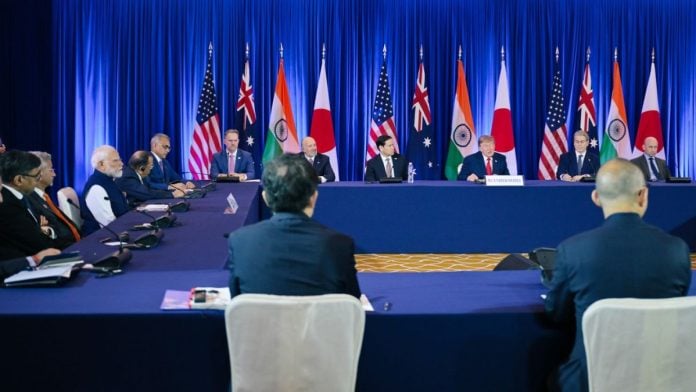
As a result, in November 2026, on the sidelines of the ASEAN Summit in Manila, a Quad Leaders Summit was held that brought the leaders of Australia, India, Japan, and the US together on the same platform.
Quad leaders recommitted, in language Beijing has spent a decade trying to delegitimise—to a free, open, stable, and prosperous Indo-Pacific; to freedom of navigation and overflight; and to opposing any unilateral attempt to change the status quo by force or coercion.
This was a substantive outcome. In the context of the South China Sea, it is a rebuke of Beijing’s grey-zone coercion, maritime militia pressure, and the slow militarisation of this strategic region.
The Quad leaders welcomed the Indo-Pacific Maritime Surveillance Collaboration, announcing, “In 2027, our respective P-8 and P-3C patrol aircraft are scheduled to fly in a maritime exercise for the first time in a Quad context, making our seas safer.”
That sentence is an important operational initiative. Since 2020, India, Japan, Australia, and the US have exercised together in Malabar, but have carefully avoided calling it a Quad exercise. Manila dropped the fiction. It put the Quad label on a flight of submarine hunters: India’s P-8I, America’s and Australia’s P-8A, Japan’s P-3C, aircraft built to find, track, and share data on submarines.
The geography is most important. From the East China Sea to the Malacca Strait to the Indian Ocean, four militaries will now jointly watch Chinese submarine fleets along their primary transit routes. This is a shared maritime domain awareness architecture that can pick up a destroyer, a submarine, or a missile battery.
Also read: Why India’s Black Sea food corridor ambition likely to run into troubled waters
Strategic autonomy in action
There is a parallel move in Tokyo, where India and Japan are exploring the use of Indian test ranges at Chandipur for Japan’s 1,000-km Type 25 anti-ship missile. Japan, a US ally, cannot fire that missile at full range in its own crowded archipelago. India can offer the Bay of Bengal.
That is not a treaty, but it is both investment and trust in a growing strategic partnership. This is strategic autonomy in practice: India provides range safety and geography, Japan provides technology to address a shared threat perception, and both gain a credible anti-ship capability that does not depend on the mood in Washington.
For India, the relevance is not academic. It is geographic and technological.
First, the maritime surveillance patrol puts India at the centre of the Quad’s operational turn, not at its periphery. The Indian Ocean is where Chinese submarines are expanding, where undersea cables run, and where India’s own P-8I fleet, now being expanded, is the only Quad asset that can stay on task for long durations without refuelling politics.
A Quad-branded flight in 2027 means Indian data will feed, and be fed by, American, Australian, and Japanese data in real time. That is a qualitative jump from the Malabar naval exercises.
Second, the related strand is the Chandipur proposal, which, if brought to fruition, solves a problem for Japan and creates leverage for India. It embeds India in the deterrence chain without India having to sign a mutual defence treaty or host US bases.
Also read: India is giving the SCO a history lesson. Purana Qila was the perfect classroom
‘Quad is committed to peace’
The Quad Leaders’ Summit Joint Press Release of 17 November is significant. It states inter alia, “This year marks nearly a decade since the Quad was revived and the 10th anniversary of the vision of a Free and Open Indo-Pacific, first articulated by the late Prime Minister Abe Shinzo of Japan in 2016. A decade on, that vision is stronger than ever. Together, we have shown that the Quad is a force for good and a partnership of action, committed to peace, stability, and prosperity. We strongly oppose any destabilising or unilateral actions that seek to change the status quo, including by force or coercion, which escalate tensions and undermine regional peace and stability.”
The Quad nations expressed grave concerns about economic coercion, including through arbitrary export restrictions, assuring to secure critical supply chains, protecting freedom of navigation and overflight, driving growth through technologies of the future including investments and deployment of trusted AI, and responding to disasters with life-saving assistance.
“The inaugural Quad Business Leaders’ Forum (is) critical to the prosperity of the Indo-Pacific. (It) affirms the importance of the AI Accelerator… intended to coordinate and fund efforts to support trusted AI access, deployment, and technical assistance across the Indo-Pacific,” reads the joint statement, acknowledging the rapid increase in the number and scale of cyber incidents in the region.
Finally, it reaffirms the commitment to upholding a free and open Indo-Pacific.
The Quad is the first entity to acknowledge that engagement with a China determined to establish its primacy in a new world order comes perilously close to appeasement. The EU, part of the Western Alliance, is no longer a balancing power between America, the Quad and China. That has many grave strategic implications.
A visit down memory lane should suffice to remind Western leaders of their own history. The policy of appeasement and the peace at Munich, which collapsed, leading to World War II, is an ominous indication that unless checked, history can repeat itself. Will the West, especially the US, finally arrive at that elusive consensus before it is too late?
As Victor Hugo said, “You can resist an invading army, but you cannot resist an idea whose time has come.”
The Quad is a forceful idea whose time has come. It rejects appeasement and recognises the challenges of China’s unimpeded rise. Quad marks the emergence of a new form of strategic autonomy, in the dangerous interregnum between world orders. India remains a crucial pivot in these developments.
Bhaswati Mukherjee is a retired IFS officer. She has served as India’s ambassador to UNESCO, Paris, and the Netherlands. She tweets @AmbBhaswati1. Views are personal.
(Edited by Saptak Datta)