



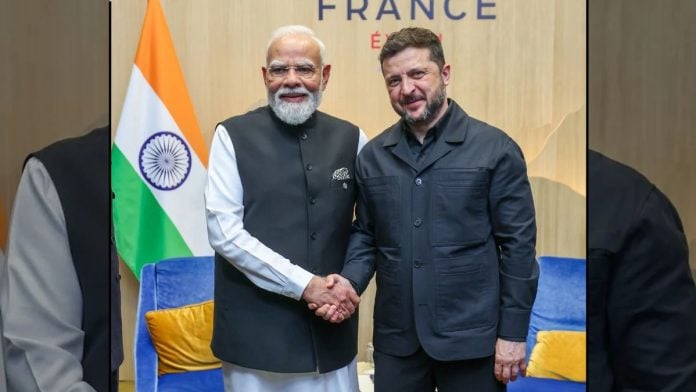
Earlier this month, India’s role in the Russia-Ukraine conflict moved beyond rhetorical calls for dialogue and diplomacy. After a phone call with Prime Minister Narendra Modi, Ukrainian President Volodymyr Zelenskyy said, in an X post, “India is ready to act as a mediator in establishing food corridors”. A day later, India’s Ministry of External Affairs said New Delhi is engaged with both Moscow and Kyiv on shipping safety in the Black Sea, grain and energy exports, and the potential non-attack agreements.
From being reticent about playing a proactive role between warring nations to pursuing this role, India has come a long way. The development comes as the Opposition says India is “just looking”, while Pakistan is busy facilitating dialogue between the US and Iran.
“By our size, our history and our relationships, we should be involved in these global conversations. But frankly, India has become a side player. We have stepped back from the stage. We have a voice and a view, but that view is missing,” the Leader of the Opposition Rahul Gandhi said.
With the Russia-Ukraine war and the West Asia conflict, many countries have sought to play the intercessor’s role, hoping to broker de-escalation and further build their mediation diplomacy portfolio. Some have read Pakistan’s go-between role in zero-sum terms – as proof that India is being sidelined and as an indictment of its foreign policy.
Although India has yet to formally announce the Black Sea Corridor, pursuing the initiative holds significant strategic merit. If it works, it may blunt the charge that India is not living up to its potential. However, the success of India’s efforts, albeit better late than never, particularly through food security diplomacy, hinges on factors beyond its control, and it may have to up its diplomatic ante.
A safer mediation tool
After the call, Zelenskyy said India could identify how it can help bring the war to an end through its own actions and dialogue with other leaders. One area could be food security, and the reason he provided was Russia blocking grain exports in the Black Sea. In truth, Ukraine, too, has attacked Russia’s agriculture-related infrastructure and exports, with both seeing a reduction in their food and fertiliser exports.
Modi’s own readout reaffirmed India’s “human-centric approach” and its efforts toward a peaceful resolution of the conflict, but without any reference to food corridors. Shortly after the Modi-Zelenskyy call, Indian Foreign Minister S Jaishankar spoke to his Russian counterpart, during which the former updated Sergey Lavrov on “ongoing diplomatic initiatives focused on the conflict”.
On India’s part, food security may be a safer instrument to mediate between Russia and Ukraine. A couple of months after the Russia-Ukraine conflict broke out in February 2022, which led the world to absorb food supply shocks, Modi said not only did India have enough food for its population, but it was also ready to supply food stocks to the world, if the World Trade Organization allowed.
However, after expressing its intent to feed the world, India banned the export of wheat in May 2022 to rein in domestic wheat prices. This blow came as countries reliant on imported grains, chiefly wheat, were looking to India to minimise the war-induced damage caused to their supply chains, considering Russia and Ukraine together account for nearly a third of the world’s wheat exports.
India is the world’s second-largest wheat producer but accounted for, by some estimates, less than 1 per cent of global wheat exports. It lifted its export ban only in August 2026. India could now fill part of the gap left by disrupted Black Sea shipping, as well as ensure export profits for its farmers. But wheat is a fertiliser-intensive crop, and India, the world’s second-largest fertiliser consumer, relies heavily on imports, with Russia emerging as the country’s single-largest foreign supplier.
New Delhi, therefore, has reason to keep Kyiv and Moscow engaged on a Black Sea corridor proposal for both domestic gains and the benefit to import-dependent countries seeking safer shipping of their supplies; the latter could additionally bolster India’s Global South leadership credentials.
This latest push won’t solely be about improving New Delhi’s diplomatic standing. There is a strong domestic rationale, even beyond grains. For instance, India is the largest importer of vegetable oil and has seen its sunflower oil imports plummet since it sources much of the oil from Russia and Ukraine.
Furthermore, India is the world’s second-largest supplier of seafarers, accounting for 12.16 per cent of this global workforce, and its sailors are increasingly being trapped in multiple conflict theatres. In July 2026, New Delhi separately summoned the Russian chargé d’affaires and the Ukrainian ambassador to protest the deaths of Indian seafarers caused by their attacks on commercial vessels.
Also read: India is giving the SCO a history lesson. Purana Qila was the perfect classroom
Will it work?
Food corridor initiatives are not new to India. A notable example is the $7 billion food security corridor signed with the United Arab Emirates (UAE) in 2022, building on earlier investment groundwork that began in 2019. This partnership aligned the UAE’s need for food security, given its heavy reliance on agricultural imports, with India’s strategic push to enhance the value of its agricultural production.
The UAE also pledged $2 billion in 2022 to establish integrated food parks across India aimed at maximising crop yields and ensuring food security across South Asia and the Middle East. This initiative was under the ‘I2U2’ framework involving India, Israel, the UAE, and the US, and would rely on American and Israeli technologies, though its implementation has reportedly stalled. Still, the India-UAE collaboration foregrounded a forward-looking model on global food security.
Establishing a corridor in the Black Sea, which has become the deadliest shipping route despite fatalities in the Gulf, like the Strait of Hormuz, gaining more traction worldwide, would be no mean feat. Moreover, in the Russia-Ukraine theatre, a food corridor would require bilateral de-escalation even if it is negotiated by a third party like India acting in good faith. With the Ukrainian attack on the Kerch Bridge, which connected Crimea with Russia, subsequent retaliation by Russia, and most recently, Ukraine’s attack on the Russian warship Merkury in Libya, de-escalation appears out of sight.
Previously, similar food corridors have been held hostage to escalation. The Black Sea Grain Initiative (BSGI), brokered by Turkey and the United Nations, lasted from July 2022 to 2023. Though Russia pulled out of BSGI for a host of reasons, Ukrainian attacks acted as a multiplier of sorts. Currently, Ukraine says it has four ceasefire proposals from India, Turkey, Egypt and the US, with New Delhi’s plan being deemed “the broadest” since it covers, according to the Ukrainian foreign minister, both Black Sea and energy infrastructure.
Though New Delhi has not publicly confirmed the corridor, it should move beyond ad hoc diplomacy and turn it into something defined and verifiable. For a war that’s about to enter its fifth year, there are openings India can use, lest it cede diplomatic influence to countries like Turkey that would be happy to fill the space. A peace plan may force a mediator to take positions where India’s closeness to Russia and its image of neutrality would be tested. But a corridor resting on food security serves Russian and Ukrainian exporters alike – and the world too. India’s message is that “endless wars must now give way to an end to war”. An India-brokered food corridor can very well be a step in that direction.
Bantirani Patro is a Staff Writer at ThePrint. She tweets @bantirani_patro. Views are personal.
(Edited by Saptak Datta)