


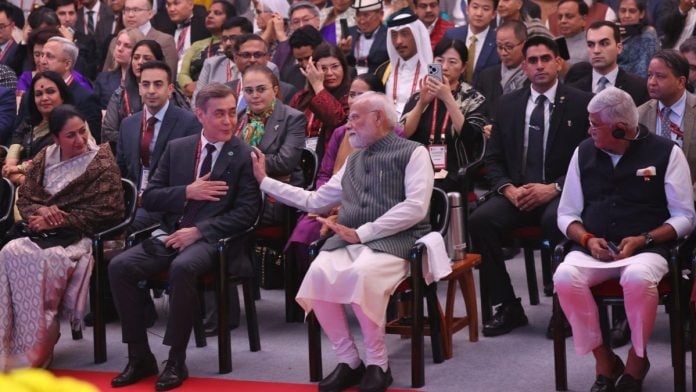
A fort becomes Purana only when something newer takes its place. From 20 November to 22 November, delegates from 22 countries gathered at Delhi’s Purana Qila for the first Shanghai Cooperation Organisation Civilisational Dialogue Forum.
The setting had history in every rampart. Humayun began the citadel as Dinpanah, the “Refuge of the Faithful”, in 1533. Sher Shah Suri drove him into exile and rebuilt it as Shergarh in 1540. Humayun took it back fifteen years later, and only a few months after that fell to his death from the steps of its library, the Sher Mandal. The citadel became Qila-e-Kohna, the Old Fort, only after Shah Jahan raised the Lal Qila upstream.
Beneath the Mughal and Sur masonry lies a much older Delhi. Excavations have turned up Painted Grey Ware, Mauryan terracotta and Shunga, Kushan and Gupta layers. Until 1913, a village called Indrapat survived inside the walls, keeping alive the memory of Indraprastha. In popular tradition, it is the first of the five prasthas, or pats, that the Pandavas would have accepted in place of a kingdom to avert the Mahabharata war.
The other four were Panaprastha (Panipat), Swarnaprastha (Sonipat), Vyaghraprastha (Baghpat) and Tilaprastha (Tilpat). So naming the outcome document the Indraprastha Communiqué was more than a flourish. It was India inviting Eurasia to see the SCO as a confluence of ancient civilisations, and not merely as a security bloc.
Delhi has traditionally been counted as seven cities, each built beside the ruins of the one before. Prithviraj Chauhan expanded the Tomar citadel of Lal Kot, transforming it into Qila Rai Pithora. Then came Alauddin Khalji’s Siri, the Tughlaqs’ Tughlaqabad and Jahanpanah, Firuz Shah’s Firozabad, the Dinpanah–Shergarh of Humayun and Sher Shah, and finally Shah Jahan’s Shahjahanabad.
Lutyens’ New Delhi makes eight, and its central vista, now Kartavya Path, points directly at Purana Qila. The planners of the imperial capital clearly understood what they were aligning themselves with.
The reluctant member
India came into the Shanghai Cooperation Organisation (SCO) cautiously, almost reluctantly. The grouping began in 1996 as the “Shanghai Five”: China, Russia, Kazakhstan, Kyrgyzstan and Tajikistan, meeting to settle borders and build military confidence after the Soviet collapse. When Uzbekistan joined in 2001, it became the Shanghai Cooperation Organisation, with countering “terrorism, separatism and extremism” as its creed. New Delhi first saw it as a Sino-Russian instrument for Central Asia. In 2205, India became an observer and kept its distance to protect its strategic autonomy and its warming ties with Washington.
Russia supported India’s entry to balance China, and Beijing insisted that Pakistan come in at the same time. Both were admitted at the Ufa summit in 2015 and became full members at Astana in June 2017. Iran joined in July 2023, fittingly under India’s chairmanship, and Belarus followed at Astana in July 2024, bringing the membership to ten. Around them is a widening circle of two observers, Afghanistan and Mongolia, and 15 dialogue partners stretching from Türkiye, Egypt and the Gulf to Nepal, Sri Lanka, the Maldives, Myanmar, Cambodia and Laos. The SCO family now numbers 27 countries.
Within SCO, India has been pragmatic but firm. It has repeatedly declined to endorse China’s Belt and Road Initiative. In June 2025 at Qingdao, Defence Minister Rajnath Singh refused to sign a joint statement that mentioned Balochistan but left out Pahalgam. At the same time, India has steadily built a constructive record: a start-up forum and a Special Working Group on innovation, a Young Scientists Conclave, an exhibition on shared Buddhist heritage, and a campaign of more than a decade to make English an official language.
That campaign succeeded at the Bishkek summit in September, when the SCO amended its charter to add English alongside Russian and Chinese. Building on that institutional momentum, New Delhi turned to cultural diplomacy: Prime Minister Narendra Modi proposed the Civilisational Dialogue Forum at Tianjin in 2025, and the Bishkek Declaration welcomed it. It is India’s most ambitious cultural initiative in the grouping so far.
Also read: Rahul Gandhi keeps painting Bharat in a bad light. He must study Nehru’s foreign policy
The Culture Secretary’s Forum
The forum was jointly run by the Ministry of Culture, under Secretary Vivek Aggarwal, and the Ministry of External Affairs, with the Indira Gandhi National Centre for the Arts as the knowledge partner.
It put immersion ahead of protocol. Delegates walked through Astitva, which tells the story of Delhi through archaeological evidence from about 1200 BCE to 1200 CE. They examined an 18th-century illustrated Mahabharata scroll and visited The Light and the Lotus, the exhibition of the Buddha’s relics at the Rai Pithora Cultural Complex. The sessions covered manuscripts, architecture, music, textiles, cuisine, traditional games and “Monastic Trails” across the Buddhist world.
Most such gatherings end with a group photograph and a press release. Aggarwal came away with deliverables: artefact exchanges, joint museum exhibitions, cooperation on preserving manuscripts, artist residencies and wider people-to-people links. In the process, the Culture Ministry has established itself as an actor in Indian diplomacy.
Ambassador Alok A Dimri, the MEA’s SCO National Coordinator, carried out the diplomatic spadework from Tianjin to Bishkek. In April, he held India’s first bilateral consultations with China on SCO matters in New Delhi. From 28 September to 30 September, he travelled to Islamabad for the national coordinators’ meeting, the highest-level Indian visit to Pakistan in 18 months. His warm exchange with Pakistan’s deputy Prime Minister and Foreign Minister Ishaq Dar, and the wish he expressed to see Lahore, Faisalabad and Sialkot, eased the way for a Pakistani minister to arrive in Delhi seven weeks later.
Also read: BJP’s youth brigade falls by the wayside as defectors take centre stage
What the Communiqué says
The Indraprastha Communiqué was adopted by 116 delegates from 22 nations in the presence of SCO Secretary-General Nurlan Yermekbayev, a former Kazakh defence minister.
It commits signatories to treat every civilisation as an “equal voice”. It defines heritage generously, from monuments and manuscripts to cuisine, crafts and living traditions. It calls for protecting heritage from trafficking and from climate disasters, for joint UNESCO nominations and shared digital repositories, and for responsible use of AI to open heritage to everyone while respecting the communities who are its custodians.
Opening the forum, Modi called cultural connection the “strongest guarantee for global peace”. He traced exchanges from Indus–Mesopotamia trade and the spread of Buddhism across Asia to India’s intellectual links with Persia, the Arab world and Central Asia. He proposed AI-assisted translation of manuscripts, joint exhibitions, Silk Road and Buddhist tourist circuits, and youth exchanges. Iran’s Mohammad Mehdi Imanipour pledged active support, speaking of dignity and coexistence.
The most memorable speech came from Pakistan’s Climate Change Minister Musadik Masood Malik, the first Pakistani federal minister to visit India since May 2023 and the first since Pahalgam and Operation Sindoor. Malik spoke in Urdu out of deference, he said, to Ghalib, who lies buried a short distance away in Nizamuddin. He observed that outsiders had never diminished Delhi, and pointed to the fort shared by Humayun and Sher Shah:
“One wall, two rivals, two rulers and one Qila,” he said, proposing a cultural network, a shared digital repository and a framework for making heritage climate-resilient.
Politics was never far away. Malik spoke of Pakistan’s own losses to terrorism and asked for mechanisms to share evidence. New Delhi cleared his visit to the Taj Mahal but refused permission for the Nizamuddin dargah. The irony was plain: the minister who spoke in Urdu for Ghalib’s sake could not visit the neighbourhood where Ghalib is buried.
Also read: India sells pluralism abroad but struggles to practise it at home
Thaw, or Thermometer?
With the Indus Waters Treaty still in abeyance, it is too early to call this a thaw. It is better read as a thermometer. Multilateral venues allow conversations that would carry too high a political price in a bilateral setting.
Pakistan now chairs the SCO until the 2027 Islamabad summit, and Bishkek named Lahore the SCO Tourism and Cultural Capital for 2026–27. That gives India a clear opening.
When Indian delegations go to Lahore, they should bring out the city’s full civilisational record and not stop at the Mughals. Tradition holds that Lahore was founded as Lavapuri by Lava, son of Rama, whose small Sikh-era shrine still stands inside the Lahore Fort; neighbouring Kasur claims his twin, Kusha.
Lahore was also Maharaja Ranjit Singh’s imperial capital, and in the colonial era it was the “Paris of the East” of British Punjab, a city of colleges, presses and Mall Road debates. Speaking of all these layers in Lahore would honour the spirit of the Indraprastha Communiqué: every civilisation given an equal voice on shared ground.
Sanjeev Chopra is a Senior Fellow at the Centre for Contemporary Studies, Prime Ministers Museum and Library (PMML), New Delhi, where his Fellowship topic is Borders, Boundaries and Bluewaters of Bharat. He tweets @ChopraSanjeev. Views are personal.
(Edited by Saptak Datta)
Syncretic traditions. Do not think of one thousand years of Muslim, then Mughal, rule in unvarnished, noir terms. The statistic some quote of India’s share in global GDP, decimated during British colonial rule, was clocked during the Mughal era.