


New Delhi: India’s proposals for a ceasefire in the Russia-Ukraine war revolve around ensuring safety of commercial shipping in the Black Sea and the flow of grain and energy supplies, Ministry of External Affairs spokesperson Randhir Jaiswal said Tuesday.
India has increased its engagement with both Moscow and Kyiv in recent months in an effort to find common avenues where the two countries can de-escalate the conflict, especially in the Black Sea. In the last few months, both Russia and Ukraine have intensified military actions in the Black Sea, which has impacted commercial shipping vessels and Indian seafarers.
“On the issue of the Ukraine conflict, India has consistently maintained that dialogue and diplomacy are the way forward. In recent months, the Prime Minister has expressed that ‘endless war must give way to end of war’,” Jaiswal said at a regular press briefing. “In keeping with this idea to bring peace, India has been engaging both sides with certain ideas such as safety of shipping in the Black Sea, addressing immediate concerns of Russia and Ukraine on grain and energy exports, and non-attack possibilities.”
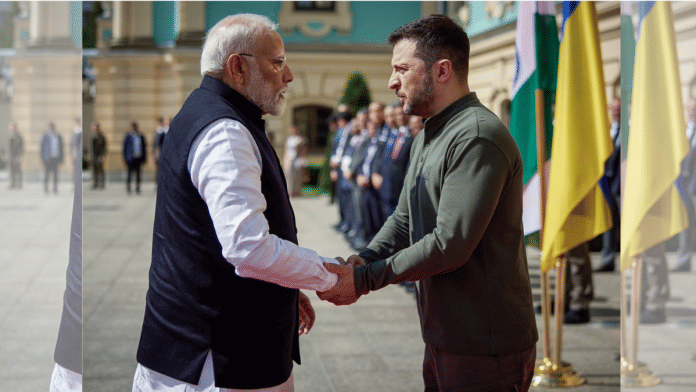
The MEA spokesperson further said: “Yesterday the Prime Minister (Modi) spoke with President Zelenskyy. They shared perspectives on the ongoing conflict, its humanitarian aspects and various efforts to restore peace. The Prime Minister reiterated India’s firm commitment to contributing in every possible way towards a peaceful resolution.”
Following the Modi-Zelenskyy call, External Affairs Minister S. Jaishankar had a call with his Russian counterpart Sergey Lavrov late Monday evening. Jaishankar updated Lavrov on the “ongoing diplomatic initiatives focused on the conflict”.
The back-to-back calls came on the eve of the resumption of trilateral discussions between Russia, Ukraine and the US in Abu Dhabi. The talks began Tuesday evening, and are scheduled to conclude Wednesday.
Jared Kushner, US President Donald Trump’s son-in-law, is part of the American delegation, and had in a statement on X highlighted that these talks are focused on addressing post-war security concerns.
The trilateral discussions had been suspended since February. Both Russia and Ukraine intensified attacks on respective military positions, as well as taking aim at energy infrastructure. Trump has blamed Kyiv for the surge in global oil prices, as Ukraine struck Russian refineries throughout the year.
For Moscow, any peace deal remains contingent on its maximalist claim of the entire territories in the Donbas region of Eastern Ukraine, including the provinces of Donetsk and Luhansk. Ukraine still controls roughly a quarter of territory in the province of Donetsk.
European officials from France and Germany as well as NATO officials are also present in Abu Dhabi. India has no representation present, but continues to engage with both Moscow and Kyiv bilaterally.
Last month, Finnish President Alexander Stubb, and Norwegian Prime Minister Jonas Gahr Støre had a call with Russian President Vladimir Putin, as European leaders continue to try to find a way to remain engaged in the peace talks.
Stubb and Store’s call has divided European leaders. For India, the key interest remains in the flow of crude oil from Russia and grains from Ukraine. The conflict in the Black Sea in the last few months has also put Indian sailors at risk.
The proposal of food corridors is the first initiative by India in the almost half-decade long war. The proposal has been described as the “broadest” by Ukrainian Foreign Minister Andrii Sybiha, and has found public support from Putin as well.
(Edited by Gitanjali Das)
Also Read: Ukraine fires new indigenous ballistic missile in largest attack on Moscow. Why it matters