


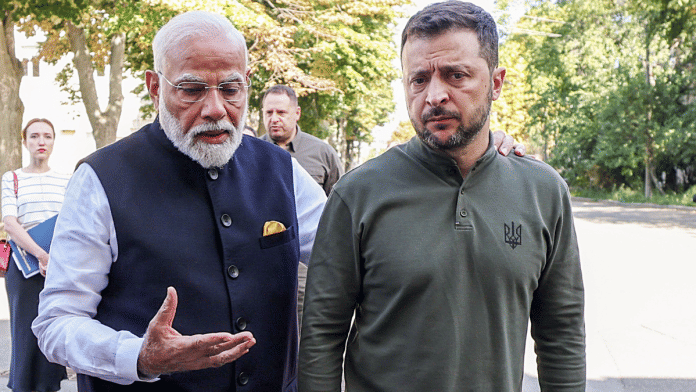
New Delhi: India is ready to help establish food corridors through the Black Sea amid the Russia-Ukraine war, Ukrainian President Volodymyr Zelenskyy said Monday, following a call with Prime Minister Narendra Modi. Shortly after, External Affairs Minister S. Jaishankar held a telephonic conversation with his Russian counterpart Sergey Lavrov.
“Our conversation focused on the Ukraine conflict and ongoing diplomatic initiatives,” Jaishankar wrote on X.
Modi, in a statement on X, highlighted India’s “firm commitment to contributing in every possible way towards a peaceful resolution”. New Delhi and Kyiv have over the past few months discussed a variety of ceasefire options proposed by India.
“Glad to have had a productive telephone conversation with President Zelenskyy. We reviewed our wide-ranging bilateral cooperation and agreed to further strengthen India-Ukraine ties. I thanked President Zelenskyy for sharing his perspectives on the ongoing conflict, its humanitarian aspects and various efforts to restore peace,” added Modi.
Glad to have had a productive telephone conversation with President Zelenskyy. We reviewed our wide-ranging bilateral cooperation and agreed to further strengthen India-Ukraine ties.
I thanked President Zelenskyy for sharing his perspectives on the ongoing conflict, its…
— Narendra Modi (@narendramodi) November 9, 2026
Zelenskyy in his own statement on X highlighted that “it is important that India identify what steps it can take and what dialogue it can pursue with other leaders to help bring the war to an end”.
I spoke with Prime Minister of India Narendra Modi @narendramodi and briefed him on the latest diplomatic developments. We are actively preparing on every item on the agenda for the meeting in Abu Dhabi. Ukraine has always taken a constructive approach, and Russia must show the… pic.twitter.com/UTe17pVWBN
— Volodymyr Zelenskyy / Володимир Зеленський (@ZelenskyyUa) November 9, 2026
During External Affairs Minister S. Jaishankar’s visit to the Ukrainian capital in early September, India had conveyed to Ukraine its position on a possible ceasefire in the Black Sea between Kyiv and Moscow.
Besides meeting with his counterpart Andrii Sybiha in Kyiv, Jaishankar also held conversations with his Polish counterpart Radosław Sikorski in Warsaw about the ongoing conflict. The almost half-decade long war, has seen an intensification over the summer, with both Russia and Ukraine taking aim at commercial shipping vessels in the Black Sea, which has further dented international trade.
Spoke this evening with Foreign Minister Sergey Lavrov of Russia. Our conversation focused on the Ukraine conflict and ongoing diplomatic initiatives.
— Dr. S. Jaishankar (@DrSJaishankar) November 9, 2026
“We discussed Russia’s blocking of grain exports via the Black Sea. India is ready to mediate in establishing food corridors, and we are counting on these efforts to continue. Russia must understand that the global economy and hundreds of millions of people around the world are suffering because of blocked sea routes. We agreed that our teams will stay in touch on these and other bilateral issues,” said Zelenskyy.
Russia and Ukraine are set to restart their talks for a ceasefire Tuesday. After nine months, delegations from the two countries, along with US negotiators, are set to meet at the Emirati capital for two days. While there will be no Indian representation at the trilateral talks in Abu Dhabi, New Delhi has maintained bilateral communication with all parties for the better part of the last few months.
Meanwhile, US President Donald J. Trump met Moscow’s special envoy Kirill Dmitriev in Washington on 5 November, and predicted a “big, beautiful agreement” that could involve all of Europe.
Jared Kushner, Trump’s son-in-law and one of the negotiators representing the US, had on 6 November, highlighted “five principal goals” to bring an end to the conflict, which could include “permanent security consultations, reliable crisis communications, greater military transparency, reciprocal measures to reduce escalation risks, and, an enduring framework for long-term European security and stability”.
However, last month, Kremlin spokesperson Dmitry Peskov poured cold water over any suggestion that Moscow would agree to a halt in the conflict while the trilateral talks are ongoing. Trump had announced that there would be an “energy ceasefire” last month, which Moscow violated within days.
The Indian proposal for a ceasefire, especially in the Black Sea, has been welcomed by both Moscow and Kyiv. Sybiha in a statement last month called the Indian proposal the “broadest” of all the ceasefire ideas floated to Kyiv and Moscow.
This is the first major proposal made by India to bring the conflict to an end. Prime Minister Modi has continued to maintain that “dialogue and diplomacy” is the only way forward, and called to move from “endless war to the end of war” during a meeting with Putin this year.
India has been one of the largest buyers of Russian oil through the conflict, and has maintained a close partnership with Moscow. New Delhi has also maintained open lines of communication with Kyiv, while sending humanitarian aid to the Eastern European country over the last four-and-half years of war.
(Edited by Amrtansh Arora)
Also Read: Not just a military theatre: Strategic significance of the Black Sea, beyond Russia & Ukraine