






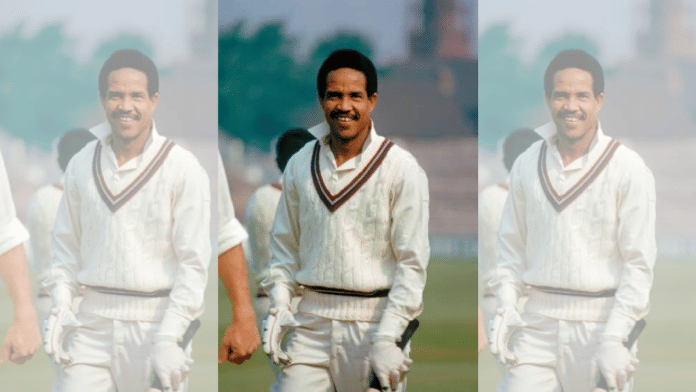


West Indies legend Garry Sobers was hands down the greatest all-rounder cricket has ever seen.
Watching the archive videos, as I didn’t have the privilege to watch him play, it almost confuses your brain. Is it possible for a player to do it all, and with such flair?
Cricket has gotten more professional, more scientific, and more lucrative. All of the data-driven training is great at producing specialists, but it cannot clone an unstructured genius like Sobers.
I am glad Sobers didn’t play in this era of modern cricket. Today, an academy would just have picked one lane for him by the age of 16.
Sobers batted left-handed but bowled right-arm. So, he would open the bowling with pace, then later switch to left-arm spin, then to wrist-spin. That’s almost inconceivable and unheard of now.
The great batsman Don Bradman, after watching Sobers hit 254 against Australia in January 1972, said, “I believe his innings was probably the best ever seen in Australia.”
In fact, Sobers held the world record for the highest individual score in Test cricket for nearly 40 years: 365 not out against Pakistan in 1958, made when he was just 21 years old. He finished with over 8,000 Test runs at an average of more than 57. It is absolutely fantastic for someone who also carried the bowling load.
In 1968, playing for Nottinghamshire, he became the first player in first-class cricket to hit six sixes in an over, off bowler Malcolm Nash. Now, Yuvraj Singh’s six sixes off Stuart Broad is close to our heart, but Sobers’ string of sixes is one of the most replayed moments in the sport’s history, and my Google search as well.
His bowling figures have been equally good: 235 wickets in 93 Test matches isn’t a small feat. He was a madman for sure.
The triple threat
Modern cricket has engineered the conditions that make another Sobers impossible.
Nowadays, specialisation starts too early. A kid’s role is decided by their mid-teens: pace bowler, top-order batter, keeper-batter, and everything from strength training to net sessions gets built around that single identity. Vaibhav Sooryavanshi is a case in point.
He made his international debut for India when he was just 15 years old, and his gameplay, through the IPL and now in the T20I outings against England, has been built around one setting: high-risk aggression. Sooryavanshi has been labeled “the next Tendulkar,” “a prodigy,” “the next big thing in Indian cricket.” Yes, it’s thrilling to watch. But that’s precisely the problem.
A career scripted this early, around one explosive skill, is the opposite of how a Sobers gets made. Tendulkar himself took years to become the batter we remember. Sooryavanshi is being asked to be the finished product before he has even faced a googly on a wearing fifth-day pitch.
Sobers became a “triple threat” because nobody made that early call for him.
Also Read: Why World Cup champions India crashed to a T20I series defeat in Ireland
Endless domestic cricket
Bowling fast for a few overs, then switching to finger-spin, then batting at four, that’s challenging, both physically and mentally.
Such swift role-switching needs time and low-stakes cricket to develop. Sobers played endless domestic and club cricket without central contracts monitoring his workload.
Indian cricket, for example, has spent the last few years openly discouraging exactly that.
Virat Kohli went 12 years between Ranji Trophy appearances, from November 2012 to January 2025, before turning up for Delhi and making six runs. Rohit Sharma had a similarly long gap, returning to the Ranji Trophy after roughly nine to ten years away. Both returned only after the BCCI began making domestic red-ball cricket mandatory for centrally contracted players.
A warning was issued that those who skip three or four Ranji games in a season risk being dropped from IPL contention. Still, the enforcement has been patchy. Ishan Kishan kept skipping the Ranji Trophy despite the BCCI’s directive, and Shreyas Iyer and Deepak Chahar also sat out a round after being explicitly told to play.
Kapil Dev said it right: whether a player scores zero or scores heavily, domestic cricket must be treated as part of the system, not an optional tune-up you dip into.
That is actually the real gap between eras. You don’t become a Sobers in the gaps between franchise commitments; you develop that range in the years nobody is paying attention. And, it’s the kind of career today’s system no longer allows its stars to have.
Today’s schedule is so saturated with franchise leagues (because that’s where the money is) and bilateral series that players are actively managed to do less, not more.
Workload management, for what it’s worth, is the natural enemy of a Sobers-type career. This may give a toxic boss vibe, but it is what it is.
Yes, franchise cricket has indeed produced brilliant multi-skilled players, but they are optimised for six-over spells and cameo innings. They aren’t built for the sustained, five-day, three-discipline mastery Sobers had. A T20 all-rounder is valuable for versatility across formats. However, Sobers was valuable for being great at everything in the most demanding format there is.
That’s why he was arguably the purest product of that unstructured environment. He was not over-coached, which is a slightly uncomfortable thought regarding how we develop athletes today.
Views are personal.