




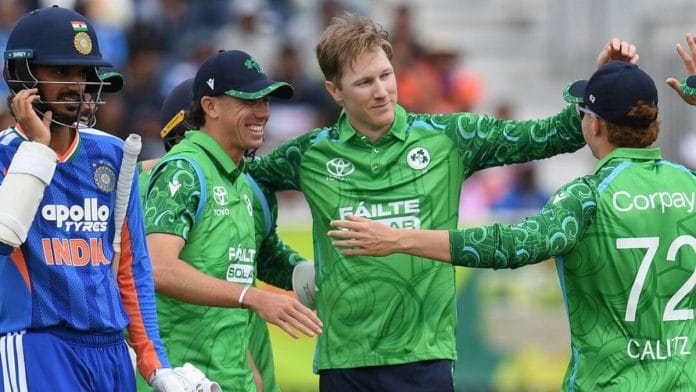

Sunday, 28 June, will go down as one of the most embarrassing days in Indian cricket’s recent history. The squad lost the two-match T20I series to Ireland, handing the hosts their first-ever bilateral T20I series win over India. Nobody could have predicted this before the tour, considering this is almost the same team that won the T20 World Cup.
What made the defeat even harder to digest was the fact that Ireland didn’t deliver a standout performance. India’s downfall was largely self-inflicted.
Overconfidence, poor game awareness, and an inability to adapt to unfamiliar conditions exposed flaws in a team that has no dearth of international talent.
India were chasing in both matches and failed on both occasions. In the opening T20I, they fell 34 runs short of a target of 183. The second game was a close call. Chasing 155, India lost by one run.
But there could be another angle to this story. Did T20 fatigue finally catch up with the Indian side?
Heavy workload
Since late 2025, India’s core T20 group has barely had a break. They played home series against South Africa (November and December 2025) and New Zealand (January 2026) before the ICC Men’s T20 World Cup. Just 19 days later, the 65-day IPL season began.
The Ireland squad reflected that workload. Four members of the playing XI had featured in the IPL playoffs, including top-order batters Abhishek Sharma and Ishan Kishan. The remaining players had also completed the full IPL season, while seven members of the squad had represented India at the T20 World Cup. Nearly the entire squad had also played one or both bilateral series before the IPL.
Physically and mentally, there was little respite, with only over three weeks between assignments before another international series. However, fatigue alone cannot explain a defeat of this magnitude.
Inability to adapt
Arguably, if the series against Ireland had been played in India, the results could have been different. The team struggled to adapt to Irish conditions.
The biggest issue was India’s inability to switch gears after leaving the IPL environment. The batting unit, especially the top order (Abhishek Sharma, Sanju Samson and Ishan Kishan), which had looked fearless throughout the World Cup and IPL, suddenly appeared one-dimensional.
The typical IPL mindset of aggressive stroke-making, which thrives on flat Indian surfaces, proved ineffective on Belfast’s slow, two-paced pitches. The batters required timing, not power, in order to score.
Rather than recognising the conditions, rotating the strike and building partnerships, the batters continued to swing for the boundary, leading to soft dismissals and middle-order collapses in both matches.
India also misread the venue. Captain Shreyas Iyer and assistant coach Ryan ten Doeschate admitted after the series that the team failed to account for Belfast’s unusual ground dimensions. Ireland cleverly protected the short straight boundaries and forced India to target the longer pockets of the ground.
The visitors looked tactically unprepared. They didn’t hit their first six in the second T20I until the 18th over, which indicated just how uncomfortable they were.
The overcast conditions only added to India’s troubles. Ireland’s bowlers exploited seam movement to their heart’s content, varied their pace, and bowled with discipline.
India, on the other hand, failed to respond either with the bat or the ball, looking reactive instead of proactive throughout the series.
Losing a bilateral T20I series is not unprecedented. Losing one to a side ranked below you after being overwhelming favourites is.
Views are personal.
(Edited by Prashant Dixit)