





In Zoya Akhtar’s 2019 film Gully Boy, Safeena Firdausi moves through Mumbai’s lanes in a hijab. But refreshingly, that is not the focal point of her character. Played by Alia Bhatt, Safeena argues with her mother, plots with Murad, throws punches when needed, and still covers her hair. The film almost lets her be normal. Almost, because, like nearly every Muslim woman Bollywood writes, she still has to come from an oppressive household. When she pushes for the most basic freedoms—going out, watching films, wearing lipstick—her mother beats her for it; the film spells out her “oppression” as bluntly as it can. Then, in the climax, as she goes to watch Murad’s final performance, the scarf comes off—right as the film needs you to feel her break free.
Alankrita Shrivastava’s Lipstick Under My Burkha (2016) builds its premise around the same idea, just louder. Rehana, a college student from a conservative family, is forced into a burkha by her parents every time she leaves the house. She removes it the second she’s out of their sight, changing into ripped jeans and lipstick to chase a Miley Cyrus fantasy of herself. The burkha here is portrayed as something to get past, not something she wears.
Similarly, in Advait Chandan’s Secret Superstar (2017), Insia’s burkha comes off as soon as she steps into the light, the visual grammar unmistakable: this is what freedom looks like. The camera frames the removal as the final break from a tyrannical father and a life of secrecy.
Now, while the enforcement of the hijab and burkha remains a real problem for many women in Muslim households, Bollywood’s limited, yet relentless framing of the garment as pure oppression leaves almost no room for the counter-narrative of it being a choice and identity. The only counter-narrative Bollywood offers is Salman Khan tripping over a borrowed burkha in Bajrangi Bhaijaan (2015). Groundbreaking.
As someone who loves Bollywood films, I have craved a representation that did not treat the hijab as either tragedy or comic relief. But after a while, I found a different portrayal of the cloth somewhere else entirely; not in a cinema hall, but in watching other women style it, wear it, and live loudly in it, on screens much smaller than any multiplex.
Also Read: Defended by husbands, scrutinised by media—why Sarah Jukaku and Rama Duwaji don’t speak
The rise of hijabi content creators
The boom in hijabi content creators did not happen in a vacuum. India is home to over 200 million Muslims, where most of the population is notably young, urbanising, and increasingly online. Social media gave hijabi women the means to stop waiting for industry approval and start setting their own terms. The numbers are only now catching up to what they built. India’s own modest clothing market is projected to reach around $662 million by 2034.
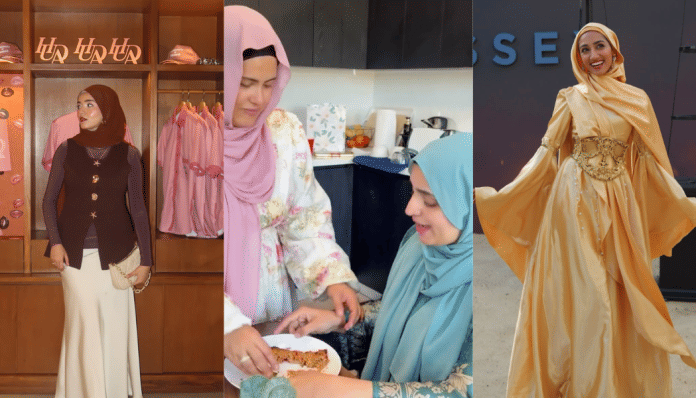
Instagrammer Anah Shaikh began with a private account and only 50 followers. Today, the Mumbai-based influencer has about 2.4 million followers on Instagram, runs her own label, and has collaborated with brands such as Huda Beauty while also landing a Femina cover themed around resilience and entrepreneurship. Scroll her page, and you can see makeup tutorials, travel, product launches, and somewhere beneath it all, an argument she never has to make outright: the hijab can be sleek, commercial and aspirational.
Mariyam Pothiawala offers a more personal arc. The stylist-turned-designer did not begin as a natural or enthusiastic hijabi. In college, she saw the garment as a restriction, something many hijabis often feel. But over time that shifted. She has described finding comfort, beauty, and self-expression in it.
“You made me stand out at all the events. I found my own comfort in you, my beauty within you.”, she says in an Instagram post.
Pothiawala also pokes fun at Western portrayals that treat the scarf as “exotic” or “oppressive”. Currently, she is documenting her pregnancy journey with the same unselfconscious ease, proving that the hijab is not really an obstacle; it is simply present while she builds a career and a family.
And then, there’s the delightful comedy duo—Shazma and Soha, aka the Bajis. Their reels include observational comedy and Rampuri-inflected dialect that dismantles the same old Bollywood checklist of kohl eyes, Urdu poetry, biryani, and perpetual victimhood. The Bajis show ordinary middle-class Muslim life: sibling dynamics, judgemental aunties, and everyday absurdities, with irony and slapstick, all the while wearing the hijab.
No rescue plot, no oppressive father, no monologue about freedom. Just two sisters being funny, which is apparently the plot twist nobody saw coming.
But their journey hasn’t entirely been free. The sisters have said that hostility comes from both directions—Hindu commentators mocking their hijab, and some in their own community accusing them of not wearing enough of it or wearing it wrong.
“We used to get very upset, but now we have learnt how to handle these people. Now, trolls are the characters of our videos. They give us content to produce more clips,” Soha told The Print. Meanwhile, their Mother, Seema Khan, blames the film industry for reinforcing the stereotypes.
How Zainab Jiwa flipped the script
But it isn’t only a Bollywood problem. Muslim characters make up roughly 1.6 per cent of Hollywood roles, and about half of those are tied to them being perpetrators of violence. Influencer Zainab Jiwa grew up watching that machinery from the outside.
Today, she interviews the industry’s biggest names, including Denzel Washington and Paul Mescal, works red carpets for the British Film Institute, and was on the 2025 Forbes 30 Under 30 list.
“I didn’t see people like me on the screen. So I decided that I’m gonna put myself on the screen,” Jiwa once told People Magazine, starting at age 10 recreating outfits from Doctor Who and Marvel.
The industry that would once have cast her as a stereotype now seeks her out.
Film industries have historically built their entire idea of freedom around the moment the hijab comes off. However, these women built careers on the moment it simply stayed on, and more importantly, nobody in their frame needed rescuing at all.
Watching this shift, what I feel is recognition—someone finally showing me how to style a hijab, instead of scripting my rescue from it.
Views are personal.
(Edited by Insha Jalil Waziri)
How good it would have been if we had Hindu women in ghoonghat taking to Instagram reels and Youtube shorts and rocking the ‘ghoonghat’ as part of their identity.
Instead, all we can see around us is a carefully choreographed insidious campaign on how evil and vile our customs are – how the ‘ghoonghat’ is a product of Brahminical patriarchy meant to oppress and enslave women.
I personally would love to create Insta content in a ghoonghat celebrating it as part of our heritage and culture. Unfortunately, I have never worn one, neither did I see anyone in a ghoonghat while growing up in my family.