






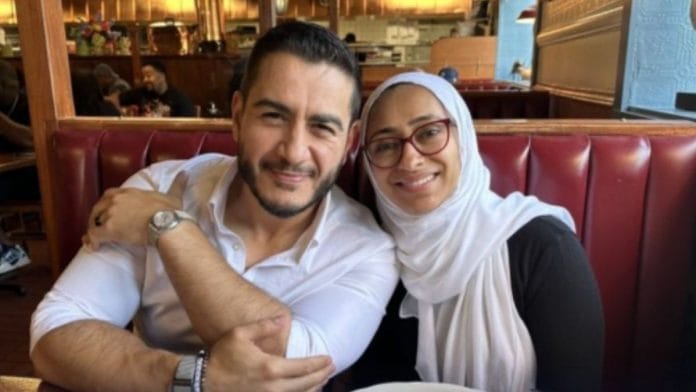


On 9 August, Donald Trump posted a graphic on Truth Social. A split screen of himself and Melania on one side, dressed for an evening out. On the other side, Michigan Senate candidate Abdul El-Sayed and his wife, Sarah Jukaku, having pancakes at a dinner. Trump called the candidate by his full name, Abdulrahman Mohamed El-Sayed, the same way he has spent a decade reminding people that Barack Obama’s middle name is Hussein. Jukaku’s hijab spoke for itself. The caption read “Two VERY DIFFERENT America’s” – apostrophe error included.
But this is not something new. After her old social media activity was dug up and dissected by news outlets, and turned into a running story about her politics rather than her mayor husband’s, Rama Duwaji has been living through a similar version since last year.
Most of the commentary since has, correctly, called this Islamophobic. But sit with the two women themselves for a second, and a strange pattern shows up. In a span of a few months, Sarah Jukaku and Rama Duwaji have become the centre of national political controversies that were never really theirs to begin with. Scrutinised in the media, defended by their husbands, debated in a hundred think pieces, mined for old posts and business records. But in almost none of that coverage does either woman actually speak for herself.
The pattern is not unique to the first lady either. Melania Trump has kept the same deliberate silence through most controversies, breaking it rarely – most notably in a White House statement denying any Epstein association. Trump, for his part, has defended her on several occasions, calling her media coverage “unfair” and echoing her Epstein denial himself – a move that protects his own image as much as hers.
El-Sayed responds
Give El-Sayed credit for one thing: he didn’t play defence. Asked on CNN’s State of the Union what he made of Trump’s post, he said simply, “Yeah, he’s right.” Reframing it, he further said that the post shows one America where your leaders are two people who don’t like each other much, but are joined by the business of making billions off you, another where two people who genuinely love each other want to build a life and raise a family. It was witty, and it worked, because it took Trump’s own frame and flipped who the “different” one actually is.
But notice what that comeback does. It’s a good line, but entirely El-Sayed’s, delivered about his marriage on his wife’s behalf, without Jukaku present or quoted. Years into that marriage, she has said almost nothing publicly, by design. Trump forced her into a graphic anyway. While defending themselves, her husband then turned that graphic into a rhetorical win. At no point did anyone ask Sarah what she thought about being Exhibit A in a fight over “real America.”
Her practice becomes ammunition
Weeks before that graphic went up, a different kind of scrutiny had already landed on Jukaku. El-Sayed has built his Senate campaign around Medicare for All, promising healthcare “from cradle to grave” regardless of who “signs your paycheck.” His wife runs a private Ann Arbor psychiatry practice, Mind Work Psychiatry, that does not accept Medicare, Medicaid, or any insurance at all; patients pay entirely out of pocket. The Washington Free Beacon reported that Jukaku formally opted out of Medicare in 2025. But amid the recent scrutiny – most of which was aimed at turning her practice into ammunition against her husband’s campaign – her clinic quietly removed a line from its website FAQ that had read: “Do you accept my insurance? – No.” Not long after, the whole website went private and became inaccessible to the public. It’s back online now, but the blunt FAQ line is gone.
Neither El-Sayed’s campaign nor Jukaku responded to multiple requests for comment from reporters. The one thing that did happen was quiet: an FAQ answer deleted, a website taken private – no statement, no interview, no version of the story in her own words.
Which is its own kind of answer, and also exactly the pattern: Jukaku became the subject of a national conversation about healthcare hypocrisy, without even contributing a sentence to it. Reporters built it from records and an archived FAQ page; her husband’s campaign didn’t even engage with it. The question was about his politics. The one who had to act was her.
Duwaji’s version
Rama Duwaji has never sought a public role, and Zohran Mamdani has said so explicitly, more than once, calling her “an incredible artist who deserves to be known on her own terms.” That didn’t stop months of digging. Reports, amplified heavily by Washington Free Beacon, surfaced her old social media activities between 2015 and 2017 and, more seriously, her Instagram likes from October 2023 on posts related to the Hamas attack. Dr Phil, in his own podcast, argued that her position as the mayor’s wife meant she “deserves a lot” of scrutiny.
Duwaji responded exactly once, months into the story, in a statement to the arts outlet Hyperallergic. She said she felt shame over “old tweets I wrote as a teenager” and that being 15 didn’t excuse it. She did not address the 2023 Instagram activity, made as an adult, that had actually driven most of the coverage. While neither really addressed the substance of the posts, Mamdani, in a press conference, called her “the love of my life” and “a private person who has held no formal position on my campaign or in my City Hall,” and said he, as the elected official, was the one obligated to answer for his own politics. Duwaji said nothing.
In another instance, Rama also distanced herself from comments made by Palestinian-American writer Susan Abulhawa. Mamdani, speaking on her behalf, said that she was commissioned to illustrate the excerpts of Abulhawa’s book by a third party but never really engaged with the author directly. While some accused Mamdani of discarding a Palestinian voice for political cover, others said he was merely drawing lines between the personal and professional. Either way, the debate that followed was still about her, but yet again, Duwaji said nothing.
Also read: Hollywood is done with body positivity. Thinness is back in fashion
What’s actually being fought over
It’s a version of what communications scholar Kathleen Hall Jamieson calls the double bind facing women in public life – damned for being too visible, damned for being erased when they’re not. Jukaku chose invisibility but got dragged into a Trump graphic anyway. Duwaji tried to stay in the orbit of Mamdani’s campaign without becoming its story and ended up more discussed than most of his actual policy platform. Neither strategy bought either woman control over her own narrative.
The silence of these women is not accidental. It is the product of campaigns that calculate a silent wife is safer than an unpredictable one, a media economy that profits more from mining her past than quoting her present, and husbands whose defences, however sincerely meant, still end up speaking over her rather than making space for her.
Put together, it forms a machinery that talks about a woman at length without ever needing to hear from her. Trump needs Jukaku’s hijab to make a point about who belongs in “real America.” Media outlets need Duwaji’s old Instagram likes to make a point about the Democratic Party’s flirtation with anti-Israel sentiment. Even their own identity stays confined to that one line – ‘the wife of a rising progressive politician.’
“This experience has absolutely changed my life. I am still figuring out how it applies to me as an artist and as a person,” Duwaji said in an interview. “It has forced me to confront how much I’ve changed.”
Views are personal.
(Edited by Ratan Priya)