




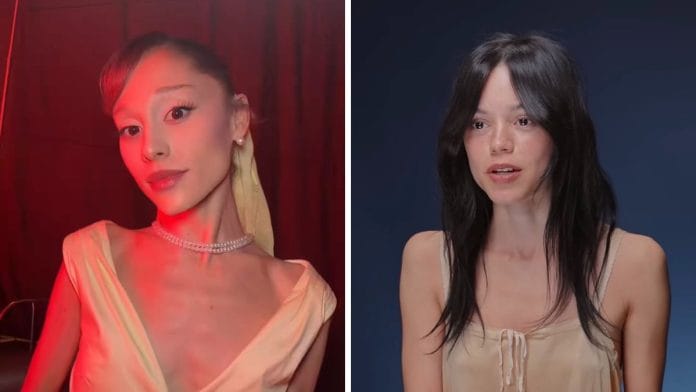

Jenna Ortega’s recent appearance has become the latest flashpoint in a familiar Hollywood cycle: celebrate body diversity when it is fashionable, then quietly move the beauty goalposts when the trend changes.
Around the mid-2010s, Hollywood woke up to body positivity. Celebrities such as Lizzo, Ashley Graham, and Jameela Jamil became some of the most vocal faces of the movement. Lizzo repeatedly spoke about self-love and accepting her body, while model Ashley Graham pushed for greater size diversity in fashion. Jameela Jamil, meanwhile, became an outspoken critic of Photoshop, unrealistic beauty standards, and the culture of judging women by their appearance.
It was a glorious little era. Celebrities talked about loving their bodies. Curves got praise. Stretch marks were no longer treated as classified information. Plus-size models graced magazine covers. For a moment, Instagram was awash with celebrities eating pizza and reminding everyone that happiness doesn’t have to fit into a certain dress size.
It seemed that the beauty industry had taken a lesson. Apparently, that lesson came with an expiry date.
Fast forward to 202, and the cultural mood feels very different. There are again lots of conversations about thinness on social media, fashion runways seem to be going that way too, and GLP-1 drugs have changed the conversation around weight loss.
The obsession with being ridiculously thin is beginning to seem less like a 1990s thing, and more like an annoyingly confident comeback.
Looks like Hollywood still hasn’t received the memo on body acceptance. And Jenna Ortega has become one of its more recent comebacks.
The Ortega moment
Ortega, who became a global star for her portrayal of Wednesday Addams in Netflix’s Wednesday, was recently featured in the Esquire ‘How I Got Here’ series. Instead of just talking about her career, social media went crazy over her looks.
Then came the inevitable internet ritual: the “then and now” photos.
Some users were concerned. Others went after the broader culture of examining women’s bodies. Others viewed the reaction as another manifestation of Hollywood’s long-standing obsession with appearance.
Singer Ariana Grande, too, was subjected to the same public scrutiny over her physical appearance.
But the irony is almost too good.
We spent years telling people it was shallow to judge celebrities by their bodies. Then a celebrity starts to look different, and the internet goes into immediate forensic investigation mode.
The problem is not that we can determine someone’s health by looking at their photograph. We can’t. The problem is that we keep believing we should.
Hollywood’s beauty pendulum
The relationship between Hollywood and the female body has always been a complicated one.
In the 1990s came the advent of the notoriously thin “heroin chic” look. The 2000s meant low-rise jeans, paparazzi photos, and tabloids treating a celebrity’s lunch as breaking news.
Kirsten Dunst, for example, was among the young actors whose appearances became regular tabloid fodder, while celebrities such as Jessica Simpson, Tyra Banks, and Jennifer Love Hewitt faced intense public scrutiny over their bodies.
Then came the 2010s and, thank God, a cultural correction.
Body positivity went mainstream. Brands extended size ranges. Fashion campaigns began to feature a curvier body more often.
Victoria’s Secret was perhaps the clearest example of the industry course-correcting. After years of criticism over its narrow beauty ideal, the brand launched its VS Collective in 2021, featuring a more diverse group of women, including transgender model Valentina Sampaio and plus-size model Paloma Elsesser.
Stars spoke out against unattainable standards of beauty.
For a moment, it seemed the industry was saying: maybe women aren’t handbags. Or maybe they don’t have to come in the season’s approved shape. Lovely.
But Hollywood has never been particularly good at leaving a trend alone. Now thinness appears to be fashionable again.
During the fall/winter 2026-27 fashion weeks, plus-size models made up just 0.3 per cent of runway castings, British Vogue reported. The number is shocking not because a runway demands anyone’s health, but because fashion holds enormous power to determine which bodies are made visible.
And social media has a role to play too.
The rise of ‘SkinnyTok’, more aggressive beauty content, and the availability of weight-loss drugs have made thinness feel less like an unattainable fantasy and more like another lifestyle upgrade to buy, share, and perfect.
Because apparently, even our bodies need a rebranding now.
And netizens are naturally asking: Why is everyone shrinking? Is there a leak in the Hollywood atmosphere causing rapid evaporation?
Enter the magic injection
The arrival of GLP-1 medications has added another twist to the story.
These drugs have legitimate medical uses, including treating type 2 diabetes and obesity. But their growing cultural visibility has also changed the conversation around weight loss.
Suddenly, a type-2 diabetes medication became the hottest VIP party accessory in Bel-Air. Why bother spending five years learning to accept your natural frame when you can simply take a weekly shot and watch your waistline evaporate into thin air?
That distinction matters.
There is a difference between discussing medical treatment and turning medication into another celebrity beauty accessory.
Yet the cultural conversation can sometimes blur the line between the two.
Fast-forward a few years, and a tiny little syringe entered the Hollywood chat.
Suddenly, medication associated with treating type 2 diabetes became part of a much bigger celebrity conversation about appearance.
Almost overnight, the “love the skin you’re in” manifestos quietly disappeared from Instagram. The pizza-eating selfies vanished. The body-positive slogans were thrown into the clearance bin right alongside low-rise jeans. Hollywood didn’t just abandon the movement — it sprinted in the opposite direction.
Hollywood didn’t just abandon the movement. It sprinted in the opposite direction.
Suddenly, dramatic weight loss is discussed alongside skincare routines, Pilates classes, and wellness rituals — as though the human body were simply another item on a celebrity’s morning checklist.
Good lighting, eight hours of sleep, and a revolutionary new approach to my metabolism.
The public explanation for every transformation may be perfectly innocent. But Hollywood’s beauty machine is not. Fashion, advertising, wellness, cosmetic procedures, social media, and now weight-loss medication all exist within a vast commercial ecosystem built around the desire to look a certain way.
It’s the ultimate celebrity magic trick: undergo a dramatic transformation, look the camera dead in the eye and say, “I’ve just been doing a lot of hot yoga lately.”
Thinness isn’t merely being admired. It can be sold.
The body-positive plot twist
And this is where the whole thing becomes rather funny — if it weren’t so exhausting.
For years, the message was: love the body you have. Now the message increasingly sounds like: love the body you have, but have you considered changing it? The beauty industry is remarkably talented at this sort of contradiction.
One decade, it tells women to embrace their curves. Next, it sells them a solution for getting rid of them.
One season, cellulite is normal. The next, it requires a campaign, a cream, and possibly a small mortgage.
Hollywood’s problem isn’t that beauty standards change. They always have.
The problem is how quickly the industry turns those changes into expectations.
And young people are watching. That matters because celebrities do not exist in a vacuum.
Young audiences see red carpets, magazine covers, TikTok videos, and carefully curated Instagram feeds. They absorb what is presented as desirable long before they have the vocabulary to question it.
When the dominant image changes, the pressure changes with it.
The danger is not that every young person will suddenly want to look like a celebrity. It is subtler than that.
It is the creeping idea that an ordinary body is somehow unfinished. That there is always another version to become. If the celebrity on the screen looks different this year, perhaps we should too.
This is where the body-positivity movement was supposed to have changed the conversation.
The most valuable idea in it was never that everyone should be celebrated every second of the day. But that a person’s worth should not be determined by the degree to which their body resembles whatever happens to be fashionable.
That principle shouldn’t be lost just because the fashion pendulum has swung again.
Also read: Former Naxal women walking the ramp is the most enduring defeat of insurgency
Hollywood, pick a lane
The biggest joke is perhaps that Hollywood keeps packaging beauty trends as revolutions, when they are just reruns with better lighting.
But bodies are not fashion cycles. They are not low-rise jeans. They do not need to return every 10 years to prove that trends have come full circle.
Jenna Ortega’s appearance should therefore not become another excuse to inspect, measure or diagnose a celebrity from behind a screen.
It should prompt a bigger question: Why are we so quick to believe that a woman’s body is public property whenever it changes?
Hollywood can change its aesthetic every few years. Fashion houses can change their casting choices. Social media can find a new obsession by Tuesday.
But perhaps the rest of us don’t have to follow.
After all, body positivity should not have been a trend in the first place.
It should have been the point.
Views are personal.
(Edited by Aamaan Alam Khan)
My father was not a fan of Twiggy. Nor am I.