






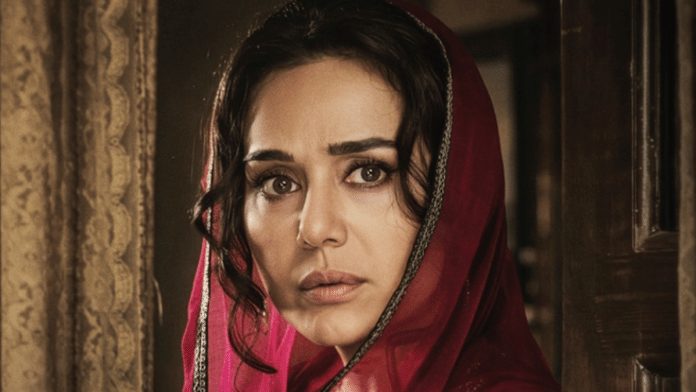


Rajkumar Santoshi’s description of a woman’s life in 1947—as shared by actor Preity Zinta—is a little too neat for history. While speaking about the new film, Batwara 1947, Zinta recalled asking the director how she should approach her scenes, to which Santoshi told her: “Preity, aap khana banao. Next scene, aap safai karo. Next scene, aap stitching karo.” His explanation: during that time, unless a woman was a freedom fighter, “the only career you can have is” a husband, children and managing the home.
There is an obvious truth buried in that description. For a vast number of Indian women, domesticity was the architecture of their lives. Nor was it a choice. Education was restricted, employment was circumscribed, marriage was often arranged early, and the home remained the principal sphere in which women were expected to exercise their labour and identity. But to turn that reality into the entire story of Indian womanhood is to condense history into a compact kitchen.
Indian women in the decades before Independence were not waiting around for history to permit them to leave the house. A fact that Mr Santoshi gladly overlooks.
In Bengal alone, the roll call is enough to complicate the director’s proposition. Calcutta has been home to Bethune College, South Asia’s first women’s college established in 1879. It was here that Kadambini Ganguly and Chandramukhi Basu, in 1883, became the first women graduates of the University of Calcutta and in the British Empire.
Kadambini did not stop at a degree. When she decided to study medicine, Calcutta Medical College had no provision for female students, but Bethune College adapted: a special arrangement was made for her to pursue medical studies, opening a path that had not existed for women before her. She went on to qualify in Western medicine, practise in Calcutta and later travelled to Britain for further training.
Whereas Chandramukhi went into academia, becoming a lecturer at her alma mater and later its principal—the first woman to head an undergraduate academic institution in South Asia. These women broke conventions, but their stories matter more because institutions were beginning, however reluctantly, to bend with them.
And they were not alone.
Neither majority, nor exception
Another Bethune College graduate, Kamini Roy, became a poet, teacher, social worker and feminist. Rokeya Sakhawat Hossain turned education itself into an instrument of rebellion, establishing a school for Muslim girls in Calcutta. Hossain refused to succumb to the zenana (harem) and instead built networks around women’s education. Sarala Devi Chaudhurani founded Bharat Stree Mahamandal in 1910, one of the earliest organisations to pursue women’s education on a national scale.
The point is not to produce a sheet of exceptional women and pretend that they represented the majority. But their existence does make it impossible to claim that the only available female script at the time was wife, mother and homemaker. It is not just modern women rejecting that narrative; our predecessors have been fighting against the odds for some time.
For a filmmaker such as Santoshi, who made Damini (1993) and Lajja (2001), which managed to capture the female struggle, to have such a narrow view of women’s stories is shocking, to say the least.
Women’s stories didn’t begin in the kitchen and stopped at the freedom struggle.
Apart from academics, women were also entering laboratories and scientific institutions. EK Janaki Ammal earned a DSc from the University of Michigan in 1931 and went on to build a career in botany and plant genetics. Kamala Sohonie fought her way into the Indian Institute of Science in 1933, after being initially denied admission, later earning a doctorate in biochemistry from Cambridge in 1939. Asima Chatterjee earned a DSc from the University of Calcutta in 1944 and became a pioneering organic chemist.
These were not women whose ambitions could be reduced to supporting a freedom-fighting husband from the kitchen.
Also Read: Dear Indian parents, women also use gaalis. It’s not just men’s domain
Containing multitudes
Of course, privilege mattered. So did geography, caste, religion, class and family. The women who reached colleges and political organisations were disproportionately drawn from communities with access to education and social capital. Their stories should not be romanticised into evidence that Indian women were already emancipated. They were not. The obstacles were formidable mainly because women had to fight their way through institutions that had been designed without them in mind.
However, the danger in describing 1947 as a world in which a woman could either fight the British or make dinner is that it mistakes the ideal for the reality. A society can prescribe domesticity without every woman inhabiting only that role. The existence of a prescription tells us what society wanted women to be, not necessarily what every woman was.
History has a habit of becoming tidier when told backwards. Once women have entered universities, hospitals, legislatures and professions in large numbers, it becomes tempting to imagine that none of those doors existed before someone officially opened them. In reality, there were women standing outside those doors long before they became institutions of equality. Some were banging on them, and some had already pushed them open.
Even the phrase “your career is your husband, your children and your home” is something more complicated than Santoshi’s formulation allows. A woman could be a wife and a doctor. A mother and a writer. A homemaker and an intellectual. The feminist struggle was never about replacing one identity with another but about refusing to be boxed into one category. One identity does not exhaust the possibilities of a woman’s life.
So when Preity Zinta says she is grateful that she can work in 2026, marry whom she wants and have a family while retaining a career, she is describing the most consequential achievement of women’s emancipation: choice.
Cooking, cleaning, motherhood or marriage were never beneath women. Preity Zinta’s character might have had to do those things in Batwara 1947. But a bigger tragedy would be to imagine that those things were all she could ever have been.
Views are personal.
(Edited by Insha Jalil Waziri)