




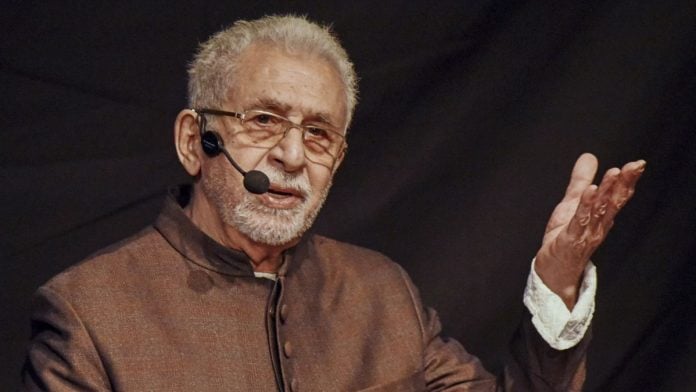

Every time Naseeruddin Shah speaks on a public issue, he is made to defend more than just his politics. He is asked to account for his identity, as though his right to dissent depends on his credentials on the matter. The veteran actor has recently backed protesting students at universities, including Jamia Millia Islamia, and embraced the label “Dimagi Naxal”. Union minister Kiren Rijiju responded by calling him a “subversive intellectual” and accusing him of being detrimental to Indian democracy. Instead of extending the elementary courtesy of rational engagement with an actor of his stature, he was immediately branded and boxed for speaking his mind.
Shah had a simple point to make in support of dissenting students at Kolkata’s Satyajit Ray Film & Television Institute (SRFTI). He alleged vendetta against students—they have been rusticated, served show-cause notices for demanding accountability—and accused that the BJP government was attempting to “brainwash or frighten” the country’s future filmmakers.
Back in 2018, he spoke of the disturbing hierarchy in which the death of a cow had more significance in India than the killing of a policeman. He said he was anxious about the future his children would inherit, including the possibility that a mob might demand to know whether they were Hindu or Muslim.
He was instantly vilified by nationalists for speaking up about the insecurity faced by Muslims. He was also accused, by some, of adopting the familiar good Muslim-bad Muslim distinction: a privileged elite, supposedly detached from ground realities, presuming to speak for a community whose religious practices he did not share.
He pushed back and described himself not as a Muslim but as a worried Indian. To his critics on one side, his Muslim origins made his intervention suspect; to those who questioned his standing within the community, his atheism made him an outsider. He was being asked to explain a religion he did not practise and, at the same time, being told that he had no standing to discuss the consequences of being identified with it.
His response now appears to be a refusal to play that game. By embracing the “Dimagi Naxal” label, Shah seems to be saying that if his critics would rather brand him than answer him, they can call him what they please.
This peculiar burden has followed Shah for a long time, one that predates this controversy. He was born into a Muslim family but identifies as an atheist. Neither fact seems to settle how he is to be judged.
Also read: Naseeruddin Shah spoke up for Muslims, but dangerously alienated most of them
Convenient attacks
Shah is a national treasure, a formidable actor and more than anything a citizen of this country entitled to speak his mind. When attacking him, the categories are applied according to convenience: Muslim when collective responsibility is being assigned, insufficiently Muslim when orthodoxy is challenged, and insufficiently patriotic when the government is questioned.
Shah’s concern has repeatedly been about the shrinking space for disagreement, the treatment of young people and the right of citizens to question authority and hardly on religion. He may be an actor, but he has never treated his public life as something that ends when the cameras stop rolling. His willingness to speak, sometimes bluntly and controversially, is part of a conviction that criticism of the country and its government is not an act of disloyalty.
So, if he supports Muslim students, does that make him Muslim again? If he criticises religious orthodoxy, does it make him less entitled to speak about discrimination? The identity assigned to him changes conveniently with the accusation.
For the atheist objector, there is no reliable escape from the identity assigned at birth. He may reject its doctrines, decline its rituals and raise his children without religious instruction; the world may continue to read his name as evidence of a faith he does not profess. The right to think independently is conceded in theory, only to be withdrawn when the conclusions become inconvenient.
Javed Akhtar has encountered this absurdity repeatedly. The atheist poet is routinely drawn into questions about Muslims whenever he comments on public affairs. In June this year, after a social media user invoked his perceived community in an argument, Akhtar replied that his qaum was all Indians. Last year, when an Urdu academy withdrew an invitation to him following objections to his views on religion, the writer simply said: “My name, Javed Akhtar, has nothing to do with Islam.”
His name still continues to be treated as a statement of faith, and his atheism as an inconvenience to be explained away.
I write this as an atheist woman who has encountered similar gatekeeping. When I have questioned the politics of the hijab, the question has sometimes been whether I am entitled to comment on it if I am neither Muslim nor a believer. The implication is that religious symbols and practices are the exclusive property of those who subscribe to the faith, and that anyone outside it must either remain silent or defer to its supposedly authentic representatives.
You don’t need to be religious to examine the social and political power of religion, just as you don’t need to belong to a particular faith to recognise coercion exercised in its name. Neither religious affiliation nor its absence should function as a veto on argument. Otherwise, debate becomes a tedious trial of credentials, with the substance of the argument abandoned before it has been heard.
Disbelief does not free the atheist objector from the identity others assign him, while dissent makes that identity newly suspect. He is expected to choose between silence and an endless defence of his credentials. It’s a quicksand the atheist cannot escape.
Shah could have easily retreated behind his stature and avoid the controversies that accompany political speech. He has seen many of his colleagues face vituperation over their comments over the years. But he has repeatedly chosen to question authority. But the response has always been to question the dissenter rather than engage with his objections.
No one should have to demonstrate that they are the right kind of Hindu, Muslim, atheist or Indian before their argument can be heard.