






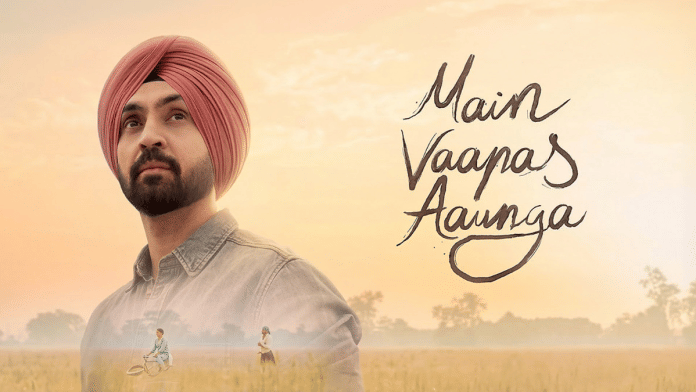


The first time I watched the trailer of Imtiaz Ali’s latest film, Main Vaapas Aaunga, I knew it was going to be a heavy watch. I even carried tissues with me to the theatre. I had learned my lesson when I went to watch Highway in 2014. And boy, oh, boy was I right. Ali’s Partition drama is hauntingly beautiful. It is disheartening to see its abysmal box office performance. Main Vaapas Aaunga deserves better. It deserves our undivided attention.
Not every good film deserves commercial success, but films like this are becoming increasingly rare. At a time when stories are expected to reaffirm our beliefs, identify heroes and villains, and leave us with a sense of a moral high ground and nationalist fervour, there is something very radical about Main Vaapas Aaunga. In a cinematic landscape where filmmakers are increasingly obsessed with drawing memories to create borders, Ali’s tender ode creates a bridge.
And perhaps, that is why it is the movie India needs but doesn’t want.
The movie has the usual Imtiaz Ali quirks: going back and forth in unfamiliar and fractured timelines, memories disrupting the present, the past becoming your haven and you, its hostage. But unlike his previous films, where love and longing eventually salvage the emotional catastrophe Ali makes the viewer live through, here we land at the deepest wounds of the subcontinent’s history—the Partition.
Remembering, not resentment
Abhishek Verman’s 2019 star-studded film Kalank is on one end of the spectrum and Main Vaapas Aaunga is on the other. Ali’s film is different, rare in its portrayal of the horrors of Partition, the political unrest and communal riots. The movie doesn’t shy away from showing you the atrocities and the gendered violence that took place in 1947. Its depiction of hate is not sanitised. But you don’t come out of the experience radicalised with a bloodlust for another community. Instead, the heart gravitates towards empathy.
Ishar, also known as Keenu, a naive lover played by Vedang Raina, thinks that he would not have to leave his watan, a metaphor for his home, his lover, or the life he has always known. Like many, he believes that love is greater than hate or politics. He is quickly familiarised with the reality that it is not.
But Keenu is not your typical hero, who takes revenge and emerges victorious. He is the emotional anchor that shows us the resigned reality of people who had to leave their homes, lives, and loved ones behind. He is a mirror of the lifelong yearning that comes with forced displacement.
That same pain is reflected when an elderly Ishar, now suffering from dementia, played brilliantly by veteran Naseeruddin Shah, says to a guard on the Attari border, “Mai waha ka hu, shayad galti se iss taraf aa agaya (I’m from there, maybe by mistake I have come on this side).”
Shah quietly captures the absurdity of the premise precisely. Ishar doesn’t remember the world being split into two. He only remembers his home.
And that is what Main Vaapas Aaunga understands better than most Partition narratives. Beyond politics, beyond the flags and slogans, there were millions of ordinary people whose greatest tragedy was losing the place they called home.
The film flips the script of assigning blame and fanning the fire of inherited trauma. We forget that before all the violence and resentment, before the lines existed, there were shared neighbourhoods, languages, festivals, and memories. In the film, Ali strips the people who create hate and chaos of their humanity calling them “Martians” because that is how Ishar remembers them. Not as people of a certain community, but as aliens who didn’t understand love and empathy.
Remembrance is not the same as grievance. One seeks understanding; the other seeks enemies. The distinction matters.
Also Read: Main Vaapas Aaunga is a masterclass in how memory works. Don’t look at it as a hit or flop
Love or loss
Yash Chopra’s 2004 musical drama Veer-Zara in many ways feels like the spiritual predecessor to Ali’s film. The Shah Rukh Khan and Preity Zinta starrer was also well received for the same reasons; it focused on humanity and not intergenerational hate. Both films insisted on an idea that has become strangely controversial: human connections matter more than political borders. Love precedes all.
Whereas Veer-Zara was about love and coming back home, Main Vaapas Aaunga is about leaving it.
What does it mean to belong? What does home mean once it has been taken away? How long can a person carry the ache and longing of return?
Perhaps that is why Main Vaapas Aaunga is struggling to find an audience.
Not because it is poorly made, but because it refuses to flatter our worst instincts. It does not offer the satisfaction of seeing enemies defeated. It does not reassure us that history belongs exclusively to the victors. It asks us to recognise ourselves in people we have been taught to see as “others.”
But that is a difficult thing to do at a time when outrage travels faster than empathy. It even sells better.
A mirror of our shared history
The world today looks disturbingly familiar. Countries are hardening their borders. Wars are displacing millions. Communities are retreating into identities defined by fear and suspicion. The lessons of the Partition should have made us wiser. If we don’t learn from our past, it will keep manifesting as our future.
The subcontinent may have been divided in 1947, but the impulse to draw borders between religions, communities and even neighbours, remains alive and is thriving more than ever now. This is exactly why we need such films.
The tragedy of Main Vaapas Aaunga is not that it isn’t a blockbuster but that it should have been one. It is not a moment but a projected nostalgic project that will travel through time and people will realise it’s brilliance and peak detailing only years later.
India needs love stories, but more than that, it needs stories about love. But alas, we seem far more interested in stories about hate and violence.
Views are personal.
(Edited by Insha Jalil Waziri)
Another half-baked sentimental-drivel.
‘Before the lines existed, there were shared neighbourhoods’.. shared between whom, exactly? People who had lived under centuries of conquest and subjugation, and a community that finally sought a homeland of its own through a movement that organized targeted violence to get it. Calling that ‘shared’ erases the actual power imbalance that existed before 1947, not just the border drawn after it.
The piece praises the film for not being ‘sanitised’ about the violence, then immediately sanitises the cause of that violence by stripping the perpetrators of identity entirely… calling them ‘Martians.’ That’s not transcending hate. That’s avoiding the one question a Partition film actually owes its audience: who started this, and why?
Ordinary Hindus, Sikhs never voted for division. They didn’t ask for it. They paid for decisions made by a handful of men in a few months in 1947. A piece that mourns ‘human connections lost to borders’ but never asks who drew the border, under what pressure, and after what campaign of violence, isn’t remembrance. It’s nostalgia with the homework left undone.
If shared neighbourhoods were really the tragedy lost, where is the movement today to rebuild any of it? Nobody’s asking. And, nobody wants it.
Remembering without reckoning isn’t healing.