




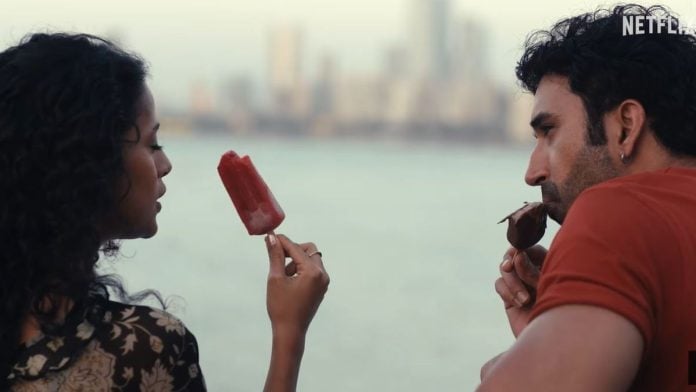

There is hypocrisy in how we consume desire in India. Naughty talk in English during a sex scene, paired with a moody pop track, and we call it artistic. Put the same scene in Hindi, a breathy moan and a few Ghalib lines whispered into someone’s ear, and suddenly the cringe cops come crying. Lust Stories 3 takes that glass ceiling and puts a dhol through it, quite literally, in Vishal Bhardwaj’s segment, the anthology’s sharpest attempt to the whole premise.
There is a moment where Siddharth tries talking dirty to Aditi Rao Hydari in English, and she simply stops and asks him to say it in Hindi instead. When the two finally do get intimate, the score doesn’t reach for sultry English lyrics or tunes, it reaches for dhol beats — local and loud. The rhythm itself becomes foreplay. Kudos to Bhardwaj. Because no one could ever think of portraying intimacy against a background score of dhol beats, as if it’s Ganapati Visarjan.
Across all four segments, the background score isn’t sitting under the scene, it’s acting in it, saying what the characters are too self-conscious to say themselves. Also, it treats a Hindi-scored intimate scene with exactly the same unhurried, cinematic confidence usually reserved for English ones.
Hindi is given the job of carrying desire, and it does it perfectly.
But for decades, we built an aesthetic hierarchy where intimacy in English is sophistication, and intimacy in Hindi is embarrassment.
Hindi writers like Kamla Das and Rajkamal Chaudhary, who wrote about desire, often got branded vulgar. We didn’t lack the vocabulary for desire in Hindi, we have just disowned it, treating our own literary and musical heritage of shringar ras as something that lacked respect.
Also read: What beauty means to Katrina Kaif after pregnancy
Linguistic colonialism
English became our first language for aspiration and intimacy, while Hindi got demoted to comic relief, never of longing. It’s like linguistic colonialism.
Lust Stories 3 flips the script on this phenomenon. For instance, the track ‘Aaye Miyan Khatpat’, composed by Bhardwaj and sung by him and Rekha Bhardwaj, is a gleeful anthem for every Indian woman unsatisfied in her bedroom and too polite to say so out loud.
The film’s smartest move, though, is that it not just embraces Hindi for the viewers to decode. In one scene, Hydari’s students argue that Hindi erotica is inherently vulgar, that English somehow dresses the same acts up in nicer clothes. After all, a “throbbing manhood” sounding more palatable than its Hindi equivalent ever could.
Hydari’s response is the line the film seems to be built around: vulgarity was never a property of language, but of intent. She says that Manto and Premchand could write about anything and call it literature, because the writing came from a literary place, not a prurient one. Explicit content stays explicit, it’s the intention behind it that decides whether it becomes vulgarity or art.
And that’s precisely where the normalising happens, not through a lecture on reclaiming our language, but through sheer refusal to flinch.
If Lust Stories 3 proves anything, it’s this: desire, spoken or scored in Hindi, was never the problem. Our cultural cringe always was.
Views are personal.
(Edited by Aamaan Alam Khan)