





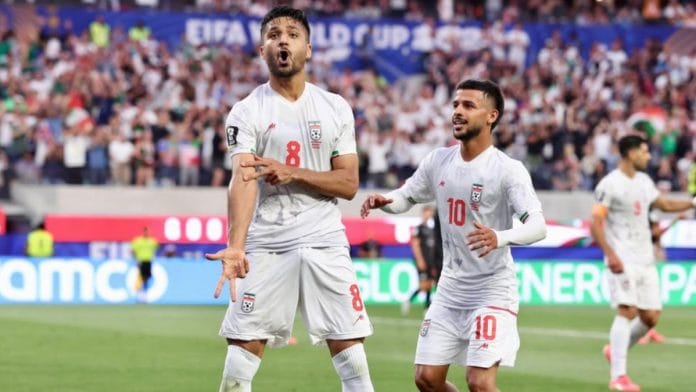


A massive row has erupted after Iran’s Mohammad Mohebi celebrated with a gun gesture against New Zealand at the FIFA World Cup. The match ended with a 2-2 draw on Tuesday. While this gesture is not new to football, the timing of Mohebi’s celebration has coloured it politically. Outrage has even led to a petition demanding that Iran and Mohebi be expelled from the tournament.
But the backlash is a bit excessive. Several players have historically used the gun-firing celebration. From Argentine Gabriel Batistuta’s machine-gun routine in the 1990s to Irish Robbie Keane’s iconic finger-gun salute and Edinson Cavani’s sniper-style celebrations—guns have long played a crucial part in the celebrations of a footballer.
Batistuta’s celebration became one of the most recognisable trademarks of his era. Several other sports stars copied it as well. Keane performed his famous cartwheel, forward roll, and finger-gun celebration so often that it became inseparable from his identity as a striker. Cavani’s sniper pose occasionally attracted criticism, but it was seldom politicised.
These expressions were generally viewed as gestures of confidence not endorsements of violence or a political statement. Fans understood the moves—a way of saying a striker was ‘on target’ or had ‘fired’ his team ahead—and took it sportingly. This sporting spirit has always been deeply embedded in football culture.
Mohebi’s celebration belongs to that same category. And, politics should not be dragged into this.
Also read: Aymen Hussein lost his family to terrorism. He scored Iraq’s 1st World Cup goal in 40 years
Wrong timing
Footballers are known to get carried away. They operate under extreme emotional conditions. And, goals are usually followed by emotions and sentiments instead of carefully calculated moves.
There is no evidence that Mohebi’s celebrations were political. It can very well be a spontaneous reaction triggered after an electrifying comeback by the West Asian team, who were trailing 2-1 until the 63rd minute.
However, intent is just one part of the story.
The 2026 FIFA World Cup isn’t occurring under normal circumstances. At a time when Iran is at the centre of intense international attention, a gun gesture was always likely to attract attention and scrutiny.
Whether fair or unfair, audiences do not judge gestures at such high-level events out of context.
A raised fist can be seen as a call for justice or an act of provocation, depending on the politics of the particular area. A flag can represent pride to some and exclusion to others. Even a simple, innocent gesture can mean something entirely different when performed at a particular moment in history.
Also read: Iran’s FIFA World Cup opener turns political as fans wave banned pre-revolutionary flags
Football is political
If the gun gesture came from the same player a year ago or another player in this World Cup it would have gone unnoticed. Maybe a few keyboard warriors, but no one else who understands the game would have reacted this way.
Many viewers connected Mohebi’s gesture to a ‘larger’ geopolitical event. Yes, football is political, but that does not mean every gesture is a political statement.
The only reason this gun-gesture moment has exploded beyond understanding is that it occurred during an ongoing conflict, and the public imagination was already occupied with bombs, drones, guns and missiles.
Naysayers can express how they feel, but the calls to expel Mohebi aren’t justified, especially when such things have often happened earlier. Mohebi is just another player who is enjoying the game.
Views are personal.
(Edited by Theres Sudeep)