




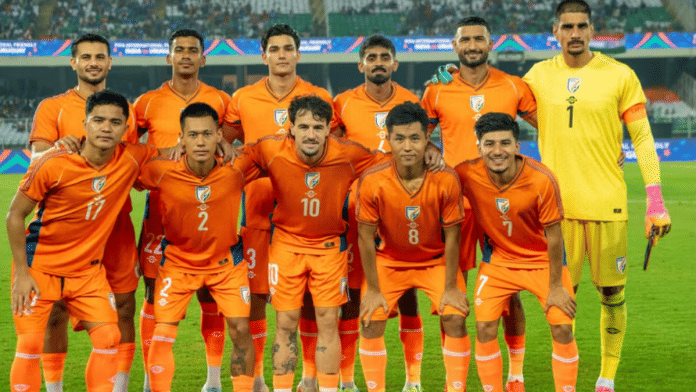

India men’s football team conceded 11 goals in three friendlies during the autumn international break, drawing once and losing the other two fixtures. Three World Cup nations—Brazil, Uruguay and Panama—flew in to face the Blue Tigers over 12 days. While coach Khalid Jamil’s men dominated the show on the first day against Panama, India ultimately fell short against Brazil and were completely dominated by Uruguay.
On Tuesday, as the final whistle blew at the Vivekananda Yuba Bharati Krirangan (Salt Lake Stadium) in Kolkata, Uruguay, with a FIFA world ranking of 20, had the last laugh. The giant screen taunted the Indian players as the 6-1 score haunted the background while sweat-soaked players exchanged handshakes, hugs and jerseys.
For most, the scoreline yet again painted a sorry picture for Indian football. But peel back the top layer, and you find the truth: India can dominate, press, attack, and play man-to-man as well as zonal-marking football. This is neither a defeat nor an end for Indian men’s football, which has come a long way in a few short years.
The fatigue effect
Uruguay scored the opener within 11 minutes. Star striker Darwin Núñez placed the ball into the net from a 12-yard spot kick, comfortably sending goalkeeper Gurpreet Singh Sandhu the wrong way. The tale took an unusual turn when a long-range strike from winger Ryan Williams was saved by Thiago Cardozo, but midfielder Anirudh Thapa pounced on the rebound to slot home a left-footed equaliser.
Was it a dream? No. India, with a 137th international ranking, did score, in fact, against Uruguay. The stadium, with 37,307 spectators, roared, Indian players sprinted toward Thapa, and suddenly, a nation with 1.48 billion people started to dream.

But professional football at such a high level is seldom about just one moment. Soon, the match was called off due to bad weather, breaking India’s brilliant momentum. When both teams returned to the pitch, India had to build it from the start—the passes, the coordination and the man-to-man marking. Uruguay, being two-time world champions, capitalised on the situation and took a lead in the 29th minute. At the break, it was 2-1.
In the second half, the fatigue of playing three games in 12 days caught up with the Blue Tigers, giving Uruguay absolute control over the match. The South American nation scored four goals after the break, putting the match beyond any doubt in their favour. However, when the statistics are viewed from a neutral point, they reveal a different story. India finished with 14 shots to Uruguay’s 17 and managed five efforts on target against Uruguay’s nine. India had 42 per cent possession compared to Uruguay’s 58 per cent. Both teams conceded six corners, with Uruguay receiving one yellow card.
The numbers will not heal us from the 6-1 setback. But they showed that Team India was not a spectator in its downfall. They continued to attack, created chances, maintained a high line despite conceding four goals and forced the Uruguayan goalkeeper into saves. The difference: Uruguay had the quality and composure to turn control into goals, while India were still learning how to do the same.
This was the most positive takeaway from the night in Kolkata. The difference between the two teams was visible on the scoreboard, but not always on the pitch.
Also Read: Yamal and Mbappé don’t deserve the Ballon d’Or
The tactical switch
Against Panama on 25 September, India were the better side for most of the game. Jamil’s players moved with confidence, made lateral passes, closed down space and carried the ball patiently before looking for openings. They pressed high, won second balls and, importantly, did not look intimidated by a side ranked 44th in the world. There was intent in India’s play — the footballers wanted the ball, wanted to attack and were willing to take the game to Panama. And it paid off: Williams scored the opening goal after a sublimely lofted through ball from Akash Mishra pierced the defensive line.
Against Brazil, however, they showed they could press and carry the game to a team that has spent decades operating at the highest level. Let’s not forget Brazil won the World Cup five times. And all the goals India conceded (four) were either errors from the goalkeeper or a defensive mistake.
For a country that has often approached games against stronger opponents with the sole objective of conceding fewer goals and defending haplessly, the switch in tactics is a bold move from Jamil. He has injected aggression into India’s football, which has been a long time coming.
His players are not dropping 10 men behind the ball when a better-ranked opponent has possession. They are trying to operate in the midfield, take on defenders, attempt to win the ball higher up the pitch and are willing to score goals despite who the opposition is.
Nonetheless, positive football will not necessarily bear fruit. The game against Uruguay is the biggest example. But it’s a step forward to compete with the highest-ranked teams.
Also Read: Cristiano Ronaldo’s Portugal exit is another selfish tantrum. He is ruining his legacy
Khalid Jamil’s trade-off
Of the 11 goals India conceded, seven came in the second half. While Jamil enforced free-flowing football, he forgot the quality the opponent possessed. Football is a 90-minute game, and both halves need separate tactics, especially when facing the likes of Brazil, Uruguay and Panama.
After a thunderous start in the first half of all three games, Jamil still chose a higher defensive line. In football, it’s often said that offence is the best defence, but the team must be able to track down opponents’ counter-attacks and regain possession. India lost there.
India kept pressing and attacking, leaving spaces behind and exposing them to high-speed flank counterattacks. Jamil has chosen this trade-off. It’s worth watching, but it’s risky and comes with a cost. Nonetheless, it can be struck off as a learning curve both for Jamil and for Indian football.

But can Jamil create players like Vinícius Júnior, Joao Pedro, Endrick, Darwin Núñez and Rodrigo Bentancur? No, at least not in just a few months. He cannot manufacture individual quality which other footballing nations already have. Those players come from systems, academies, training, diet and funding that India is yet to receive or even cultivate.
But he can inject passion into the Indian team, making them believe that they can compete with world-class footballers. He can make the nation believe in him. Somewhere between the 6-1 defeat, the 1-1 equaliser and the dominating performance against Panama, Khalid Jamil has given Indian football a reason to believe that the Blue Tigers do not always have to play like underdogs.
He has proved his worth and shown us the way. Now it is up to the government, the AIFF, sponsors and the wider football ecosystem to give him the resources and time to build it.
Views are personal.
(Edited by Insha Jalil Waziri)