





Gen Zs are crybabies. They have every right to question the education system, women’s safety, toxic workplaces, bad bosses and unreasonable working hours. But somewhere, every discomfort has become something to question, discuss, post and seek validation for. There is a difference between whining and questioning what genuinely needs to change. And that difference needs to remain, lest someone stop taking you seriously for crying wolf.
I see people calling ordinary hard work hustle or struggle. Learning a new skill becomes a struggle story, staying back for a deadline becomes hustle culture and getting criticism becomes a conversation about mental peace.
Sometimes I wonder, when did doing your job become something extraordinary?
Then comes the work-life balance argument. Yes, work-life balance is important. Nobody should be expected to destroy their personal life for a job. But sometimes the conversation starts even before a person has learnt the skill or delivered what was expected. First, learn the job. First deliver. First take responsibility. Then have the conversation about how much of your life the job should take.
And work-life balance is also a privilege. A large section of Gen Z cannot even afford to have this conversation. They have families to support, bills to pay and responsibilities that need to be fulfilled. For them, work is not something they can simply reject because it interferes with their personal life. They cannot afford to romanticise quitting the rat race.
And Gen Z has somehow developed a vocabulary where every minor inconvenience sounds like a human rights violation. Are you tired? Burnout. Your boss asks you to work? Toxic workplace. Someone gives you feedback? They are invalidating your boundaries. Your situationship ends? Time to heal, unlearn and protect your peace. You have to come to the office five days a week? Capitalism. At this point, I am genuinely surprised nobody has called Monday morning a traumatic experience and started a carousel on LinkedIn about it.
That is where I have a problem with the way Gen Z is represented. Manoj Tiwari’s daughter Rhiti recently said on Bigg Boss that she gets around Rs 25,000 as pocket money, and it is nothing. Gen Z is usually depicted as one with an adequate safety net, or as sheltered and privileged. But that doesn’t mean that all Gen Z is advantaged. Like other generations, it suffers from class divide too. For many, Rs 25,000 is their monthly salary. For another person, it may have to run an entire household.
Also read: Starbucks has launched aloo posto burger for Pujo. It’s blasphemy to Bengalis
Gen Z’s class divide
There are people from Gen Z working day and night just to make ends meet, and they are not crying about it on Instagram. They are simply working because they have to. I don’t want that privileged version to represent an entire generation.
And Gen Z is not one group. Someone sitting in an upper-class urban environment and someone who is the first person in their family trying to earn enough to support everyone cannot have the same relationship with work.
The irony is that the generation that constantly talks about escaping the rat race is also one of the most trend-driven generations.
Millennials had their own subcultures and identities. Not all of them, of course, but many were artistically expressive without needing to click a picture in blur and warm light and explain what it meant. Gen Z talks a lot about individuality, but look around and see how quickly everyone starts following the same thing.
Everything has become content. We are also told that Gen Z is the most emotionally available generation. But emotionally available to whom? To the internet?
Then comes the language. Every few months there is a new word, a new phrase, a new way of describing an emotion or a relationship. Sometimes people from the same generation need a dictionary to understand each other.
I don’t like being labelled as Gen Z. I don’t think a generation should have its personality decided by Instagram or whatever trend is going around that week.
It’s a breakup, remove the DP. Someone doesn’t reply, put up a story. You fought with your friend, post a cryptic note. You are angry with your partner; share a sad song. Someone hurts you; unfollow them and make sure everyone knows you have unfollowed them. You are going through a difficult phase; put up a black-and-white picture with a long caption about healing. You want to look intellectual, get a coffee, carry a book from Daryaganj and take a picture at Faqir Chand.
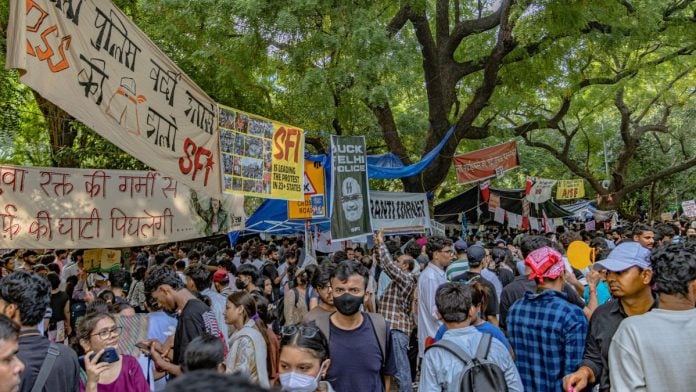
And this obsession with turning everything into content also drives their activism. I saw this during the CJP protests. Before Sonam Wangchuk was evicted from the protest site, some young people seemed more interested in making reels and documenting themselves at the protest. But there is also a section of Gen Z that cannot simply afford to go to every protest. Most of them have to go to work on Monday, and being late for work can cost them half a day’s salary.
That is the difference I am talking about. There is a difference between protesting and looking like you are protesting. And even saying that will probably trigger them. Which, honestly, proves my point a little.
(Edited by Saptak Datta)