



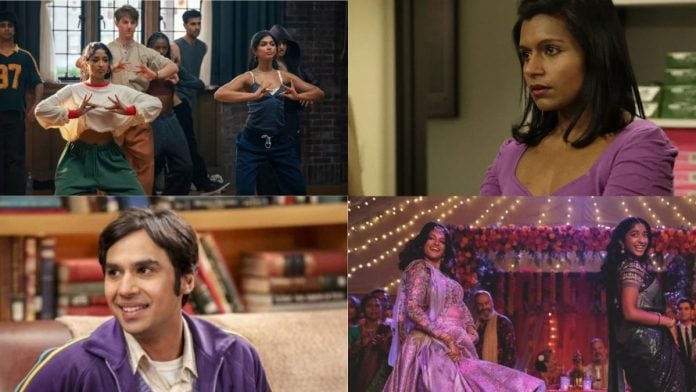
Dear NRI filmmakers, the portrayal of Indian culture in Hollywood movies has long been caricatured. But now it has crossed into something more unsavory: cringeworthy, over-the-top, and essentially a khichdi.
It’s an insipid mix of Indian cultural practices and Western popular culture, made for the White gaze. What’s more painful: this mishmash is usually shown by Non-resident Indians, who, one would assume, have at least some connection with their roots. But their limited familiarity, evident in their films, inadvertently ends up perpetuating decade-old stereotypes about Indians and their customs.
Bollywood, Bharatanatyam and a drone
Take Hasan Minhaj’s Best of the Best (2026), for instance. The film is a patchwork of platitudes in the name of portraying Indian culture. In a scene, the protagonist Maya, played by Maitreyi Ramakrishnan, dances to hip-hop music in a Bharatanatyam costume. The music briefly shifts to Indian classical but is mixed with electronic beats.
As if this hotchpotch was not enough, drones suddenly appear in the scene. The rest of the film is merely an extrapolation of this scene, stretched over 112 minutes. Minhaj crossed High School Musical and Step Up, cast Indian-origin actors, and made them dance to Bollywood songs on steroids.
The film’s other Indian references — an overbearing parent who wants her daughter to focus on Computer Science when she clearly doesn’t have a knack for it; a Bollywood shaadi inspired by Karan Johar’s K3G, and the association with the Kohinoor diamond coupled with the needless urge to bring it back from the British — are nothing but a tired collection of clichés.
The brownwashing of Mindy Kaling
This is hardly a new trend. The cultural dissonance of NRIs has found its way into their films for decades. Be it the Diwali celebration in The Office (2005-2013) or the Ganpati festival in Never Have I Ever (2020-2023), the representation doesn’t evoke Indianness but an unpalatable, or even ridiculous, parody of Indian customs.
The common thread in both these examples is Mindy Kaling, an American actor and filmmaker of Indian descent. Her father is Tamil and her mother Bengali, but Mindy is neither, if her films are anything to go by.
Her character Kelly Kapoor in The Office hosts a Diwali party that resembles an Indian wedding rather than a celebration of the Hindu festival.
15 years later, when she wrote Never Have I Ever, with Maitreyi Ramakrishnan in the lead, she retold the same banal stereotypes about India that American filmmakers have, but cloaked them in brown characters wearing traditional Indian costumes. Brownwashing, if you will.
In the 2020 show Never Have I Ever, Kaling shows the brown kid with an overprotective mother who enforces a strict “no-boys” policy, an overachieving cousin, and, of course, the attempt at an arranged marriage.
Now compare this to The Big Bang Theory (2007-2019), in which Chuck Lorre and Bill Prady show Raj Koothrappali (played by Kunal Nayyar) as a sweater vest-wearing, subservient son who freezes at the sight of a woman. Lorre and Prady are outsiders looking in, but from an NRI like Kaling, I expected better.
Snake charmers and cobra dances
But what happens when Gurinder Chadha, in her 2004 film Bride and Prejudice, plays into the reductive British stereotype of India being the land of snake charmers? And not just metaphorically. In this adaptation of Jane Austen’s classic Pride and Prejudice, Mary Bennet’s character, played by actor Meghna Kothari, actually performs a cobra dance for her NRI guests.
Also Read: Why Maitreyi Ramakrishnan changed a dialogue on her Tamil identity in Netflix’s Best of Best
The NRI cultural template
For years, Hollywood films made by NRI filmmakers have templatised the telling of Indians, their ethos and their customs. It either echoes a general disregard for cultural accuracy or pokes fun at beliefs that are uniquely Indian— such as arranged marriages, Bollywood-themed shaadis, helicopter parenting, and the diaspora life— to incite cheap laughs.
But it’s not funny for Indian audiences. It reeks of a lack of research, if not complete ignorance. An attempt to pander to their White neighbours, employers, and colleagues. A testament to the saying that Indians are coconuts, brown outside and white inside.
Whether it is a result of a colonial hangover or an innate exoticisation of the fair-skinned, the NRI’s aspiration to assume whiteness is so strong that they drop their culture like a hot potato the minute they land in the West.
Remember when your cousin took a year-long course in the US and came back with an American accent, needlessly rolling his tongue on the Ls and the Rs. Now imagine that cousin with a script and camera.
India is more than Bollywood and butter chicken
There is, however, more to Indian culture than superstitions, spices and smells. For it has stories germinating in every gully, nukkad and high-rise. There is a certain warmth in celebrating festivals together, a story behind a custom, and a deeper philosophy for the spiritually curious. The same is true for its films too.
And Mira Nair captures it faithfully in her 2006 adaptation of Jhumpa Lahiri’s The Namesake, as well as her 2001 film Monsoon Wedding. Nair shows the same arranged marriage in a mature way — the awkwardness of the couple, the excitement of the parents, and everything in between.
There is more to the Indian film industry than Bollywood, more to Bollywood than Karan Johar, more to Indian weddings than playing dress-up. India celebrates festivals other than Diwali; we don’t just eat samosas or butter chicken, and, more importantly, we are not just brown. We are a diverse nation, housing more than 4,600 communities, each having its own distinct food, customs, and traditions.
NRI filmmakers must take note of this, or their films will end up as fodder for cultural appropriation.
Edited by Maryam Hassan