



A video of Bihar MLA Anant Singh has taken social media by storm. Standing in his Land Cruiser, dressed in a white shirt, black coat, and sunglasses, he twirls a gamcha in the air as thousands cheer: Chhote Sarkar, Chhote Sarkar.
The spectacle captures the aura of Bihar’s last surviving bahubali. But scenes from his daughter Shivangi Singh’s wedding in his ancestral village, Nadwan, reveal something far more troubling: a state with immense human potential, a young population, and a rich history, yet struggling to channel its energy toward progress.
I travelled nearly 70 km from Patna to Nadwan on Wednesday. About 4 kilometres from the wedding venue, traffic came to a standstill. People abandoned their vehicles and began walking, shoulder to shoulder. Thousands poured in from various parts of the state. The crowd was estimated to exceed 2 lakh. On that day, I walked more than 15 kilometres to cover the wedding and the horse race.
It was chaotic. People climbed trees and electric towers to catch a glimpse of a horse race. Hundreds crowded a weak bridge over a stream, risking their lives to reach the venue. Food stalls turned into battlegrounds as people struggled to get a plate. Elderly visitors, some barely able to walk, were caught in the crush.
Fortunately, there was no major tragedy. But the question is, why should such a display of popularity and power be celebrated in the first place?
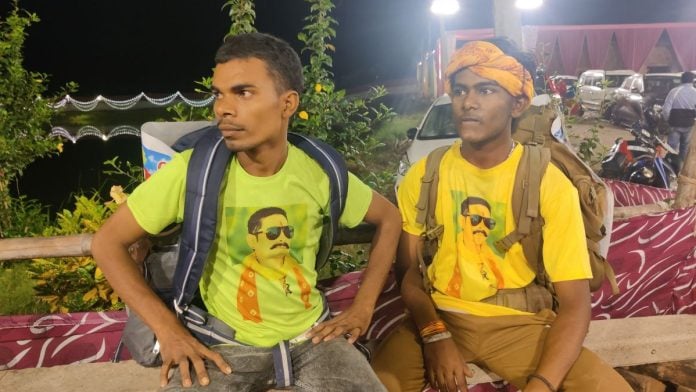
The most disturbing part was the sight of children and young men caught up in the frenzy. They were not there to see the bride and groom. They had come for Anant Singh—to cheer him, photograph him, and make reels.
No one had come to attend a wedding. They were there to witness the spectacle of power.
Bihar’s last surviving bahubali
Singh has long enjoyed considerable influence in Mokama and surrounding areas. But social media has taken his popularity far beyond his traditional stronghold.
At the wedding, Singh appeared to relish the attention. He met visitors, posed for photos, and personally asked people whether they had eaten. His bedroom was open to visitors. People could walk in, meet him, and speak to him. This accessibility is part of his appeal. Many see him not merely as a politician but as someone who belongs to them.
Yet, the adulation surrounding Singh comes with an uncomfortable reality. He has faced serious criminal cases, including those relating to murder and kidnapping. His public image, complete with armed men carrying rifles, snipers, and pistols, is more akin to a character from a 1990s Bollywood gangster film than an elected representative.
Bihar has seen its share of bahubalis—from Surajbhan Singh and Kamdev Singh to Mohammad Shahabuddin, Pappu Yadav, and Pappu Dev. Yet, Anant Singh continues to operate on the old vocabulary of muscle power. Interestingly, he helped Nitish Kumar in the 2004 Lok Sabha election, following which he got a ticket from the JDU to contest his first election from the Mokama Assembly seat.
Also read: Inside the cult of MLA Anant Singh and Bihar’s grandest wedding. What rest of India missed
Two decades of development
I have a personal connection with this part of Bihar. Singh’s ancestral home is just a few kilometres from my maternal grandmother’s house, where I spent my summer vacations. I grew up hearing his name and knowing the influence he wielded in the area. People were often afraid of him.
I have also lived in Delhi since childhood and have closely witnessed the stereotypes associated with being Bihari.
When Nitish Kumar came to power in 2005, he sought to change that image. Roads were laid, electricity reached more households, and governance improved in parts of the state.
Over the past two decades, Bihar has made considerable progress. For me, it brings hope that the state is finally moving in the right direction.
But the scenes at Nadwan forced me to ask: while Bihar’s infrastructure has upgraded, has its political and social mindset changed?
The state continues to struggle with unemployment, poverty, and large-scale migration. Millions of young people leave home in search of jobs and opportunities. Against this backdrop, watching thousands celebrate a leader whose public persona is rooted in the culture of muscle power was deeply disappointing.
There is nothing wrong with celebrating a wedding. Nor is there anything unusual about a father wanting to organise a lavish celebration for his daughter.
The problem is not about how much Singh spent or how many people he invited. It is about what the spectacle says about our collective priorities.
Where is Bihar’s demographic dividend?
Bihar has one of India’s youngest populations. Its young people should be the driving force behind its transformation. They should be demanding better universities, jobs, hospitals, roads, and opportunities.
At Nadwan, I saw young men wearing T-shirts bearing Singh’s image. They arrived on bicycles from hundreds of kilometres away, cheering his name.
One image has stayed with me: hundreds of people standing precariously on a small bridge over a stream, trying to cross it to reach the venue. It was a picture of collective excitement without any regard for personal safety.
Millions of young people, full of energy and ambition, are capable of building businesses, universities, movements, and institutions. Yet that same energy is being spent cheering at a wedding, whistling at dance performances, and shooting reels of a bahubali.
People often mock Bihar for being backward. But the more painful truth is that Bihar is not simply backwards; it is distracted.
We have the energy to bring highways to a standstill for a wedding, but rarely see such enthusiasm for a movement demanding employment. We can travel hundreds of kilometres for a glimpse of a powerful man, but how many would travel the same distance for a public library or a better school?
Also read: Inside a Bihar MLA’s daughter’s wedding spectacle — Lakhs of guests, lavish pandals, rain-hit venue
The bahubali cannot be Bihar’s role model
Bihar’s history is inseparable from the history of India. This is the land of Nalanda, ancient centres of learning, philosophical debates, and the rise of ideas that shaped civilisation. It is also the land where democratic traditions have deep roots.
Yet today, we risk confusing spectacle with achievement, a crowd with public support, and muscle power with leadership.
The problem is not that 2 lakh people attended a wedding. It is that the political culture surrounding such gatherings continues to glorify strongmen rather than public service.
It is that young people see a bahubali as an aspirational figure when they should be looking toward entrepreneurs, scientists, teachers, reformers, and leaders who build institutions.
Bihar has spent two decades trying to move beyond the image of lawlessness and backwardness. It cannot afford to return to an era when the influence of a politician was measured by the number of armed men around him and the size of the crowd at his doorstep.
The bahubali era must end. Not merely through stronger policing, but through a change in public aspiration. Bihar has the crowd. It has the numbers. It has the talent. What it needs now is direction. Anant Singh may enjoy his popularity. But he cannot be the role model for Bihar’s youth.
Views are personal.
(Edited by Prasanna Bachchhav)