




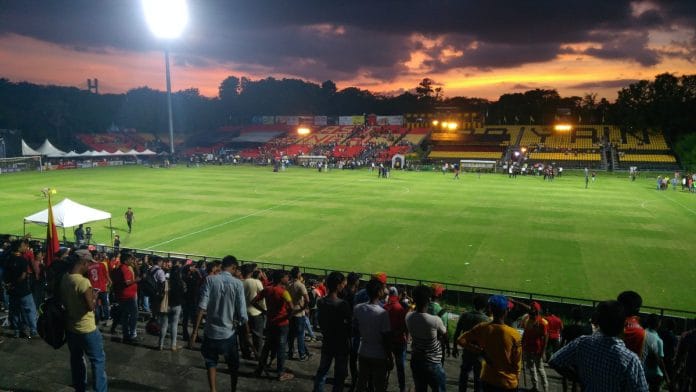

The high-voltage West Bengal Assembly elections have lived up to the expectations—drama, rhetoric and enough identity politics to fuel primetime debates for months. But Bengal’s identity conflicts are not new. What has changed now is the field on which they are fought. There was a time when the eastern Indian state settled its identify battles on the field. Yes, the football field.
Stadiums, boots, goalposts, jerseys, slogans and a ball — these were the arenas of rivalry, not polling booths, political speeches and welfare promises. The clubs still exist, and so does the passion. But football no longer occupies the same space in West Bengal’s everyday life. The political field has taken over.
If’ Egiye Chalo’ once echoed from the stands, today it is, quite ironically, ‘Khela Hobe’ that dominates the discourse. It’s just that the game now is electoral.
And in this new identity war, the “outsider” (or bohiragoto) has emerged as the central midfielder, put to duties by both the defense and the attack — the TMC and the BJP. As the state heads into the second phase of the polling, both parties have identified their own ‘outsiders’.
The BJP, which eyes a breakthrough in the state, has raised issues of illegal migration from Bangladesh and what it calls crumbling border security. In response, the TMC has leaned into Bengali ‘asmita’, accusing “people from Delhi” of trying to impose a culture that Bengalis don’t relate to. The party has positioned itself as the protector of Bengali identity.
Fight for an identity
It may sound dramatic, but West Bengal’s football history mirrors the state’s deeper social and political currents.
And the story goes back to 1889, when questions of identity was not rhetorical. From guns to a peaceful march, it was a lived reality, often carrying huge risks. In that climate, Mohun Bagan was formed by a mix of professors, bank clerks and labourers.
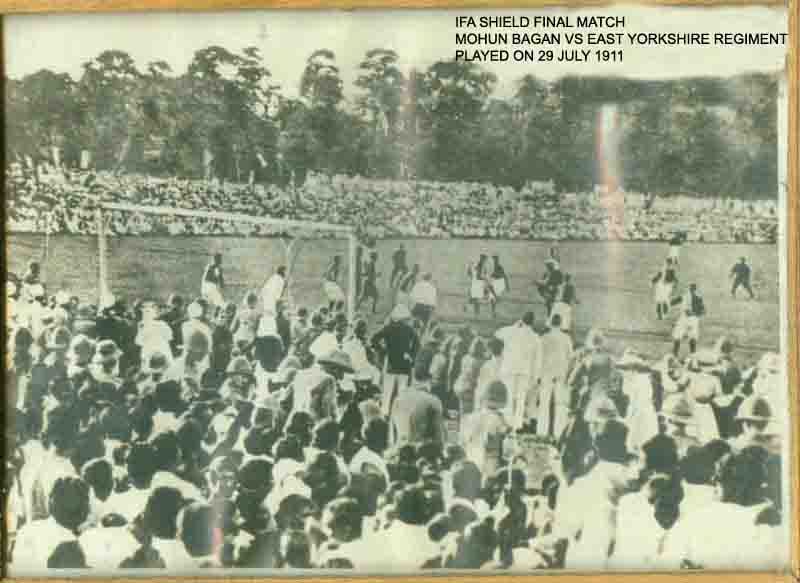
And suddenly, the White rulers had another front to cover. Football moved beyond recreation, and became a site of resistance against British dominance. That resistance found its loudest voice in 1911, when a barefoot Mohun Bagan defeated the East Yorkshire Regiment to win the IFA Shield. The team cemented its identity in colonial India. For many Indians, it felt like a symbolic blow to British rule. It was one of the earliest examples of sport becoming intertwined with identity in Bengal.
The emergence of Mohammedan Sporting Club in 1891 added another layer. The club became a major cultural institution for Muslims in colonial India, giving the community a platform to challenge the British regime.
Then, in 1920, came East Bengal Football Club. Its identity mostly came into play after 1947, when refugees from East Pakistan (now Bangladesh) arrived in West Bengal. Many of them faced discrimination and struggled to adjust. For them, East Bengal became more than a football club; it was an entity to connect with their roots.
Mohun Bagan is closely associated with the ghotis—the native communities of West Bengal, while East Bengal is seen as a representative of the displaced. Along with Mohammedan Sporting, the trio from the Maidan became the beating heart of Indian sporting history, shaping the legacy of Indian football along with the state’s layered identity politics.
Football, in other words, became the arena where West Bengal’s social and cultural tensions were evenly squared.
From jerseys to food
The rivalry among the three teams was not limited to goals or winning matches. It was about refugee identity. It was about old residents versus newcomers versus the minority community. Ultimately, it was about pride.
From jerseys to food, all three clubs have a distinct identity. While Mohun Bagan is represented by its iconic green and maroon jerseys, East Bengal and Mohammedan Sporting don red and gold, and black and white. Even the colours are clearly distinct, ensuring they do not overlap.
That was the real beauty of the state. Such differences played out on the football fields. Not that it wasn’t bloody, abusive or heart-wrenching, but it was only for 90 minutes. In any match of the historic Kolkata derby—a face-off between Mohun Bagan and East Bengal Football Club—flags are waved, tifos are unfurled, and chants mocking opponents echo across the city, alongside drumbeats and trumpets.
For fans, a win for their favourite team meant celebratory meals that reflected those loyalties—prawns for Bagan, hilsa for Bengal, and biryani for Mohammedan. Food, too, was clearly demarcated.
Fans clashed ahead of matches, only to move on and look forward to the next derby. From the 1980s stampede that killed 16 fans to the infamous 2023 post-Durand Cup final violence, supporters have witnessed stone-pelting, bamboo-stick skirmishes and lathi charges. Everyone carried the attitude of “one for the team”. And the rivalry, however toxic at times, remained confined to the sport.
However, ironically, it was the same set of fans who united during the RG Kar Medical College rape and murder case in 2024 to raise their voices against the ruling TMC in the state, setting aside their ‘identity’. They came together to protest corruption and lawlessness.
That moment said something larger about football and West Bengal itself.
Bengal’s politics has stooped to a new low. Somewhere down the line, the state lost its sporting spirit. And political ideologies, surely, don’t respect such boundaries anymore.
A vacuum
Earlier, football clubs were about identity, pride and an outlet for frustration. They turned social tensions into rivalry, tradition and spectacle. That space has since shrunk.
And politics has filled that vacuum.
Today, along with the politics of the state, the quality of football has also declined.
Earlier, West Bengal’s politics was deeply confrontational too, but debates were not centred on identity issues. In 2011, when Mamata Banerjee dethroned the Left Front, slogans revolved around unemployment, economic stagnation, political violence and “justice”.
Fifteen years down the line, unemployment and economic stagnation remain the state’s biggest concerns, while political violence has significantly increased under what is often described as the “syndicate raj”. Today, narratives feel far more personality-driven. Elections are increasingly dominated by questions such as: “Who is a real Bengali? Who is an outsider? Who protects Bengal’s culture?”
Interestingly, the BJP has toned down the “Hindu-Muslim” plank in West Bengal. Instead, it is targeting the TMC over anti-incumbency, corruption allegations, law-and-order concerns and governance fatigue.
Cornered, the TMC has leaned more heavily into identity politics—an unusual move for a party in West Bengal.
Football tells a similar story. There was a time when Kolkata was dubbed the “Mecca of Indian football”. Several players, such as PK Banerjee, Chuni Goswami, and Subhas Bhowmick, emerged from the Maidan. Conversations about football dominated tea stalls, offices and family dinners. Now, everything is being politicised. And the Maidan, too, has stopped producing players of that calibre.
This is the real shift. This is the real loss of West Bengal.
(Edited by Prashant Dixit)