



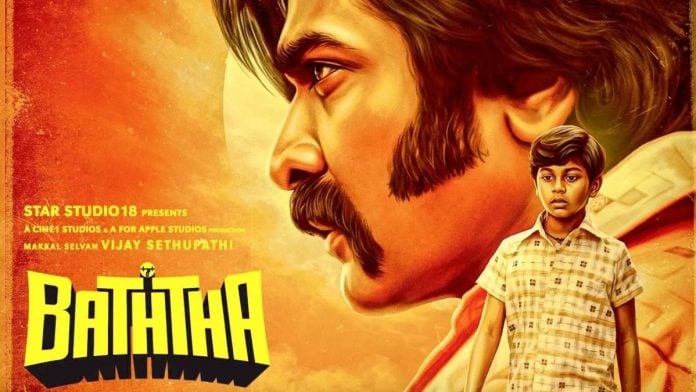
Balaji Tharaneetharan’s Baththa draws on films from around the world, reworks their plots and turns conventional power dynamics on their head. Borrowing the survival tension of films like Vikramaditya Motwane’s Trapped (2016) and turning it into comedy, the film centres on an unlikely friendship between a feared local gangster and a young boy.
The gangster, Baththavachalam, finds himself locked inside a school washroom after Sabari, an eight-year-old, accidentally traps him while trying to retrieve his confiscated toy stick. As the two strike up an unexpected bond, the feared gangster comes to depend on the very child who once feared him.
Baththa is a complex character. He loves his daughter and wants to celebrate her puberty ceremony with all the joy he can muster. He also shares a strained relationship with his wife. However, after being trapped in the washroom and eventually rescued by Sabari, he begins to see his family and relationships differently, becoming more aware of their needs and more caring towards them.
There is also a parallel with Park Chan-wook’s Oldboy. Oh Dae-su’s confinement in a private room for years turns him into a monster, a man consumed by the desire for revenge. Baththa, too, experiences loneliness and comes close to death while trapped inside the school washroom. Initially, he wants revenge on the person who confined him. But his ordeal changes him. He begins to recognise the value of his family and the little boy who saves his life. His desire for vengeance gradually gives way to love and friendship.
Also read: How India Gate became Delhi’s public living room
An unlikely friendship, told through cinema
One of cinema’s most beautiful portrayals of friendship between a hardened man and an innocent child is Charlie Chaplin’s The Kid (1921). Chaplin’s character takes care of the young boy through a difficult world, while the child depends on him for survival. Tharaneetharan flips this relationship in Baththa. Here, it is the gangster who depends on eight-year-old Sabari. The boy is not merely a supporting character who helps Baththa change; his decisions drive the story. Baththa is alive and able to return to his family only because of little Sabari’s mercy. The feared gangster survives because of an innocent boy whose biggest concern is his Rs 3 stick toy.
One of the film’s most beautiful homages to cinema comes when Tharaneetharan directly references Giuseppe Tornatore’s Cinema Paradiso (1988). As Baththa and Sabari’s friendship grows, he takes the boy to a local cinema hall. Tharaneetharan recreates the iconic framing from Tornatore’s masterpiece, in which young Salvatore watches a film. For that brief sequence, Baththa becomes an Alfredo-like figure, not just for Sabari but for me as a viewer too.
Baththa draws on films from around the world, reworks their narrative elements, reverses their character dynamics and challenges conventional notions of who holds power. The result is an endearing story of a gangster trapped in a washroom and the little boy who turns his world around.
(Edited by Prashant Dixit)