



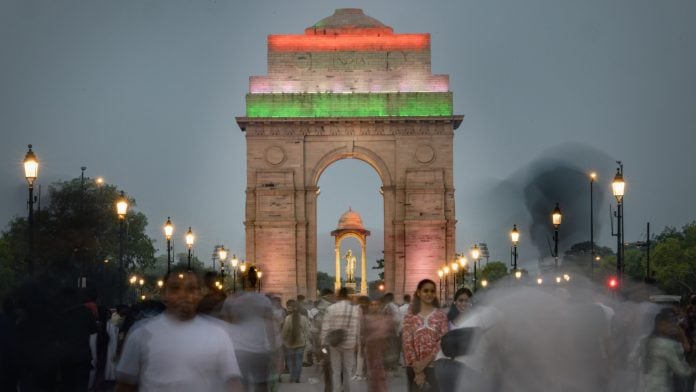
The mercury has dipped, the new year is a few weeks away, and Delhi smog is back once again, yet Delhites still refuse to stay indoors.
Sunder Nursery and Lodhi Garden are full of families with their dabbas and dhurries. But for many, something is missing. The city’s favourite spot is still out of reach—India Gate.
Delhiites rarely go to India Gate intending to see the monument. They go because it was Sunday, because the ceiling fan was losing its argument with June, because someone’s chacha was visiting from Kanpur and “Delhi dikhana hai (We have to show Delhi),” or because India was just four runs away from winning the World Cup.
For generations of Delhiites, India Gate has been less of a monument to visit and more of a place to turn up at. You didn’t need an occasion. And if you did, the monument was happy to accommodate.
It bears witness as the city comes together in joy and celebration, year after year, for every annoying relative visiting, and for milestones achieved. Sometimes, it is there in between, in the unexpected visits. On late-night drives, after Diwali parties, or just for some peace and quiet amid Delhi’s hustle and bustle, India Gate sees Delhites through thick and thin.
Dhurrie, dabba, and Dilli darshan
An India Gate family outing came with its own checklist. A family panic blanket, lunchboxes full of parathas and sandwiches, packets of namkeen, and enough snacks to suggest nobody would be eating dinner at home.
The monument was the backdrop. The real entertainment was everything happening around it.
There was the ice-cream seller whose cart was almost as much a landmark as the 42-metre-high arch itself. And who decided that ice cream was only for summer? Delhiites have never allowed a little December chill to come between them and a Chocobar.
There were balloons, cotton candy, roasted peanuts, bhutta and chuski. I still find myself drawn to the glowing colours of the little toys at India Gate that lit up, spun around or shot into the air, cheap enough that a parent would say yes twice without doing the math.
And for the grown-ups, there was the paanwaala, with his little steel tray of kattha, supari and gulkand—the evening’s last excuse to stay five more minutes.
There were also new additions to the scene. After its launch in 2019, Yulu bikes became a common sight at India Gate. A QR scan away, friends could be seen driving down the Kartavya Path on the electric two-wheelers.
Also Read: Delhi’s markets have changed in 20 years. Diwali shoppers still struggle to find toilets
Open Stadium
But Delhi has never reserved India Gate for only picnics or rides. The monument has always had an impressive social calendar.
India Gate has no seats, no scoreboard, and no ticket counter, which is exactly why Delhi uses it as an overflow stadium for national celebrations. When India won the T20 World Cup in 2007 and the ODI World Cup in 2011, fans made their way to India Gate to celebrate.
The tradition continued with the T20 World Cup victory in 2024, the Champions Trophy in 2025, and India’s T20 World Cup win in 2026. Each year, the monument stands opposite a sea of blue jerseys, tricolours and loud chants.
New Year’s Eve is another occasion when Delhi collectively decides that there is nowhere else to be. The attraction is easy to understand. At the stroke of the midnight hour, a grand monument, thousands of people, and beginning another year with a photograph that looks suspiciously like everyone else’s.
Beyond celebrations
Then there are the occasions when the mood is far from festive.
India Gate became a focal point of the anti-corruption movement in 2011 and the protests following the December 2012 gang rape in Delhi. Candlelight vigils, placards, and slogans turned the monument into a site of collective grief and anger.
Maybe that is the best thing about India Gate. We have used it to celebrate victories, mourn tragedies, protest, welcome New Year’s, and spend perfectly uneventful Sunday evenings.
Which is why the changes to the space feel personal to so many Delhiites. The 2025 Central Vista redevelopment introduced restrictions on entering, sitting, and eating on the lawns.
Of course, nobody wants littered lawns or a monument that cannot be maintained. But there is a difference between protecting a public space and sanitising the life out of it.
India Gate’s charm was always in the little chaos—children running around, vendors calling out, families arguing over where to sit, and people who came without a plan.
Ask a Delhiite about India Gate, and chances are they won’t begin with Edwin Lutyens or the First World War. They’ll tell you about a winter picnic, a World Cup celebration, or that one evening when the family stayed longer than planned.
Views are personal.
(Edited by Insha Jalil Waziri)