






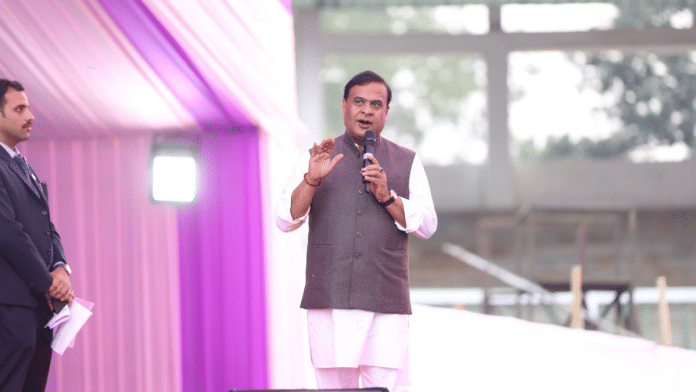



The Congress is following a familiar script in Assam— a tweaked version of Rahul Gandhi’s ‘chowkidar chor hai’ campaign from the 2019 Lok Sabha elections. The party is going overboard to paint Chief Minister Himanta Biswa Sarma as corrupt. And Gandhi is threatening to throw Sarma into jail. He must be very sure about the Congress returning to power in Assam. What makes him so confident, though?
Congress leaders cite at least three major factors. To start with, the Opposition party is counting on 10 years of anti-incumbency against the National Democratic Alliance (NDA) government. Sarma’s personal popularity, however, gives it the Teflon coating. That explains the Opposition’s relentless attempts to demolish his public persona. It comes from Rahul Gandhi’s playbook against PM Modi.
The second factor the Gaurav Gogoi-led Congress is banking on is the large social coalition it has sought to build through alliances with five parties—Akhil Gogoi’s Raijor Dal, Lurinjyoti Gogoi’s Assam Jatiya Parishad, Communist Party of India (Marxist), CPI(M-L), and All Party Hill Leaders Conference. The coming together of ‘three Gogois’ is expected to secure the backing of the influential Ahom community, which is largely concentrated in Upper Assam. The region comprises around 40 Assembly constituencies. Tea tribes play a decisive role in determining the winners in over 35 constituencies. If both Ahoms and tea tribes rally behind the Congress, the party can hope to sweep the election in this region. But that has to be a wishful thinking as of today.
It was the tea tribes’ shift toward the BJP that propelled it to power in 2016 and 2021. The Congress is going out of the way to woo them back. It has promised Scheduled Tribe status to six communities, including tea tribes and Ahoms. Rahul Gandhi has also promised to increase the wages of tea garden workers to Rs 450 per day, a hike of Rs 200 over their current wage.
Tea tribes also have a significant presence in many constituencies in Barak Valley, which has 13 Assembly seats. ST status and wage hike resonate strongly with the tea tribes but there are many other factors when it comes to their voting choices.
The entry of the Jharkhand Mukti Morcha into the Assam electoral fray has added another twist to the plot. After the Congress, its Jharkhand ally, rebuffed its proposal to contest 8 seats as a part of the alliance, the JMM fielded 16 candidates. Jharkhand CM Hemant Soren and at least 15 JMM MLAs camped in Dibrugarh for over a week. Ancestors of many of these tea tribes were brought from Chota Nagpur by the British in the 19th and early part of the 20th century to work in tea gardens in Assam. The JMM is banking on this connection to make inroads in Assam.
The third factor that gives the Congress confidence is the common feeling of despair and anger about the death of hugely popular singer Zubeen Garg in Singapore. The Congress has promised to order a probe and bring justice to Zubeen within 100 days of coming to power. Himanta Sarma government had earlier constituted an SIT to investigate the “murder” and the trial is on. That’s despite the fact that the Singapore coroner has concluded that it was an accidental death by drowning and there was no foul play.
There are many imponderables when it comes to how these three factors will play out. For instance, when it comes to social engineering, even in the 2021 Assembly elections, the Congress had stitched a coalition of eight-party Mahajot. Two of the Mahajot partners—All Indian United Democratic Front (AIUDF) and Bodoland People’s Front (BPF)—are not a part of the Opposition alliance this time.
They together secured over 12 per cent votes as Mahajot constituents in 2021, can that loss be compensated by the AJP and Raijor Dal joining the Congress-led alliance in 2026? Raijor Dal and AJP had contested as a third front in 2021, securing 5.2 per cent votes.
While the Congress’ decision to stay away from Badruddin Ajmal was driven by its apprehension about giving more fodder to Himanta Sarma’s polarising narrative, things can only get tougher for the Congress. While the 2023 delimitation exercise has brought the number of Muslim-majority seats from 35 to 23, the fight even on these seats can become intense. For example, three sitting Muslim MLAs are contesting in the newly created Aligapur-Katlicherra constituency. They include the sitting MLAs of Aligapur and Katlicherra and also the MLA of Hailakandi. As a result of delimitation, The Indian Express reported, Aligapur and Katlicherra were merged with over 80 per cent Muslim population while Hailakandi became a Hindu majority constituency, forcing the sitting MLA to shift to Aligapur-Katlicherra and contest on NDA constituent AGP ticket. That’s why delimitation was seen as Himanta Biswa Sarma’s masterstroke in a state with 34 per cent Muslim population. While he said hat the NDA was looking to win 103 seats, he hasn’t exactly taken his eyes off the remaining 23 Muslim-majority seats. Out of the 26 seats the AGP is contesting, it has fielded Muslims on 13. Now that the AIUDFis not a part of the Opposition alliance, it will only queer the pitch for the Congress on the Muslim-majority seats.
Hagrama Mohilary’s BPF secured 3.39 percent votes with four seats in 2021. It is part of the NDA now. It won 28 of the 40 seats in the Bodoland Territorial Council election last September, forcing Himanta Sarma to bring the BPF back into the NDA fold. The BPF is contesting 11 out of 15 seats in the Bodoland Territorial region. As part of the NDA now, it risks losing the support of the Muslims who backed it in the Council election.
As for the Zubeen factor, people are agitated about his death, but as Dibrugarh University students told me, it won’t dictate their voting choice. A University teacher, however, told me that at least one out of three students wasn’t happy with the way the government handled Zubeen’s death even though they didn’t voice their anger publicly.
BJP’s freebies
There are some other issues that give hope to the Congress—rebellion and resentment in the BJP camp due to the denial of tickets to old party loyalists, for instance.
The BJP is assured of at least two definite positives—Himanta Sarma’s popularity as a ‘development man’ and cash assistance through DBT. Himanta Sarma’s polarising politics didn’t resonate in Upper Assam but that’s because Muslims constitute barely 10 per cent of the population in that region. However, the people I interacted with in Dibrugarh and surrounding areas were largely supportive of his controversial eviction drives.
Travel around in Upper Assam and the positive views about infrastructure development like bridges and flyovers are unmistakable. So are the ubiquitous beneficiaries of Himanta Sarma’s welfare schemes and doles. At the Manohari tea factory in Dibrugarh, I met many women who had received up to Rs 14,000 in their bank accounts in the past few days and weeks—Rs 5,000 as four months’ instalment under Orunodoi scheme, Rs 4,000 as Bihu bonus and Rs 5,000 special financial assistance to six lakh tea garden workers. If you multiply 40 lakh beneficiaries of Orunodoi by just two, it comes to 80 lakh votes out of the total 2.49 crore voters in Assam. In 2021, the NDA had secured 86 lakh votes as against the Opposition bloc’s 84 lakhs.
On Dibrugarh University campus, many students wouldn’t stop talking about Himanta Sarma’s development works. It’s only when you ask what the CM has done for them specifically that they talk about Rs 2,500 that they get in their bank accounts every month. After their monthly mess fee of Rs 2,000, they still have a little left to indulge themselves. I am mentioning just a couple of schemes here. There are dozens of other welfare schemes that bring varying amounts of money into the bank accounts of lakhs of others.
In Bihar, Rs 10,000 cash transfer to women’s accounts was interpreted as an election-clincher although I don’t entirely agree with it. That was Himanta Biswa Sarma’s idea. He has already implemented it many times over in Assam over the past five years. The Congress has promised Rs 50,000 assistance to each woman but as we’ve seen in many recent elections, voters seem to be conscious of the proverb: ‘A bird in hand is worth two in the bush.’
Congress strategists say that the Assam election is not a done deal for the BJP yet. Of course. There are so many imponderables on both sides. No election is a done deal until the results are out.
DK Singh is Political Editor at ThePrint. He tweets @dksingh73. Views are personal.
(Edited by Theres Sudeep)