






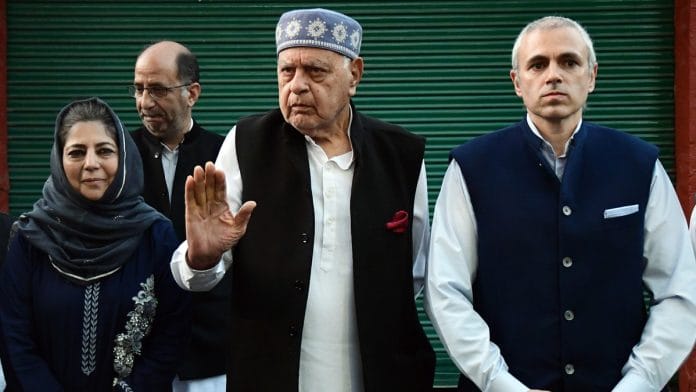


The three-phased elections in Jammu and Kashmir in 2024, almost five years after the abrogation of Article 370 and 35A in 2019, brought in a government led by the National Conference, a party led by Chief Minister Omar Abdullah that had strongly defended the continuation of Article 370. The 2024 election verdict should be seen as a stamp of approval for the abrogation of Article 370, on the one hand, and as an opportunity for the state political parties to bring about a course correction in their approach to the issue, on the other.
Nevertheless, both the central and state governments of J&K have done remarkably well to stabilise the situation and put the state back on the rails. Article 370 is almost a forgotten story mentioned in passing by the older generation, who do not have time or inclination for its obituary amid their busy routine, earning a livelihood.
Suggestions like “now is the right time to restore statehood to J&K because the situation has improved” are slowly but surely gaining ground. By most official metrics, the security situation has improved, and large-scale terrorism-related violence is in decline, resulting in increased tourist inflow. Several infrastructure projects are being implemented in fast-track mode. The government has also successfully conducted Panchayat and local body elections, projecting grassroots democracy as evidence of political revival.
Upward business trend
According to the Economic Survey Report for 2025, J&K has demonstrated commendable economic performance in the Fiscal Year 2024-2025, with the real Gross State Domestic Product (GSDP) projected to grow 7.06 per cent and the nominal GSDP by 11.19 per cent. The nominal GSDP is estimated to reach Rs 2.65 lakh crores, while the real GSDP is projected at Rs 1.45 lakh crores.
This development reflects a compound annual growth rate of 4.89 per cent in real GSDP from 2019-20 to 2024-25, surpassing the previous period’s growth rate of 4.81 per cent from 2011-12 to 2019-20. The per capita income is expected to reach Rs 1,54,703 in 2024-25, showing a robust 10.6 per cent increase, indicating improved economic well-being for the residents of J&K.
The Shikara business has picked up speed in Dal Lake, tourists are lining up at the Gondola ticket counter in Gulmarg, and there is a traffic jam on the way to Sonmarg. The deep wounds of the 2025 Pahalgam terror attack have no doubt left an ugly scar on the snow-clad meadows, but the place is alive with tourists under heavy security cover. No one talks of the terror attack anymore, even as business is brisk and hotels are gearing up for the snowfall season.
The Tulip Garden, Shalimar Bagh, Kheer Bhavani Temple and the Shankaracharya Hill in Srinagar are crowded with locals and tourists. The skilled and unskilled, educated and the unlettered are all finding jobs as the economy is picking up. The results of the J&K government’s Mission YUVA and Skill Development Mission are seen on the ground as it ensures financial aid, providing skill sets and market linkages to young entrepreneurs.
Also read: 1989 Rubaiya Sayeed kidnapping case still haunts Indian policy-making in Kashmir
Complex issues
It is, however, too early to celebrate the economic revival. A private baseline survey for the Jammu and Kashmir Mission YUVA entrepreneurship program for fiscal years 2024-25 points out the issue of increasing unemployment rate of 6.7 per cent, nearly twice the national figure of 3.5 per cent, especially among youth (17.4 per cent) and urban females (28.6 per cent), highlighting persistent economic and gender-related challenges.
While improved economic indicators in statistical spreadsheets bring smiles to the faces of officials in cosy rooms, the ground realities are likely to change as fast as the mountain weather. The security situation is well under control, but last year’s terror attack in Pahalgam has underscored existing security vulnerabilities, suggesting that the external threat to security remains complex and volatile despite very high levels of counter-terrorism mechanisms.
The abrogation of Article 370 kindled a ray of hope among a section of the displaced Kashmiri Hindus of their possible return to their home. Recalling the injustice done to the Kashmiri Hindus, the Prime Minister had reiterated the BJP’s resolve to create an atmosphere in J&K to facilitate the return of those who were driven out of their homes. During the run-up to the abrogation of Article 370, the BJP had assured the Kashmiri Hindus a safe and dignified return to their home and regain the lost property.
The locals fondly remember their Hindu neighbours, and with the trust quotient going up in a positive direction, the social situation appears to be conducive for the return of Kashmiri Hindus. The Jammu and Kashmir Migrant Immovable Property (Preservation, Protection and Restraint on Distress Sales) Act 1997 aims to protect properties of migrants who had left the state after 1 November 1989 due to “disturbed conditions” still remains a non-starter. This Act needs to be amended and implemented sincerely by the coordinated efforts of both the Union and the state governments.
Restoring J&K statehood appears to be a matter of time rather than a serious issue to be resolved through negotiations. Needless to say, the process should follow a calibrated security, economic, social and political roadmap, paired with Constitutional and institutional safeguards. The ‘Naya Kashmir’ has to resolve several complex issues, but meanwhile, people are ready to celebrate regaining Paradise.
Seshadri Chari is the former editor of ‘Organiser’. He tweets @seshadrichari. Views are personal.
(Edited by Saptak Datta)
Honestly do not understand why statehood was withdrawn in the first place. Whether this is constitutionally permissible is an issue on which the Supreme Court, with respect, ought to have ruled. Abrogation itself has not proved to be the panacea many had thought it would be. No substitute for winning the hearts and minds of the good people of Kashmir.